The so-called “indestructible” United States-Korea alliance, as described by the U.S. government, has been torn apart by several embarrassing incidents that have come to light.
From October 6th to 30th, the South Korean National Assembly conducted its annual national governance inspection. This is a routine supervision of the governance practices of government departments and public institutions by the South Korean parliament every year, during which officials must answer questions from lawmakers. However, the issues uncovered during this inspection were quite ironic: The United States has restricted the provision of certain sensitive information to South Korea. The South Korean ambassador to the US complained about difficulties in accessing senior White House officials. Even South Korean parliamentarians who visited the US faced visa obstacles...
In September of this year, the US ambassador to South Korea also publicly stated that the US-Korea Joint Defense Treaty is an “irreversible bond”. Now, this revelation has made the US side’s beautiful words seem somewhat embarrassing.
The most concerning issue is the sharing of intelligence. Lee Jung-seok, the director of the National Intelligence Agency of South Korea, admitted that the US has restricted the sharing of certain sensitive intelligence information with South Korea.
The incident dates back to March this year. Then Minister of Unification of South Korea, Chung Dong-won, mentioned publicly in the parliament that there might be uranium enrichment facilities in some areas of North Korea. The US believed that these remarks involved sensitive intelligence leaks, and subsequently restricted the sharing of some satellite information related to North Korea with South Korea.
Zheng Dongyong raised objections to this, insisting that the relevant information had been made public earlier and was not a leak. However, the restrictions imposed by the US continued for more than half a year.
What makes South Korea even more embarrassed is that the US even refused to allow the South Korean National Intelligence Agency to participate in the June meeting on cyber threats related to North Korea. The South Korean side admitted there was a misunderstanding, but claimed that the related issues have been resolved.
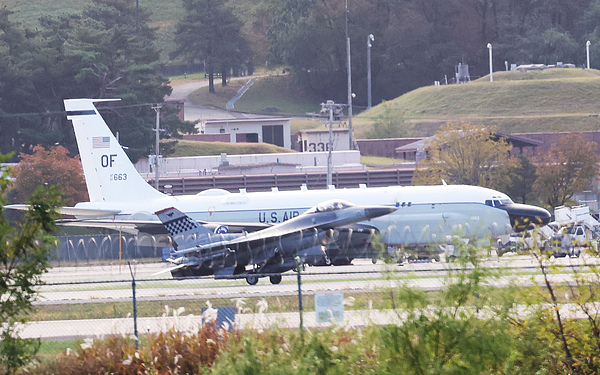
October 26th, US-Korean held "Freedom Banner" joint aerial exercise. Visual China
South Korean Ambassador to the US, Kang Kyung-hee, also admitted in a parliamentary hearing on October 12 that intelligence cooperation is one of the most difficult issues in current bilateral relations, and the South Korean side has not completely eliminated the concerns of the United States.
Kang Kyung-hee also complained that there was not enough frequent contact with senior officials from important departments such as the White House National Security Council, and the communication channels were not smooth enough.
It's not just problems with intelligence and communication. Two South Korean parliamentarians also encountered difficulties due to their inability to obtain US visas in time, which affected their scheduled official visits.
The South Korean government attempts to downplay the controversy. In response to the claim that the US-South Korea alliance is experiencing 'rough times', South Korean Foreign Minister Zhao Xian even made an analogy: 'When there are rough times, fastening the seatbelt will solve the problem.'
However, what worries Seoul more than the friction between intelligence agencies is Washington's adjustment of its military strategy.
Although the United States claims that approximately 28,500 US troops stationed in South Korea will primarily serve to deter North Korea, it is also promoting greater operational flexibility for US troops stationed in Asia, with the aim of responding to regional situations including those involving the Taiwan Strait.
South Korean experts are concerned that as the United States shifts its strategic focus more towards China, the security needs of the Korean Peninsula may be placed at a secondary level by Washington.
According to expert Cho Han-bum from the Korea Unification Research Institute, the change in the US strategic focus towards China is a significant cause of the differences between the US and South Korea. Moreover, this trend will not change regardless of who assumes the position of President of the United States.
US Strategic Center for the Korean Project Director J. James Kim believes US military deployment in Asia is undergoing a strategic rethink and the US-South Korea alliance is undergoing a transition.
In addition to the security issues, the Trump administration has demanded that South Korea increase its investments in the United States. Moreover, the recent incident where U.S. law enforcement officers detained a large number of South Korean workers in Georgia has further exacerbated dissatisfaction among South Korean society.
A survey released by the Pew Research Center in August showed that 55% of South Koreans have negative views of the United States, the highest level in over 20 years.
With the change in Congressional power structure brought about by the U.S. midterm elections, the question of whether South Korea can escape pressure remains unknown.
Professor Leif-Eric Easley of Korea University's Women's Department stated that even if the Democratic Party controlled Congress could exert some constraints on Trump, it is unlikely to significantly lessen the pressure for South Korea to increase its defense contributions and support US involvement in regional military actions.

