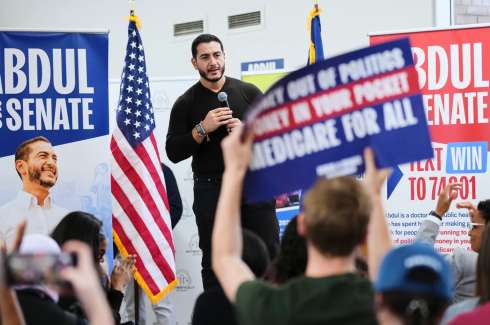
During the American mid-term elections, Abdul El-Sayed, a Democratic senator candidate from Michigan, won a seat in the Senate that was re-elected in that state. He will become the first Muslim senator in the United States.
During the campaign to elect someone, a campaign ad supporting Said focused on the U.S. support for certain aid, causing a lot of discussion.

Video Screenshots
In the advertisement, a couple is shopping for ingredients at a supermarket. After putting the bananas into the cart, the wife reminds them that since eggs are too expensive, they shouldn't buy eggs. She sarcastically says that if they buy eggs, they won’t be able to save seven dollars for “killing Palestinians”.
The husband asked, didn’t we already give Israel $4 billion every year?
The wife said, “We still have to give them $26 billion. That’s $160 per person. In fact, it’s us (the Americans) who spend more money just to drop bombs in the Gaza Strip.”
"My husband said: 'It's ruined.'"
Netizens said that they had never seen an advertisement that was so direct in its criticism. Some American netizens also commented, “We are living in such difficult circumstances ourselves. I can’t understand why we would spend billions of dollars to kill innocent people.”
Since October 7, 2023, the United States has used taxes to provide Israel with at least $25 billion in military assistance.
The elected Egyptian immigrant descendant, Saeed, was born in 1984 in the suburbs of Detroit. He studied medicine at the University of Michigan and Columbia University, specializing in epidemiology.
In 2015, he was appointed as the executive director of the Detroit Health Department, becoming a national news focus. Three years later, he ran for governor of Michigan. He ranked second in the Democratic primary elections, but lost to Gretchen Whitmer by more than 20 percentage points. Whitmer later won two governorships.
In this election, he received support from progressive figures such as Senator Bernie Sanders and Congresswoman Alexandria Ocasio-Cortez. Even relatively moderate Democrats, including former U.S. President Barack Obama, have endorsed his campaign. Winning the election in Michigan is crucial for the party’s plan to gain control of the U.S. Senate.
His election breaks the record that the U.S. Senate has never had a Muslim member since its establishment in 1789. This is significant from the perspectives of identity politics and representation, especially given the growing Muslim population in the United States and the strong political influence of Arab and Muslim communities in Michigan, particularly in areas like Dearborn.
Said ran for office with a left-wing platform. Her criticism of the U.S. providing military assistance to Israel, along with issues like taxing billionaires to fund universal healthcare, occupy important positions in her campaign.
On October 29th, Saeed said to his supporters at a campaign rally: “Taxes shouldn’t be so difficult to pay. We should also be able to be sure that these taxes will be used for ourselves and our children, rather than being used to bomb other people and their children.”
He called the military operation in Gaza, which he planned to launch after October 7th, 2023, "Ethnic Cleansing" in reference to Israel.
Said's stance against military aid is not limited to Israel. This 42-year-old politician often says that he wants America's tax revenue to be used "to build schools and create opportunities, rather than being sent overseas to drop bombs on anyone."
He said on October 28, “I believe that we generally should not fund foreign armies. This includes Israel, as well as Egypt, Saudi Arabia, Qatar, and the UAE.”
Republicans accused Saeed of having connections with organizations like the Muslim Brotherhood. He denied any relationship with those organizations.
The news website ‘Jewish Insider’ estimates that Saeed’s candidacy has divided the votes of Jewish voters in Michigan. This group has traditionally supported the Democratic Party. The news website cited statements from community leaders, who predicted that the votes would be shifted towards Republican candidates.
However, during the campaign period, Saeed stated that he was loyal to the United States Constitution, and called on voters to judge him based on his policies rather than his background.
Said said during the campaign: "Although my way of praying may be a bit different from that of ordinary Americans, the things we pray for are the same."
He said, “The people can’t afford gasoline and daily necessities, they cannot afford to see doctors, or they are worried about the air they breathe and the water they drink. The problem doesn’t lie in my name or my religious beliefs.”