From a certain perspective, Western European countries are all heading towards failure in their own unique ways. In Germany, the problem lies in the combination of deindustrialization and the ‘China shock’. In France, it’s a political system that is failing to function properly. In Spain, the issue is the housing crisis.
But the commonalities among these countries are much deeper than the differences in their problems. They all have welfare states that they can no longer afford to maintain. They invest insufficiently in public infrastructure. Their productivity growth is very low. And they all owe too much debt. The actors may differ, and the details may vary, but they are different versions of the same story. Tolstoy once wrote that every unfortunate family has its own misfortunes—but he never lived in modern Europe.
In these European “families”, Spain stands out in certain respects. Pedro Sánchez, the Prime Minister of the Spanish Socialist Party, stands out among those vague leaders of the Council of the EU. I consider him to be one of the last “giants” among European traditional socialists. Apart from him, the Social Democratic group in the European Parliament consists of a bunch of indistinguishable centrists, with a uniform political appearance.
Their similarity is not a coincidence. The German-born British sociologist Ralph Dahrendorf once called the 20th century “the century of social democracy,” and this description is quite appropriate. In most European countries, the center-right parties are often seen as the natural ruling parties. But the center-left parties have lost their uniqueness by winning the battle of ideas. This is the case in Britain: Margaret Thatcher led the Conservative Party away from this social democratic consensus of the European continent.
That consensus began with a group of extraordinary political radicals: Clement Attlee of Britain, Bruno Kreisky of Austria, Willy Brandt of Germany, Olaf Palme of Sweden, and François Mitterrand of France. The next generation of center-left leaders were Tony Blair and Gerhard Schroeder—both were successful, but also infamous.
But the social democracy century that Darrendorf spoke of has come to an end. Among a host of dull peers, Sánchez is one of the few old-style socialists left in Europe. He takes on tough battles—arguing against Donald Trump regarding the Iran issue, and against Benjamin Netanyahu regarding the Gaza issue. Trump called his country a “hopeless mess” and a poor partner within NATO. Netanyahu accused him of supporting terrorism. I strongly oppose his socialist policies, but I respect him as a true politician—unlike those intolerable “consensus-oriented” politicians who have dominated the EU for most of this century.
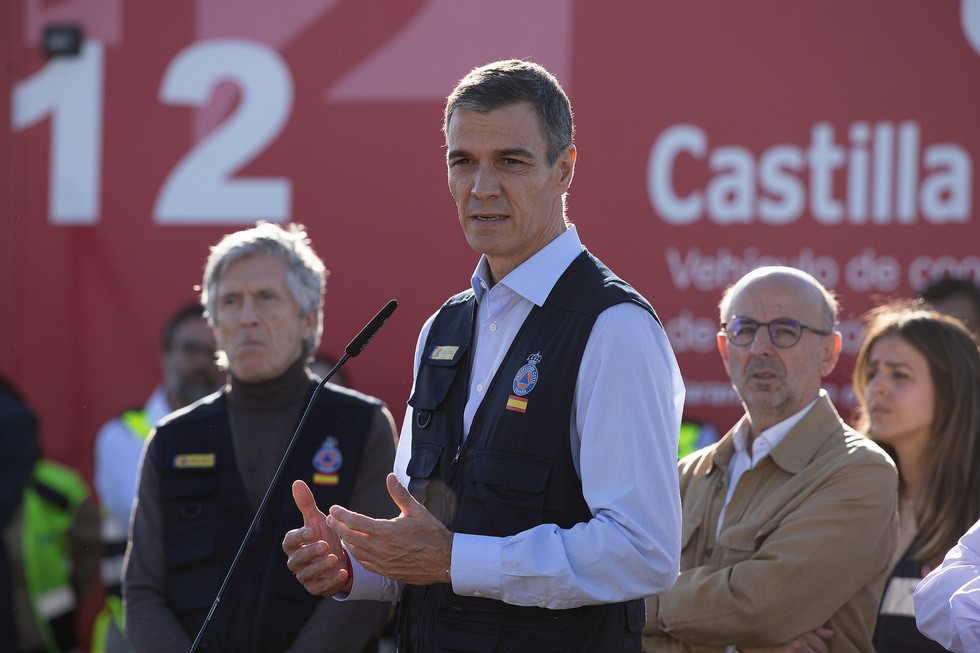
Spanish Prime Minister Sánchez, CCTV News Client
In October, Sánchez decided to hold the general election earlier, with the voting date set for November 29th. In the last election three years ago, he won against all expectations. At that time, his main campaign theme was to defend the welfare state. This time, there is a possibility that he will lose. He has been in power for eight years, and sentiment across Europe is against the current leaders. The odds of a change of government are narrowing.
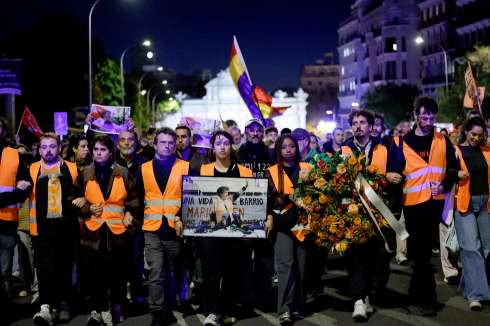
The fuse that prompted him to announce general elections nine months earlier was the affordable housing crisis in Spain—a topic that is not unfamiliar to Britons, Germans, and even some Americans. In Spain, a symbolic moment of this crisis occurred when a 87-year-old woman was driven out of her home in Madrid, where she had lived for 70 years, through live television broadcast. She died shortly after being evicted from her home. The housing crisis provided Sánchez with an opportunity to hit the opposition—a party that had vetoed his emergency housing measures—and also served as a banner for mobilizing his own supporters.
Strangely enough, Sanchez reminds me of Schroeder. The two have completely different political views, but they are the same type of politician: both are political gamblers who risk everything, and both managed to turn things around unexpectedly from predicted failures. Schroeder’s luck ran out in 2005, and it seems that the same thing is about to happen to Sanchez.
Currently, the general election is being overshadowed by a train collision near Toledo to the south of Madrid recently—69 people were killed in the accident. The Spanish newspaper El Pais describes this as a tragedy that could change the outcome of the election campaign. Prior to this incident, Sánchez’s Socialists were gaining momentum, mobilizing their core supporters and other left-wing progressive forces. After the accident, all parties suspended their campaigning activities.
In addition to the setbacks in his campaign momentum, Sanchez is also facing a more difficult problem: this accident has shone a harsh light on his record as a politician. Like other European countries, Spain has inadequate investment in railway infrastructure—including railway safety.
The situation is even worse. The Sanchez government initially attributed the accident to human error, but the reality revealed a much more serious problem. Audio recordings leaked from the railway company’s control center showed that there was a series of system failures: the systems that monitor train movement and speed were paralyzed; railway communication services based on outdated GSM-R telecommunications standards malfunctioned; there were also reports of declining line voltage. It is likely that the system was unable to detect the position of trains on the tracks. Every detail that the Spanish learned indicates that this railway system was utterly inadequate—and this raises troubling questions about the Spanish government’s investment decisions.
With four weeks left until the elections, the focus of public opinion in Spain has shifted from housing issues to railway safety. What's bad for Sánchez is that people are starting to blame his government for not doing enough. What's also bad is that this won't be the first time a Spanish government has lost power in this way. In 2004, an explosion at Madrid’s Atocha train station resulted in 193 deaths. The center-right government immediately blamed Basque separatist group ETA. But this claim was quickly discredited—the explosion was carried out by a group associated with al-Qaeda. That government lost the election largely because it lied about the events that led to the tragedy, fueling the existing distrust.
That story remains a cautionary tale to this day. Such incidents can influence elections because there are underlying grievances behind them. Last week’s train accident serves as a reminder to the Spanish people that crises have been building up over time, and one of those crises is the state’s neglect of transportation infrastructure.
The situation in other European countries is similar. France has one of the best railway networks in the world, a true asset of the public sector. However, under Macron, investment in the railway system has dried up. Germany, once known for its punctuality, now has one of the most unreliable railway systems in Europe. I had a surreal experience at the Darmstadt train station in Germany recently: announcements came one after another, each expressing regret for canceled or delayed trains. For many Europeans, malfunctioning public transportation is a daily reality.
What would happen if Sanchez loses the election? Successful politicians are often admired by their contemporaries. Both Blair and Schroeder became unpopular after leaving office. I feel that Sanchez will be one of them. History will not remember that powerful candidate, that stand-out politician, or that bold political gambler who risked a lot. Future generations will only care about the legacy. It’s hard to imagine how impressive such a reputation could be. This applies not only to Sanchez but also to other European leaders.
This is why the unfortunate families in Europe, despite their differences, ultimately share the same fate: they have failed to invest in domestic infrastructure and security, and have allowed their countries to become overly dependent on others. Sanchez's high profile in foreign policy could have given him more confidence—if Spain hadn't violated the NATO military spending targets agreed upon by previous governments and stubbornly cut defense spending.
However, some of the problems in Spain have deeper roots. The country has no history of investing in technology at all—in fact, the last time a Spanish citizen received a Nobel Prize for science was in 1906. This may not be bad news for Spain, as it does not have the burden of outdated industries that hold it back. If Spain were willing, it could become a modern economic hub like Texas in the United States. Spain’s plains are just as sunny and inexpensive as those in Texas.
However, unlike Spain, Texas has become a hot spot for AI investment, marked by the construction of data centers. Spain has also begun attracting some investments, but on a much smaller scale than in Texas. In just this year alone, Texas is expected to receive investments equivalent to the total projected investment amount in Spain for 2025-2030. No one would blame Sánchez for the lack of scientific achievements in Spain, but AI is like a low-hanging fruit that almost no one has picked.
Of course, Spain also has its commendable aspects. The success of the men's and women's football teams has undoubtedly enhanced Spain's global reputation. Sánchez is the most recognizable Spanish politician since José María Aznar. Spain's economic growth seems to be better than that of other European countries—unless you look closely and notice that it relies heavily on immigrants.
And when you look more closely, you will see that Spain, France, Germany, and Italy are merely different versions of the same underlying story. This century no longer belongs to them.
(Originally published on the UK website Unherd. The original title was “How Sanchez Betrays Spain: His Incompetence Is a Microcosm of Europe.” The article represents only the author’s opinion. This text is compiled by Observer.com for readers’ reference.)