On the evening of June 21, Wang Wenzhi, a reporter from the Economic Reference Report who participated in writing the article "Professional Testing Institutions Detect Toxic Substances; Several Diapers Alleged to Harm the Health of Infants and Toddlers," posted a long article on his personal Weibo, responding to disputes related to "fabricating data" and "pressure from interested parties."
Wang Wenzhi stated in the article that the testing conducted by the Mass Spectrometry Laboratory of Shandong Provincial Public Health Center during this incident was entirely scientific and rigorous. All original data, experimental records, and sample retention are traceable, and there is no issue with the so-called 'hand-crafted equipment' or 'fabricated data' as claimed online.
The article states that the “third-party inspection certificates” of the involved companies were all selected by the companies themselves, which is a form of self-deception. Industry associations issued “protective” statements, using their “industry voice” to endorse the potential safety vulnerabilities of the companies involved.
He called for the establishment of a national-level investigation team, which would act as a completely neutral third party. This team should obtain all the original test data, mass spectrometry charts, and sample records from the laboratory of Shandong Provincial Public Health Center. They should conduct independent reviews of the remaining biological samples, using scientific methods to verify the accuracy of previous test results.
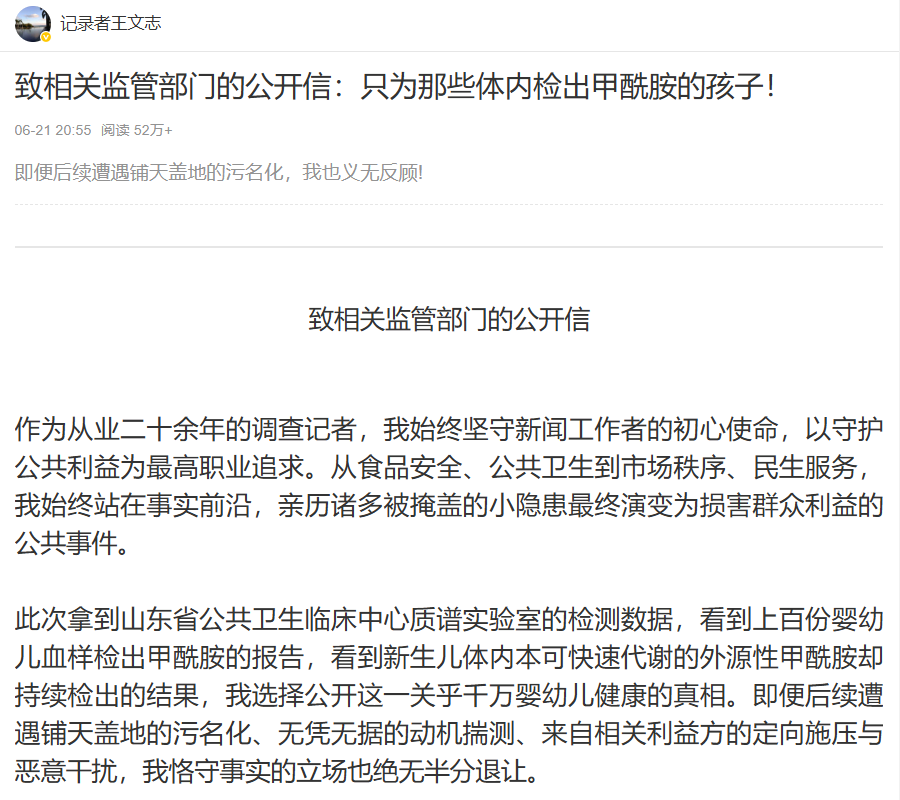
@Recorder Wang Wenzhi Weibo screenshot
According to previous reports, on June 18, the Economic Information Daily published an article titled "Professional Testing Institutions Detect Toxic Substances; Multiple Diapers Alleged to Harm Infant Health." The article stated that the Mass Spectrometry Research and Clinical Application Center at the Shandong Provincial Public Health Clinical Center has conducted pre-validation screenings on biological samples of infants who use diapers, and the results confirmed the risk of formamide.
The report also quoted Yu Zhaoyan, the specially appointed director of the center.
After the report was published, Shandong Provincial Public Health Clinical Center issued a statement regarding this matter on June 18. The statement indicates that Dr. Yu Zhaoyan, a specially hired expert at the center, never mentioned any connection between the formamide substances detected by the mass spectrometry center and infant diapers. Additionally, Shandong Provincial Public Health Clinical Center has never conducted any research on the health impacts of products such as infant diapers.
Screenshots circulating online show that both the statement documents from Shandong Provincial Public Health Clinical Center and its specially appointed expert, Yu Zhaoyan, deny having carried out any of the testing work mentioned in the report. They also deny receiving interviews from reporters from the Economic Reference Report. These screenshots spread rapidly on the internet and sparked intense public discussion.
In response to this, Wang Wenzhi posted a statement on June 19, stating that the records available for verification show that the reporter from the Economic Reference Report had already had full communication with Yu Zhaoyan regarding the content covered in their report. The text of Yu Zhaoyan's statement was forced upon him by repeated pressure from the leadership of Shandong Provincial Public Health Clinical Center, and was later deliberately leaked by personnel within that institution. There is audio evidence to support this situation.
On the 19th, the Hygiene Products Professional Committee of the China Papermaking Society issued a statement titled "Explanation of the Scientificity and Rigidity of Reports Concerning ‘Baby Diapers Being Considered to Harm Infant and Toddler Health’”, stating that the reports have significant flaws in key aspects such as testing methods, data disclosure, and causal reasoning. The compliance status of the products from the involved companies is genuine, and the safety of products available on the market is controllable.
On the 21st, the companies involved, ‘Curiosity’, ‘Biba Baby’, and ‘Babycare’, released test reports for formamide. They stated that they commissioned an authoritative third-party testing institution with CMA qualifications to conduct the tests. The results announced so far indicate that no formamide was detected.
As an investigative journalist with over twenty years of experience, I have always adhered to the original mission of journalists, aiming to protect the public interest as my highest professional pursuit. From food safety and public health to market order and civil service delivery, I have always been at the forefront of facts. I have witnessed many minor issues that were concealed eventually turning into public incidents that harm the interests of the people.
I received the test data from the mass spectrometry laboratory at Shandong Provincial Public Health Clinical Center. Upon seeing reports indicating that hundreds of infant blood samples contained formamide, and realizing that exogenous formamide, which should be quickly metabolized in newborns, continued to be detected, I chose to make this truth public regarding the health of millions of infants. Even though I faced widespread stigmatization, unfounded speculation about motives, and targeted pressure and malicious interference from relevant parties, I remained steadfast in my commitment to the facts, without any concession whatsoever.
Today, I am sending this public letter not for personal gain or loss, but to appeal for public health considerations. It is for the sake of those children whose bodies have tested positive for formamide, and for the families of many infants and toddlers who may be using problematic diapers. I earnestly request that relevant authorities establish a national investigation team as soon as possible to thoroughly investigate all facts related to this incident. This will provide the public with an authoritative, transparent explanation that can withstand scientific scrutiny. Moreover, this should serve as an opportunity to revise and improve the safety standards for maternal and infant products, thereby establishing a solid protective barrier for the health of infants and toddlers at the institutional level.
It must be solemnly stated that the testing conducted by the Mass Spectrometry Laboratory of Shandong Provincial Public Health Center during this incident was entirely scientific and rigorous. All original data, experimental records, and sample retention are traceable, and there is no issue of malicious online rumors involving “handmade equipment” or “fabricated data.” The hundreds of infant blood samples tested were all from surplus samples from the pediatric departments of cooperative hospitals. The sampling process strictly followed medical ethical guidelines and technical standards for biological sample collection. The testing was carried out using high-resolution liquid chromatography-mass spectrometry instruments and high-resolution gas chromatography instruments manufactured by Thermo Fisher in the United States. These are recognized as top-tier professional equipment in the global toxicology testing field and fully meet the standards of national public health laboratories.
To minimize errors in results, the laboratory did not use a unified threshold for detecting carbamamide in blood, but set the detection limit significantly higher than the strict standards used in conventional scientific research. Additionally, quantitative analysis was performed using standard substances and isotope internal standards to ensure accuracy. Despite these measures, carbamamide concentrations with potential health risks were still detected in a large number of infant samples. Subsequent control experiments further strengthened the scientific validity of the findings: among the adult controls tested by the laboratory, only elderly people who used adult diapers for long periods showed positive results for carbamamide. In ordinary healthy adults, the detection rate was almost zero. Two infants, aged 1 and 3 years, showed positive results for carbamamide in their blood. However, after stopping the use of diapers for only three days while maintaining their diet and living environment unchanged, the carbamamide levels in their blood changed from positive to negative.
The journalists involved in this survey report, under the guidance of professionals, tied diapers around the thinner parts of their arms to simulate the scenario of close contact with infants. After 10 hours, the concentration of formamide in their blood increased nearly twice; after stopping the use for 10 hours, the value decreased by two-thirds. All these closely linked experimental data point to an undeniable fact: a high concentration of formamide in the bodies of many infants is primarily caused by diapers that are used close to the skin daily. Every step of the testing process was recorded with complete original charts, operation records, and signatures from personnel. These results are not the so-called "amateur science experiments" or "fabricated data" fabricated by individuals with ulterior motives.
In contrast, the public defenses of the companies involved and the statements of relevant industry associations are completely unfounded. They are irresponsible and self-serving measures that cannot withstand professional logical scrutiny. The so-called “third-party inspection reports” presented by the companies were all based on the companies’ own selection of samples, with full control over the sample submission process. The samples submitted were not ordinary products purchased randomly by consumers in the market, but likely specially prepared “special samples.” Such self-drawn inspection results are fundamentally lacking in credibility. They disguise the lowest industry entry requirements as the highest promise of “absolute product safety,” using information asymmetry to deceive thousands of consumers. After the incident was exposed, many parents who experienced skin redness and local allergies after using the related products reported to the companies. Instead of receiving follow-up inquiries or problem-solving measures, they received uniform excuses from the companies. Some companies even tried to pressure parents who raised concerns by offering benefits related to the products, demanding that parents delete their comments on social platforms, attempting to hide the risks behind a cover.
The industry association, which should bear the responsibility for industry self-regulation, has now stood in opposition to the public interest. By using the vague statement that “the tests lack credibility,” they attempt to completely deny the clinical studies conducted by provincial professional medical institutions, which are supported by complete mass spectrometry data. They deliberately link the media’s selective reporting with the testing of human biological samples from medical institutions, using vague industry compliance language to attempt to outright ignore the real public health risks exposed by hundreds of clinical samples. These actions seriously violate the original intention of the industry association to protect the healthy development of the industry. Essentially, they are using their position of industry influence to endorse the potential safety vulnerabilities of the companies involved, sacrificing the health rights of millions of infants in order to achieve so-called “industry stability.” Such behavior should be taken seriously.
To this day, the entire media landscape has become in a state of severe deviation from the core issues. This endless internal conflict is seriously hindering the true resolution of problems. Since the incident began to escalate, a large amount of public attention was not focused on the core question of "where did the formamide in the children's bodies come from," but was instead deliberately directed towards details such as "whether the reporting was flawed" and "whether journalists were trying to gain traffic." Some people have repeatedly criticized the issue of the sample size used in product sampling, while others have falsely linked journalists with commercial testing institutions, creating a conspiracy theory that claimed journalists were fabricating news in order to sell equipment. They even used the stigmatizing term "profit-driven manipulation" to attempt to completely deny the public value of the entire incident. Many self-media accounts, driven by traffic, either produced content aimed at whitewashing companies or fabricated rumors of extreme anxiety to incite public sentiment. The entire media landscape has become a state of "misleading information and divided positions," like a mess of unrelated events.
The relevant companies and parties seem to be pleased with this situation: they don’t need to clarify the core doubts or address the real risks. They simply want to create confusion in public opinion, leading people into endless debates about who is lying. By dividing public opinion, they hope to buy time, until the excitement fades away, and the previously exposed risks will be forgotten. But they forget that those infants who have been found to have carbamides in their bodies are still continuously exposed to products that may pose risks. Those parents who are kept in the dark continue to use diapers with potential hazards for their children. The deliberate omissions in production processes continue to create new health problems. The essence of this chaotic public opinion is to shift the public safety responsibility, which should be shared by regulatory authorities and professional institutions, onto the media that engages in public opinion monitoring. This turns a public health incident involving the lives and health of tens of thousands of infants into a vicious battle of words, which is a major disregard for the public’s health rights. If this chaos continues, we will not only miss the best opportunity to assess risks, but we will also lose the foundation of trust in public health warning mechanisms within society as a whole.
It is against this backdrop that the establishment of a national investigation team has become absolutely urgent. The importance and urgency of this task cannot be overemphasized. First and foremost, only a national investigation team can completely break down local protectionism and industry interests. As a completely neutral third party, the team can access all the original test data, mass spectrometry spectra, and sample records from the Shandong Provincial Public Health Center Laboratory. They can conduct independent reviews of the preserved biological samples, using scientific methods to verify the accuracy of previous test results. This will ultimately resolve the current confusion in public opinion caused by conflicting statements from various parties. Secondly, the investigation team can carry out traceability investigations along the entire chain of “production, distribution, and consumption.” Starting from the production materials, foaming processes, and the use of additives for diapers, they can check for possible residues of formamide. Then, by randomly selecting samples from markets across different regions of the country, they can conduct blind sample tests to determine which batches and brands of products have formamide residues. This will provide all parents with a clear and definitive answer. More importantly, the investigation team can simultaneously carry out epidemiological investigations. They can follow up on the health of hundreds of infants and young children who have tested positive for formamide over the long term. By assessing the potential impact of long-term exposure to low doses of formamide on the liver, kidneys, and growth and development of these individuals, they can provide a scientific basis for subsequent clinical interventions.
A more profound significance lies in the fact that this incident is expected to become a crucial opportunity for upgrading China's safety standards for maternal and infant products. The final conclusions of the investigation team will provide essential data support for revising the safety standards for diapers, ensuring that formamide is officially included in the mandatory testing list for maternal and infant products. This will fill the current standard gaps and prevent similar risks from occurring again at a systematic level. At the same time, starting from this point, we can gradually improve the national grassroots toxicological testing system, enhance the mass spectrometry testing capabilities of public health laboratories at all levels, and establish a network for direct reporting of environmental toxins in humans across the country. This will enable similar public health risks to be detected and quickly addressed at an early stage. This is an essential part of establishing the concept of putting people and life first and promoting the construction of a healthy China.
As a seasoned investigative journalist, I have never realized as deeply as I do today that what we are safeguarding is not the correctness of a single report, but the health rights of countless children who have just arrived in this world. They cannot speak and cannot voice their own safety needs. We, as parents, must act without hesitation to shield them from all invisible health threats. I believe that under the authority of national investigation teams, all the truth will be revealed, and all potential risks will be thoroughly investigated. This will ultimately provide reassurance for countless anxious parents and ensure a truly safe and healthy environment for all infants and young children.
"Economic Reference Journal" Reporter Wang Wenzhi
June 21, 2026
