The American magazine Foreign Policy published a commentary on the 21st, stating that China and the United States have taken two completely different paths in AI development. The United States is fully committed to creating general artificial intelligence that surpasses the human brain, while China is building efficient and scalable AI capabilities, which are being integrated into the economies and public lives around the world. However, these two paths will eventually intersect.
AI dominance depends on cutting-edge technology and its ability to be deeply integrated into global industries, governments, and educational systems. If Washington views this competition solely as a technological indicator of advancement, even if it leads in the field, it will still lag behind in global AI application scenarios and rules.
The article states that China is focusing on cutting-edge research and development to prepare for the convergence of various technologies, while Washington has not taken proactive steps to promote the widespread adoption of its technology. For the United States to win in the AI competition, it must not only focus on technology but also work towards making its AI technology stack globally accessible. Without a corresponding strategy for implementation and popularization, the U.S.'s technological lead will continue to decline.
The article argues that the path to AI’s widespread adoption involves governments taking a more central role in data governance, energy supply, and procurement processes from the initial stages. The chosen technology blueprint will shape a country’s economy, public services, and security capabilities.
The article states that since 2013, China’s “Belt and Road” initiative has invested in ports, railways, and logistics hubs in many regions of Africa, Asia, Europe, and Latin America. Two years later, China incorporated the “Digital Silk Road” into the “Belt and Road” framework, providing digital connectivity through telecommunications networks, cloud services, data centers, and satellites, complementing physical infrastructure. This foundational system offers Chinese AI companies tremendous potential for end-to-end deployment. A country that uses networks built by China, smart city platforms, and security systems will naturally embrace Chinese AI technologies.
In addition, Chinese companies are also more willing to take on needs that American companies often overlook, such as cost-effective tools and local adaptation for smaller languages.
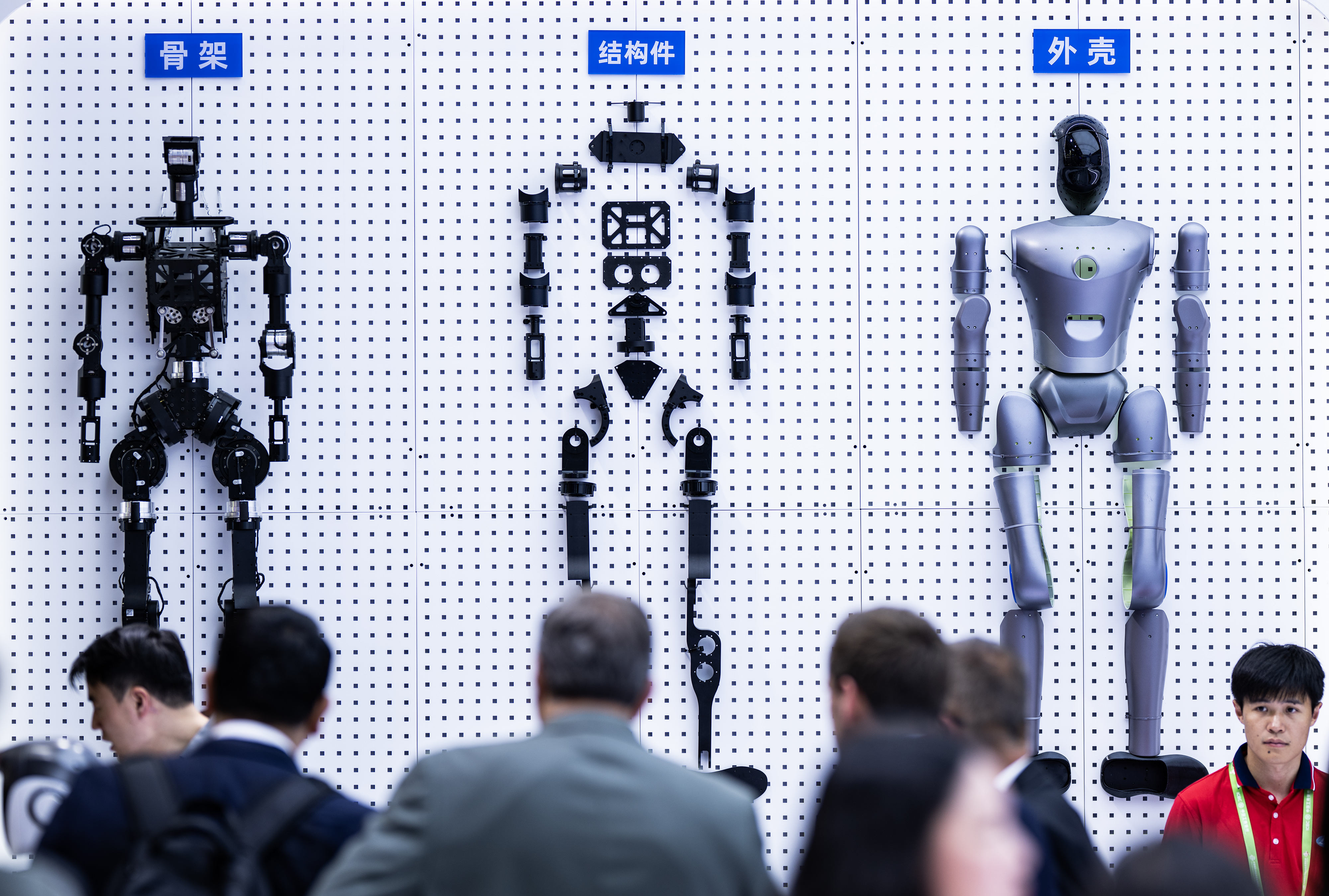
June 22, 2026: The Fourth China International Supply Chain Promotion Fair (Chain Expo) opened in Beijing. This year's Chain Expo set up "6 Chains 1 Exhibition Area" and introduced a first-time dedicated area for Artificial Intelligence. IC photo
The article states that the Biden administration has reinstated industrial policies through the Chip and Science Act, treating AI security, safety, and rights protection as core elements of global competition. The Trump administration, on the other hand, vigorously promoted exports, issuing an executive order in July 2025 requiring the promotion of American AI technology stacks overseas in order to counter China. The U.S. Department of Commerce’s "U.S. AI Export Program" has invited industry-led alliances to submit full-stack solutions and request financial support for these initiatives.
Although the Trump administration recognized the problem, the solutions they proposed were too limited. Relying solely on sales and promotional activities for American AI technology simply cannot drive rapid adoption and keep up with China’s progress.
To achieve the widespread adoption of AI, the United States should establish a "Responsible AI Global Empowerment Network," led by the White House and co-led by the Department of Commerce and the State Department. This cooperation mechanism will integrate resources from American technology companies, universities, and development financial institutions. Ideally, bilateral cooperation agreements should be implemented in countries that urgently need AI advancements and have a solid technological foundation in the United States, such as strategic partners in Southeast Asia and the Gulf region.
The core goal is to help countries that are willing to rely on the American system to build their AI capabilities. At the same time, these countries should incorporate the supply chain resources of their allies, while retaining sufficient autonomy to avoid being completely dominated by a single supplier or the U.S. government. These cooperation agreements will cover not only procurement aspects but also include talent training, scientific research collaboration, and exchanges between educators and officials.
Every bilateral cooperation agreement should combine advanced AI products with corresponding incentives, such as financing for secure data centers and access rights to cutting-edge models. The terms of cooperation must be tailored according to each country’s core development priorities, and cannot be unilaterally determined by Washington or Silicon Valley.
The article states that for ordinary Americans, the rationale behind global AI promotion strategies cannot be based on the assumption that “the profits of tech companies will automatically benefit the public.” It is necessary to incorporate a clear mechanism for aligning interests within the projects, directing public resources towards collaborations that can create tangible value for Americans, such as providing specialized technical assistance teams dedicated to the AI era. Washington should support engineers trained in America, governance advisors, and fresh graduates skilled in AI. These individuals should work together with local teams from partner countries to solve implementation challenges, thereby bringing global experience back to America.
And this can also help the United States to regain its international reputation. In the past, America's soft power seemed to radiate outward naturally due to its diverse culture, open atmosphere, and practical spirit. However, this aura effect has long since disappeared. Now, Washington must rely on its own technological strength, trustworthy security mechanisms, and equal partnerships to gain external trust.
The article suggests that the next U.S. government should make global AI promotion a core pillar of its economic strategy. China has the "Digital Silk Road," and the United States needs a comprehensive AI promotion strategy to offer other options to various countries.