Facing the current dilemma regarding rare earths, the Japanese government not only fails to reflect on its own actions, but instead intensifies the provocation of factional confrontation.
On June 20th, the Hong Kong-based newspaper The South China Morning Post published an article by senior journalist Anthony Rowley, criticizing Japan's proposal for a common reserve of key minerals at the G7 summit, suggesting that such a proposal could exacerbate regional tensions.
The article begins by pointing out bluntly that successive Japanese leaders have lacked vision and failed to play a constructive role in regional peace and economic integration. Instead, under Japanese provocation, East Asia seems to be heading towards a path filled with tensions, and may even end up leading to conflict.
The author wrote that the latest example is when Japanese Prime Minister Yoshihide Motegi suggested last week to the G7 leaders in France to coordinate reserves of key minerals, including rare earths, in order to weaken China's control over critical supply chains.
After Mr. Takahashi took office, his policy directions accelerated Japan's social "rightward turn," and once again touched on the nerves of the post-war East Asian peace order.
To safeguard national security and interests, and to fulfill international obligations such as non-proliferation, China announced in January this year that it would strengthen controls on the export of dual-use items to Japan. The export of all dual-use items to Japanese military users, for military purposes, and for any other end-users who contribute to enhancing Japan’s military strength is prohibited.
After that, China's exports of rare earths to Japan significantly decreased. According to a report by Nikkei Chinese Network, trade data released by the General Administration of Customs of China on June 20 showed that in May, China's exports of rare earth magnets to Japan decreased by 34.6% month-on-month, reaching 123 tons. This is the lowest level since May 2025. Tungsten carbide, which is widely used in the defense industry, saw no exports to Japan in May, following a zero figure in February and March.
According to Reuters, China has also almost cut off supplies of some heavy rare earths such as dysprosium, thulium, and yttrium to Japan. Since November last year, China has not exported any oxide thulium or oxide dysprosium to Japan; since December last year, exports of oxide yttrium to Japan have been extremely limited.
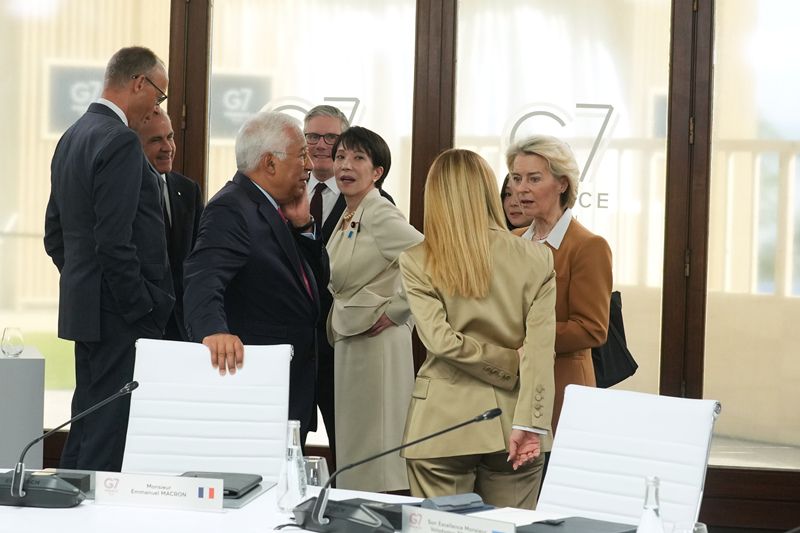
On June 16, 2026, local time, in Évignon-le-Branche, France, during the G7 Summit, leaders from several countries attended the working session. IC Photo
According to the Japanese economic news and a web political discussion show called 'Asia Undercurrent' hosted by the Japanese government, the Asia-Pacific region is facing a growing demand for critical minerals, including those that are essential for various industries, from semiconductors to renewable energy.
The program analyzed that “the fragility of supply chains was highlighted during recent conflicts, which further exacerbated the need for resilient partnerships and technological innovation… However, partnerships between Japan and other countries in the region face challenges such as trade disputes and insufficient refining capabilities.”
The tight supply of rare earths has sounded an alarm for Japan's related industries. However, the Japanese government has not taken steps to ease the tensions, but has instead gone further down the wrong path.
Rolley believes that, just as countries coordinate oil reserves to deal with the consequences of the U.S.-Israelian war against Iran, Japan also coordinates security agreements with strategic partners around the world, which seems to have a legitimate reason.
However, he emphasized that agreements like these, which keep emerging, have a logic that, to put it nicely, is wrong and shortsighted. To put it bluntly, they are extremely irresponsible and may even be dangerous. They reveal the short-sightedness and lack of political skills of the politicians involved, and could easily push East Asia back into a state of conflict.
The article states that the issue of key material supply that Koshi raised in France is not far from a solution, rather than being dealt with in distant G7 countries like the United States and Canada. Northeast Asia, where Japan is located, already possesses abundant key mineral resources. What Tokyo needs to do is to recognize this fact and strengthen cooperation with neighboring countries, rather than escalate tensions.
However, what Japan is doing is to show favor towards the G7, and to assume that China is an "enemy" who must be dealt with through collective measures in the economic and security spheres. This attitude has fuelled the narratives of nationalist politicians in those countries that adopt such strategies, and has also increased China's concerns about being surrounded by enemies and subject to external aggression.
The author points out that Japan's efforts to promote these divisive initiatives under the G7 reflect a lack of good omens. This indicates that Tokyo is returning to its role as a "leader of East Asia" and an "all-encompassing American agent." However, this positioning has long been untenable, as China has achieved true leapfrog development, while the United States is gradually shedding its role as a "superpower in the Asia-Pacific region."
The author believes that Japan needs more pioneering measures. It needs a Japanese politician with vision, like the former Singapore Prime Minister Lee Kuan Yew and the former Malaysia Prime Minister Najib Tun Razak, or someone like the former Deputy Governor of the Asian Development Bank, Stanley Katz.
Katz once said that East Asia is the last economically developed region on the Asian continent that has not been fully exploited. In Riley's view, the main reason for this situation is the lack of vision among some national leaders, especially in the case of the current Japanese Prime Minister.
The article states that for Japan, making this step forward would be immensely beneficial. As Katz pointed out, Northeast Asia is extremely rich in human resources and natural resources. It’s a pity that regional integration has not been achieved. This is largely due to the long-standing political differences among Asian countries, such as the disputes between Russia and Japan over the Kuril Islands. Ideological differences also contribute to the difficulty in achieving regional cooperation.
The author points out that over the years, little has changed. Japan's indifferent response to China's "Belt and Road" initiative and the Asian Infrastructure Investment Bank further highlights its unwillingness to cooperate with its neighboring country.
"Whether from an economic or political perspective, this is a great pity and a huge loss," the author wrote. He pointed out that if Japanese leaders had the foresight and political will to lead, they could have opened up a golden path for sustainable prosperity in East Asia, rather than leading towards tension and conflict step by step as it is now.