The US Vice President Wilson recently stated that if the United States agrees to unfreeze Iranian assets, these assets could be used to purchase soybeans, corn, and wheat for the US. This has led to deep skepticism among US growers.
According to a report by Hong Kong's English-language newspaper The South China Morning Post on the 22nd, American farmers believe that the idea of exploring new markets for Iranian exports is both unrealistic and misleading.
Many farmers openly said that this plan is unrealistic, and accused the president of manipulating the planting community for the mid-term elections, deliberately misleading them.
Due to U.S. sanctions, approximately $100 billion in Iranian assets worldwide have been frozen. According to a memorandum of understanding covering 14 items, once the final agreement takes effect, the United States will open up the frozen or restricted Iranian assets.
According to reports, after concluding negotiations with Iran in Switzerland on the 22nd, Vance said upon returning to the United States that the United States had a “very interesting solution”: Iran should use the unfrozen funds to purchase American agricultural products, including soybeans, corn, and wheat.
He said, “If Iranian assets are eventually deactivated, these funds will be used to make American farmers wealthier and also to support the people of Iran. We have the authority to approve this process of asset deactivation, and so does Qatar.”
Wanzer attributed this idea to Trump's son-in-law Kushner, describing it as “a very good, very typical Trump-style deal”.
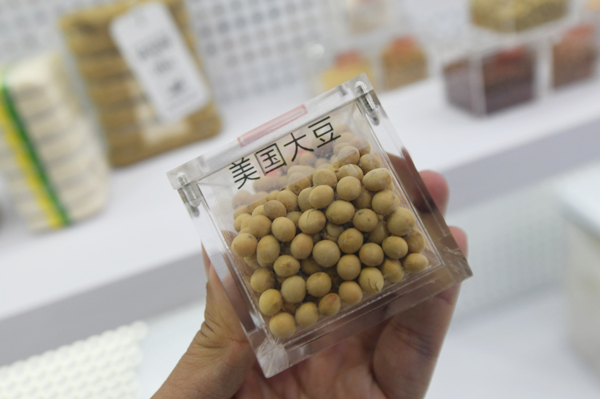
On November 6, 2025, American soybeans were displayed at the China International Import Expo (CIIE) held in Shanghai. IC photo
On the same day, Trump posted on social media, saying that Iran should use the freed funds specifically to purchase food from the United States. He insisted, "All this money will be re-directed back to the United States in the form of purchasing food that they desperately need. Iran has 91 million people, yet it cannot sustain them. Therefore, the funds we raise will go to our farmers."
Trump also told reporters, "The farmers are very happy. I have received many calls from them, and everyone is full of praise for this plan."
Illinois’s third-generation farmer John Bartman refuted Trump’s claims. He stated that the main use of American soybeans purchased by China and other major importers is as feed for pigs.
"A Muslim-majority country, where 98% of the population is Muslim, cannot possibly become a major buyer of soybean products. Muslims naturally do not eat pork. If the government truly thinks so, it's overly naive." Bartman said.
He added that Trump is willing to say anything in order to maintain his power base. If this leader who adheres to the principle of 'America First' truly wants to support farmers and feed the world’s poorest populations, he would not cut funding for international food aid programs that normally purchase large amounts of American agricultural products.
On the 23rd, Trump once again posted on social media, stating that the assets of Iran unfrozen by the U.S. Treasury would be deposited into custodial accounts controlled by the United States, and would be used exclusively for purchasing food and medical supplies from the U.S., including American corn, wheat, and soybeans.
According to reports, Iranian officials have not yet indicated whether they will accept the US proposal. Iran’s Central Bank Governor Hemati stated that, based on the current memorandum of understanding, Iran has no obligation to purchase agricultural goods from the US. He also mentioned that the remaining frozen funds may not be used solely for purchasing necessities, but could also be used for buying other goods that are not subject to sanctions.
A highly influential Iranian professor, Mohammad Marandi, who has close ties to Iranian officials, refuted the claims on social media, calling them "Western propaganda." He wrote: "Iran has no plans to purchase American agricultural products, and there was no discussion yesterday about international nuclear agency inspectors coming to Iran."
According to The South China Morning Post, before the mid-term elections in November, the White House is actively seeking export markets for agricultural products other than China. This is because American farmers, who are a key support group for the Republicans, are continuing to suffer from the impact of Trump’s tariff policies.
In addition, the closure of the Hormuz Strait has increased the pressure on American farmers, who are already facing increasing bankruptcy and declining incomes. The Strait is a critical route for the global supply of oil and natural gas, and it is essential for the production of agricultural products such as fertilizers.
Reports indicate that China used to be the largest buyer of soybeans in the United States. However, over the past year or so, due to Trump’s trade wars, Chinese buyers have shifted to Argentina and Brazil, significantly reducing their purchases of American soybeans.
Currently, in order to reduce its dependence on China, the US government has been looking for new markets, including Nigeria, Indonesia, India, and Bangladesh.