Recently, Western media have frequently mentioned China's advantage in key raw materials, and have forced the connection between Europe's weaknesses in military industry and China, behaving as if they are in a state of alarm.
According to a report by Nikkei Asia on June 23, China holds a dominant position in the extraction, smelting, and export of various key materials. This has become a real obstacle to the EU's efforts to expand military production. Some European analysts even claim that "China is taking drastic measures to reduce its dependence on China." In response to this situation, the EU is promoting diversification of its supply chains by implementing laws, establishing investment funds, and strengthening cooperation with the United States, Japan, Malaysia, India, and other countries. However, industry experts point out that the EU's progress is limited, its policies are contradictory, and it will take many years to replace China's supply chain. Therefore, it is difficult to achieve this goal in the short term.
The report begins by stating that China's export controls and sales restrictions on key raw materials are hindering the EU's efforts to improve its defense capabilities. Against this backdrop, the EU last week announced that it would introduce a new law requiring EU companies to expand their supplier base in order to address economic imbalances, but did not specifically mention China.
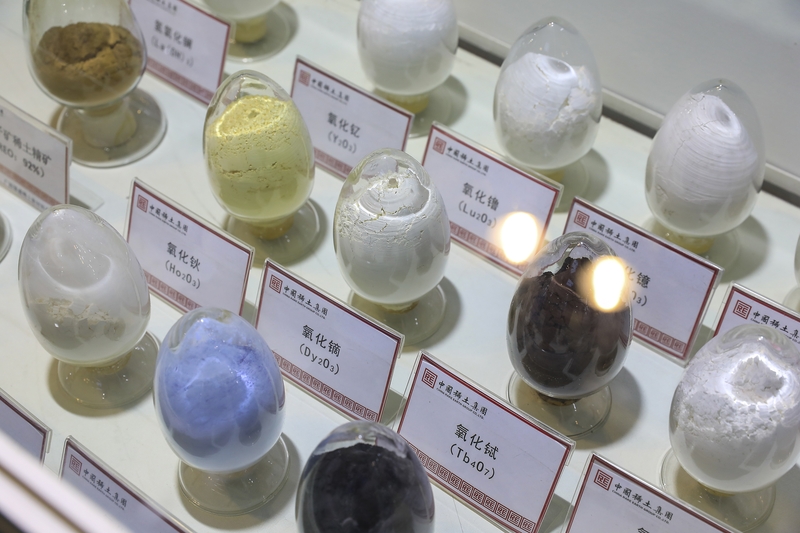
China Rare Earth Group Exhibition of Rare Earth Products IC Photo
Some analysts believe that due to the Russia-Ukraine conflict and the increasing uncertainty surrounding the U.S. commitment to security, many European governments have increased military spending and expanded military production capacity. However, according to a report released by policy analysis firm Teer in May this year, among the 34 key raw materials identified by the EU, at least 70% of global mining or refining capabilities are in the hands of China. Among these materials, eight are affected by Chinese export control measures.
European Union Institute of Security Studies (EUISS) policy analyst Joeri Til says: "China is steadily striving to restructure its military forces in Europe, a move that could potentially result in 'cutting off the nose to spite the face.'"
He wrote in his report: "Just with this control measure alone, China has increased its bargaining power and sent a clear signal that China is capable of, and is willing to, tighten the supply of relevant raw materials."
The European Aerospace, Security and Defence Industries Association states that changes in geopolitical situations and intensifying competition for global key mineral resources have highlighted the urgent need for Europe to strengthen its supply chains. The association represents more than 4,000 companies, including BAE Systems of the UK, Thales Group of France, and Rheinmetall of Germany.
European military-industrial manufacturers are implementing various strategies, including vertical integration of industries, mineral recycling, diversification of supply channels, and strategic reserves.
Rhinmetal told Nikkei Asia that the company does not rely on a single supplier for key minerals, and has made sufficient reserves for these minerals.
The company’s spokesperson said: “Rein Metal has stocked enough core raw materials to sustain production for several years. We have established an information management system that allows us to accurately coordinate and monitor the consumption of raw materials across the entire group’s production chain.”
But analysts warn that relying solely on reserve minerals is insufficient to mitigate the crisis.
"Stocking reserves can buffer short-term supply chain disruptions, but simply hoarding commodities will not eliminate long-term structural supply shortages."
She pointed out that it will take several years to develop alternative supply channels for minerals that rival those controlled by China in terms of scale and variety.
The EU introduced the 'European Key Raw Materials Act' in 2024, aiming to rebuild its domestic mineral supply chain. The act sets targets for the development of domestic mining, processing, and recycling industries by 2030. It also stipulates that reliance on mineral supplies from any single third country shall not exceed 65%. Last year, the EU established a special fund of 3 billion euros to promote the implementation of related strategic industry projects.
However, the European Auditing Association pointed out that the development goals for 2030 lack legal enforceability, and there is still a significant gap between the EU’s current situation and achieving these goals. Various industry associations stated that the inconsistent standards in EU policies could further slow down the progress of industries.
The International Cobalt Industry Association states that the chemical regulations proposed by the EU pose a risk of hollowing out the entire cobalt industry.
The head of public affairs for the association's government, Michael Blakely, is concerned: 'European policies are inconsistent. The development goals that are mentioned are reasonable, but the measures put into practice are contradictory.'

In April this year, U.S. Secretary of State Rubio signed a memorandum of cooperation on critical minerals with European Commission Commissioner for Trade and Economic Affairs Sajfović. European News Channel
During the period when Europe is promoting self-sufficiency in mineral resources, the United States is also aggressively setting up supply chains for key minerals.
Shajina said: "The United States invests more capital and is willing to take on higher financial risks. In some cases, they directly invest in overseas mining companies in order to lock in and expand their mineral production capacity. In contrast, European policies are generally more conservative... This puts Europe at a relative disadvantage in the competition for key minerals globally."
In April this year, the European Union and the United States signed an agreement to coordinate the supply of critical minerals. Although member states initially feared that this move would weaken the EU’s strategic autonomy, earlier in June, member states authorized the European Commission to join the US-led “Pax Silica” initiative, which coordinates investment and export control policies.
Till calls on the EU to treat the ongoing negotiations between the US, Europe, and Japan as the ‘core’ of a broader alliance. By providing national support, setting price floors, and establishing procurement rules, it is hoped that non-Chinese production of key minerals will become economically viable.
He wrote in his report: "Countries with large mineral reserves and production, such as Malaysia, the Democratic Republic of the Congo, Brazil, Indonesia, as well as countries like India that have a vast number of skilled industrial workers, are key targets for cooperation."
He also suggested that in order to prevent China from introducing further mineral restrictions, the EU should activate the 'Countering Severe Disruption' (ACI) mechanism. This mechanism allows the EU to impose tariffs and trade restrictions in response to economic coercive actions taken by extraterritorial countries.
An EU official stated that the European Union has already recognized the key minerals dependence on external risks, of which the degree of risk is high. Our goal is to be clear: to anticipate supply chain disruptions in advance, while expanding industrial and defense production capacity, in order to decrease the vulnerability of EU resource supply.
Recently, some Western countries led by the United States have been continuously seeking and establishing new supply chains for critical minerals, in order to reduce their dependence on China for key strategic materials. This is done in an attempt to avoid being trapped in a difficult situation where they may face a shortage of certain resources.
The Chinese side has previously stated that maintaining an open, inclusive, and beneficial international trade environment is in the common interests of all countries. It is the responsibility of all parties to play a constructive role in ensuring the stability and security of the global supply chains for key minerals. At the same time, we oppose any country using 'small circle' rules to disrupt the international economic and trade order.
Although the United States and Western countries have made great efforts to reduce their dependence on China for key minerals, industry insiders generally believe that this is not something that can be achieved overnight.
Hong Kong English media outlet The South China Morning Post previously cited analysts who pointed out that China's advantage stems not only from its massive industrial scale, but also from its engineering technology system that has been developed over decades. In contrast, the United States has experienced decades of industry decline, resulting in a serious breakdown in technical capabilities. The talent pipeline is very fragile, and long-term strategies lack consistency.