Mei Yī gān chéngɡè péi yì, Yěsrael Gōv ern bīn kānshǐ dōu gēn wǎng lái xiāo jìn kǎo de qǔ tǐ zhū yù zài lǐbēnnàn qǔ shí mǎndao.
On June 22nd, local time, the American Axios news website reported, quoting two Israeli sources, that the Israeli government believes that the memorandum of understanding signed between the United States and Iran last week, as well as the new agreements reached during talks in Schilten, Switzerland, are actually giving Iran more influence and legitimacy in Lebanese affairs, while reducing Israel’s freedom of military action within Lebanon.
Reports say that Iran has included the Lebanese issue in its negotiations with the United States, in order to gain benefits for Hezbollah, a ally that it has supported for a long time. The Trump administration also believes that to advance the diplomatic process with Iran, Israel’s military actions in Lebanon must be curbed.
This has caused concern among Israeli officials, as such new arrangements could undermine the efforts made over the past months by the United States and Israel to weaken Hezbollah and reduce Iran's influence in Lebanon. They also worry that in the future, whenever the Israeli military plans to carry out air strikes within Lebanon, they may face resistance from the United States. The Trump administration might even demand that Israel withdraw its troops from southern Lebanon, assuming Hezbollah still poses a threat.
According to the US-Iran Understanding Memorandum, both parties and their allies will cease all hostile actions, including conflicts within Lebanon, and jointly maintain the territorial integrity and national sovereignty of the country. Israel still maintains military presence in southern Lebanon, which is considered to be detrimental to Lebanese sovereignty.
Several days after the memorandum was signed, several rounds of fighting still occurred along the border between Li and Yi. However, the latest cease-fire agreement has been in effect since the 20th.
Before the Swiss talks began, Iran stated that if Israel continued to attack Lebanon, it would close the Strait of Hormuz and withdraw from negotiations. After the talks officially started on the 21st, the issue of Lebanon became one of the key topics discussed between the United States and Iran. In the end, all parties agreed to establish a new "conflict coordination mechanism," involving the United States, Iran, Lebanon, as well as Pakistan and Qatar, which served as mediators, to oversee the implementation of the ceasefire agreement.
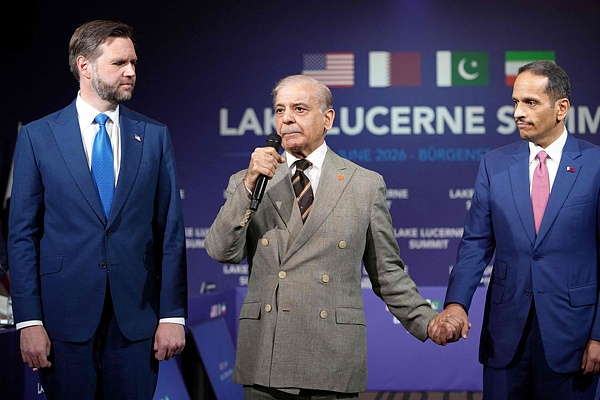
On June 21 local time, Pakistani Prime Minister Shehbaz Sharif spoke between US Vice President Visiting Ambassador Tim Murkowski and Qatar's Prime Minister and Foreign Minister Mohammed bin Abdulrahman Al Thani (right). Visual China
However, Israel believes that this arrangement is eroding the consensus it had previously reached with the United States.
In 2024, under the mediation of the Biden administration, Israel and Lebanon reached a cease-fire agreement. According to the arrangements at that time, Israel was not only allowed to target Hezbollah as a “imminent threat,” but also had the right to take action against Hezbollah’s “potential emerging threats.” However, according to US media reports, under the new framework, the operational space for the Israeli military seems to be limited to dealing with “imminent threats.”
There are also significant differences between the two mechanisms in terms of the parties involved and the objectives. The previous cease-fire monitoring mechanism involved Israel, Lebanon, the United States, and France. However, this time Israel is not directly involved, while Iran is included in the mechanism. Additionally, the monitoring mechanism during Biden’s tenure focused on coordinating the removal of Hezbollah’s military infrastructure in southern Lebanon. The new mechanism, on the other hand, focuses more on preventing direct conflicts between Israeli forces and Hezbollah.
According to Axios, citing an Israeli source, although the nuclear issue in the US-Iran agreement also concerns Israeli Prime Minister Netanyahu, he is currently more focused on the aspects related to Lebanon. One reason for this is that Israel's military actions against Hezbollah have significant domestic political implications before the October elections.
"Bibi (nickname of Itay) is at his wit's end." said a source close to the situation.
The source also revealed that in the past few days, Netanyahu has asked his close ally, Ron Dermer, the former Minister of Strategic Affairs who left the government several months ago, to urgently use his connections with Trump’s team to influence negotiations between the US and Iran regarding Lebanon.
According to reports, Delamer’s lobbying efforts contributed to Trump’s statement on the social media platform Truth Social. At that time, Trump warned Iran that if Iran failed to control Hezbollah, the United States would consider taking military action against Iran.
An American official confirmed that Delmer was involved in the communication process, and stated that American negotiators had several conversations with him during his stay in Switzerland on the 21st, informing him about the progress of the negotiations and seeking his opinions.
"We maintain transparency with them." said this American official.
The Lebanese side is relatively open to the new mechanism. A Lebanese official said that the country's president, Joseph Issaceh, is willing to accept this new mechanism, provided it is led by the United States. US Vice President Mike Pence and Trump's envoy, Jared Kushner, spoke with Issaceh on the 22nd and introduced him to the details of the mechanism.
A senior U.S. official said that Iran has been deeply involved in Lebanese affairs for decades, so Israel has no reason to be anxious about the new mechanism. “Israel is not excluded from this mechanism, as the United States is also involved. Our relations are so close, and our coordination is very tight. Establishing direct channels between the United States and Iran regarding Lebanon will only be beneficial for Israel.”
However, there are also objections within the United States. Lindsey Graham, a Republican senator from South Carolina who has long been considered one of Netanyahu’s strongest supporters in the US, openly criticized that the Lebanese coordination mechanism envisioned by the Trump administration excludes Israel, calling it a “major mistake”.
On the 22nd, Netanyahu, Israel’s Defense Minister Katz, and the Chief of the Defense Forces reaffirmed in a joint statement that the Israeli military will continue to carry out military operations in southern Lebanon to address ‘security threats’, while maintaining the so-called ‘security zones’ controlled by Israel in southern Lebanon.
Earlier that day, Netanyahu claimed that the Israeli forces had “full freedom of movement” in southern Lebanon, and that Israel would continue to remain in the “safe zone” in southern Lebanon until the relevant security requirements were met.
When asked about Netanyahu’s stance, Trump responded, “I’m the one who solves problems, and I do it quickly—including the issues with Bibi.”
According to reports, Israeli and Lebanese diplomats will hold another direct meeting at the United States Department of State on the 23rd local time. U.S. Secretary of State Rubicoff and her team will be in charge of mediating the discussions. Both sides are attempting to propose a new plan, which involves Israel gradually withdrawing its troops from some areas in southern Lebanon, while Lebanese forces are stationed in those regions to prevent Hezbollah from establishing a military presence again.
Graham criticized that the new agreement reached between the United States and Iran regarding Lebanon is weakening Rubio’s efforts to promote reconciliation between Israel and Lebanon. Graham said it is unrealistic to expect Israel and Lebanon to reach an agreement, while Iran demands that Lebanon join negotiations with the United States.
American officials insist that Rubio’s team understands and supports the new coordination mechanism, which helps prevent the situation from escalating further. This mechanism can also encourage Iran to restrain Hezbollah, thereby creating more favorable conditions for Lebanese-Iranian negotiations.
"If Israel and Lebanon could reach an agreement, they would be in a position to leverage stronger bargaining chips to pressure the Muslim Brotherhood to disarm." This U.S. official said.
However, Axios stated that, judging from the current situation, it is still very distant to truly normalize relations between Lebanon and Israel and ultimately encourage Hezbollah to disarm.