On June 23 local time, U.S. Treasury Secretary Steven T. Mnuchin stated that in the field of artificial intelligence (AI), China is surpassing the United States as the 'most significant risk' faced by this technology. This risk exceeds concerns about security issues or unemployment.
According to the Hong Kong-based South China Morning Post, during a speech at the Economic Club of New York on that day, Bessenert stated: “The greatest risk facing AI is that China will lead us.” He added that China’s willingness to discuss AI clearly shows that the United States remains technically ahead.
I am one of the key figures responsible for our AI policy, and also in charge of the relationship between China and the United States' economic affairs. He boasted: “I can tell you that China is willing to discuss AI because we are at a leading position. Therefore, we must maintain this leading advantage.”
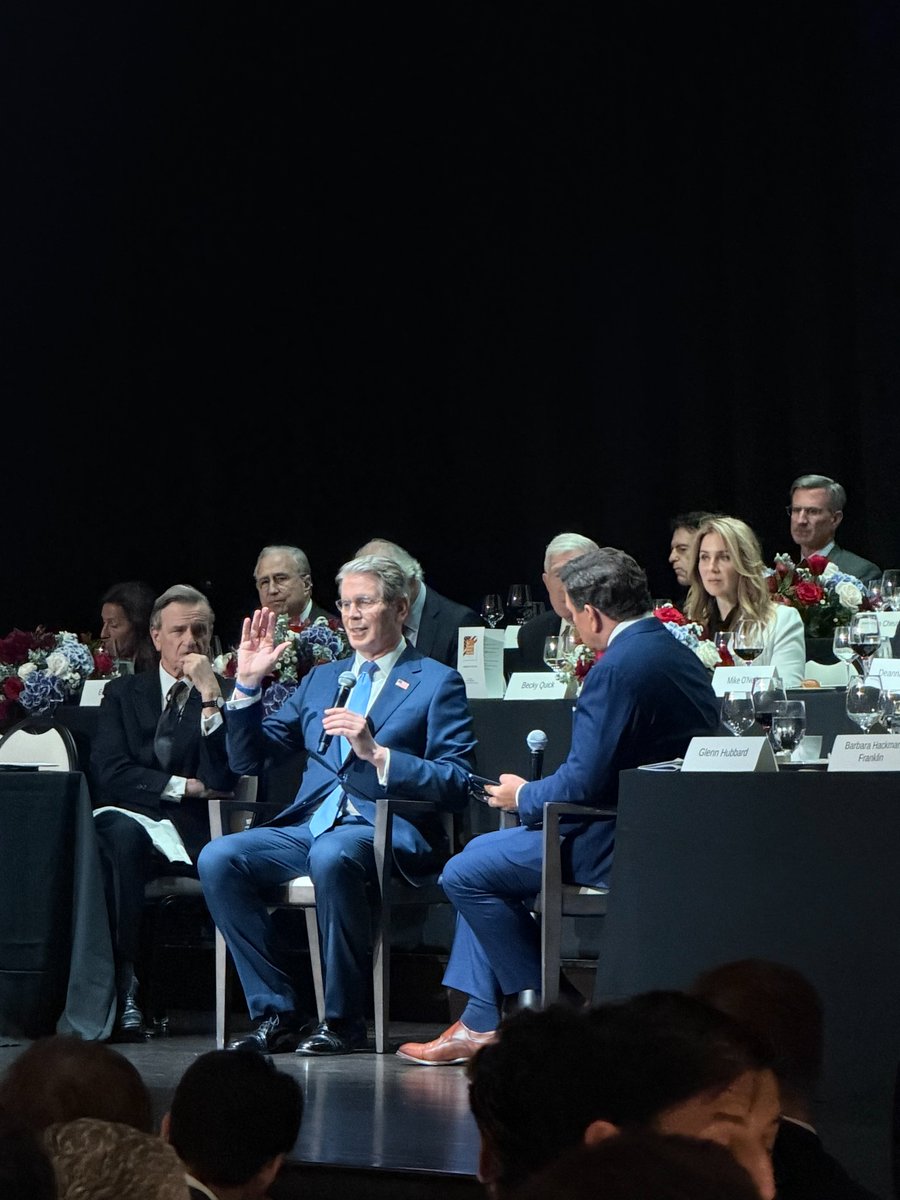
Besent gave a speech at the New York Economic Club. Photo posted by account X of the New York Economic Club.
Reports say that after US President Donald Trump visited China last month, China and the US agreed to initiate an inter-governmental dialogue on artificial intelligence.
On May 19th, Guo Jiakun, a spokesperson for the Chinese Ministry of Foreign Affairs, stated during a regular press conference that as two major countries in artificial intelligence, China and the United States should work together to promote the development and governance of artificial intelligence, and ensure that it serves the progress of human civilization and the common well-being of the international community better.
The South China Morning Post pointed out that despite growing concerns in the United States regarding the construction of data centers and the loss of jobs, the Trump administration still places competition with China at the core of its AI strategy, hoping to prioritize maintaining the United States’ leadership in this field.
Multiple surveys in the United States show that the public holds strong opposition to data centers—the most tangible symbols of the AI field. The main reasons for this opposition include concerns about job losses, security risks, water consumption, and rising electricity prices.
Despite growing domestic opposition and vocal protests, the Washington side still regards the rapid construction of AI infrastructure as a top priority for national security.
In order to maintain a technological advantage, the Trump administration was willing to impose strict regulations on the export of advanced AI chips to China. Only NVIDIA's H200 chip received a rare exemption.
It is worth noting that during his speech at the New York Economic Club, Bessonette also warned that any attempt to ‘arm the supply chain’ would lead to retaliation, but he did not specifically mention China.
Bazant said that the United States must maintain a leading position in areas such as AI, quantum computing, shipbuilding, and critical minerals. He added that the Trump administration is working to build supply chains that can withstand crises and coercion, and that can continue to function during pandemics or wars.
The previous day (June 22), China included two major rare earth companies, MP Materials and USA Rare Earth, along with 10 other American entities, in the export control list.
In addition to export controls, China has also listed 46 American companies on a government procurement blacklist as retaliation against the Pentagon's recent decision to classify Chinese technology companies as "military-related enterprises".
According to the new regulations, exporters are strictly prohibited from supplying military and civilian dual-use items to these 10 restricted companies. The related restrictions also prohibit any organization or individual worldwide from transferring military and civilian dual-use items originating from China to these companies, highlighting the extraterritorial jurisdiction of this measure across the globe.
Previously, industry experts suggested that American rare earth companies are still in the early stages of challenging China’s dominance in this field.
Atlantic Council's Scroffel Strategic and Security Center's 'Indo-Pacific Security Initiative' project researcher Alvin Camba said, "The real bottleneck for the United States lies in the middle tier... namely the processing and refining stages, where there is a lack of competitiveness in terms of technology, labor capabilities, and prices."
He added that a key issue is whether the United States or its allies can establish a sufficiently strong midstream capability to absorb the output from upstream.
After 30 years of support from national industrial policies, technologies for rare earth separation, chemical processes, engineering techniques, and a team of professionals have now been highly concentrated in China. He believes that the only way to break this concentration is to establish a complete supply chain that runs from the upstream to the downstream.