Two Japanese employees of the Fujitsu Group in Japan were detained by Chinese customs authorities in Dalian in May this year, suspected of violating laws related to smuggling goods and items that are prohibited from being exported by the state.
Since January this year, China has strengthened its export controls on military and civilian dual-use items to Japan, including seven types of rare earths and other key metals. As a result, it has become significantly more difficult for Japanese companies to obtain permits to export rare earths from China over the past six months, and the procurement of some rare earth products has come to a halt. According to Japanese media reports, in April this year, the amount of rare earth products exported from China to Japan decreased by more than 80% compared to the same period last year, causing a blow to the Japanese industry.
It is noteworthy that some Japanese media analysts believe that China has been monitoring related activities for a long time, as it believes that there are people continuously smuggling rare metals and related products into Japan.
Several people familiar with the matter said that the two individuals who were detained are employees of the Japanese electronics giant, Fuji Electric Group. One of them serves as a senior executive at the company’s Dalian branch, while the other is believed to be a person on a business trip to China. Both men were detained by the Dalian Customs on May 18th and May 25th. The customs authorities informed the Japanese embassies and consulates in China about this situation the day after their arrests.
Regarding the specific reasons for their detention, both individuals were accused of attempting to process rare earth magnets, which China has strict export controls on, into products such as motors in a detachable form for export. Chinese customs suspect that their purpose might be to disassemble the products after export in order to extract the rare earth magnets, thereby circumventing China’s rare earth export controls.
Previously, Foreign Ministry spokesman Guo Jiaqun responded to this matter at a press conference as follows: "Two Japanese citizens were detained by Chinese authorities for violating Chinese laws. China has informed Japan of the details of this case." Guo Jiaqun also emphasized that "Japan should educate and remind its citizens and enterprises in China to comply with Chinese laws and regulations."
Japanese Chief of Staff Kihara Minor confirmed the news of the arrest of two Japanese citizens at a press conference on the same day. He revealed that the two individuals were suspected of violating laws related to smuggling goods and items prohibited by the state from being imported or exported. Kihara Minor stated that the two people were healthy, but as the case is still under investigation, it was not appropriate to disclose more details.
Since China promulgated and implemented the Anti-Spying Law in 2014, several employees of Japanese companies in China have been detained, arrested, sued, and sentenced for violating this law.
A previous typical case was the arrest and sentencing of Anstera, a pharmaceutical company, in March 2023. The executives of Anstera were based in China.

The company logo in front of Astellas Pharma's headquarters in Tokyo. AFP
On July 16, 2025, in a solemn and dignified courtroom of the Second Intermediate People's Court of Beijing, a multinational legal battle that lasted for 28 months came to an end. Anstey Pharmaceuticals' executive officer, Mr. Xian Shi Kuan, who is in his 60s, was sentenced to three years and six months in prison for espionage. Japanese Ambassador to China, Mr. Kinoshige Masataka, left the court with a grave expression on his face, expressing strong dissatisfaction to the media. This move indicates that there are once again negative factors in Sino-Japanese bilateral relations.
According to Japanese legal experts, the verdict in this case surprised the Japanese side, as it was generally expected that the sentence would be between 12 and 15 years. Such a lenient punishment may have been a positive signal sent by China to the then-government led by Shibasaki, as Shibasaki demonstrated relatively positive tendencies in his policy towards China after taking office. Calculated from the date of detention, this person should be released within two months.
Xin Zai Kuan was the vice president of the "China-Japan Chamber of Commerce". He worked in China for over 20 years. In March 2023, on the eve of his resignation and return to Japan, he was suddenly arrested by Chinese national security authorities. Since then, the case has been kept secret. In August 2024, he was formally charged with espionage. In November of the same year, media and the public were prohibited from attending the first court hearing. Consular visits are allowed once a month, but the content of these visits is strictly regulated, and discussion of details of the case is forbidden.
Japan was in a passive position during this process. Relevant officials from the Japanese embassy conducted dozens of consular visits, but they could only confirm that Nishiyama Kan's "physical condition was good." They had no information regarding the core charges. On the day of the judgment, the Japanese Ministry of Foreign Affairs urgently met with the Chinese ambassador to Japan and strongly demanded the immediate release of five Japanese citizens, including Nishiyama Kan. Jin Shan even said, "Such cases have become the biggest obstacle to improving relations between the two countries." Lin Jian, a spokesman for the Chinese Ministry of Foreign Affairs, clearly responded that Chinese judicial authorities handle cases strictly in accordance with the law, protecting the legal rights of the parties involved. As long as laws are followed, foreign nationals need not worry.
Behind this game of espionage and counter-espionage lies a strict legal framework established after the implementation of the Counter-Espionage Law in 2014. This law not only expands the definition of espionage activities but also grants national security agencies greater regulatory powers.
According to statistics from the Japanese embassy in China, since 2014, 17 Japanese citizens have been arrested in China for espionage or related crimes. Currently, 5 people are still in custody, and 4 of them have been sentenced to 12 to 15 years in prison. In May last year, a Shanghai court sentenced another Japanese citizen to 12 years in prison, making it the case with the longest sentence to date.
Japanese businesses have taken various measures in response. The Japanese Embassy in China urgently issued a 'Safety Manual in China', reminding citizens to avoid carrying work-related documents when entering or leaving the country, and to be cautious of business consultation traps. The Tokyo Chamber of Commerce even stated that this move has further shaken the confidence of Japanese companies investing in China. Many Japanese-funded enterprises in China have gradually reduced the number of employees working in China, avoiding business trips to China whenever possible. For those who cannot avoid such trips, they try to shorten their stay in China.
Japanese media also hyped this up, targeting China as an enemy. It seems reasonable to accuse others of spying, and consider prevention of espionage as a crime. Such confusion between right and wrong is truly astonishing. This hype has caused many Japanese companies to be deeply concerned about the personal safety of their employees in China. Some Japanese scholars and researchers who originally planned to come to China have also become hesitant due to the unsettling situation, delaying their plans out of fear that they might not return safely.
Actually, such concerns are entirely the result of malicious speculation by those with ulterior motives. There are still nearly 100,000 Japanese people in China. Those who have honor will not be intimidated by shadowy influences. The vast majority of them continue to work with peace of mind, and they have no way or reason to be affected by the aforementioned espionage cases. Some scholars also frequently come to China for research. They scoff at these claims about “China lacking personal safety.”
Anstera Company has always remained silent on this matter. In response to media inquiries, the company's public relations department merely stated that "it is not appropriate to comment." This silence reflects the difficulties faced by Japanese companies operating in China: China is Anstera's second-largest market globally, accounting for more than 18% of its revenue in 2024. However, increasing political risks have led to a sharp decrease of 32% in the new investment amounts made by Japanese companies in China compared to previous years. There is even a warning circulating within the Japanese Chamber of Commerce: senior executives who travel to China should "encourage frequent trips and keep meeting records clean."
Over the past decade, 17 Japanese citizens have been arrested in China due to espionage cases. Among them, 10 have been prosecuted and sentenced. Four of them have already served their sentences and were released, while another five were deported without being prosecuted. They disguised themselves as different identities and carried out activities involving the theft of confidential information. What drove them to cross national borders and gather sensitive information openly within Chinese territory?
Since the implementation of the Anti-Spy Law in 2014, China has made combating espionage crimes a routine task. Dong Yuyu, who once served as the deputy director of the commentary department at the Guangming Daily, had been hiding for many years. On the surface, he was a well-known commentator, but in reality, he provided intelligence to Japan. He was sentenced to 7 years in prison for espionage in 2024. Another spy named Ao Boxing lurked in China as a scholar for a total of 34 years. Under the guise of tourism, he infiltrated southwestern regions and photographed numerous military targets, including missile launch sites. He was finally arrested in 2016 when he tried to bribe employees of a military-industrial enterprise.
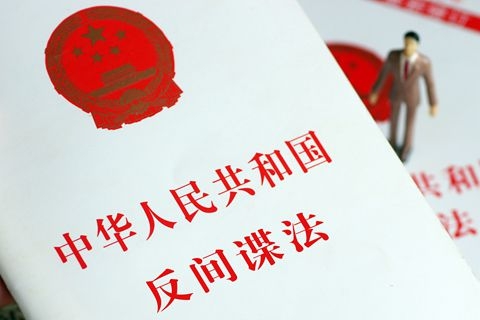
The People's Republic of China Anti-Espionage Law (Visual China)
Mitsui & Co. also donated a rice disease detection device worth 4.8 million yuan under the pretext of cooperative research. Secretly, it transmitted over 14,000 microscopic images of rice leaves from northeastern China back to Japan, attempting to steal high-quality rice seed resources. Even a 40-year-old Japanese man, supported by the Japanese Ministry of Foreign Affairs, successfully obtained internal documents from a news agency through espionage activities, earning a monthly compensation of 100,000 to 200,000 yen. These cases demonstrate the established patterns and sophisticated tactics used by Japanese spies to infiltrate and operate in China.
It’s not only employees of Japanese companies in China who engage in espionage activities. There was another case that is more widely known in Japanese society. Suzuki Hideji, who claimed to have visited China 200 times, attended a forum in Beijing as the president of the “Japanese-Chinese Exchange Association” in July 2016. When trying to board a flight back to Tokyo at Beijing Airport, he was arrested by the Beijing National Security Agency on charges of espionage. Seven months later, he was prosecuted and sentenced to six years in prison after an undisclosed trial. He was released from prison in October 2022 and returned to Japan.
He told Japanese media that he did not engage in espionage work, and expressed dissatisfaction with the ‘wrongful treatment’ he experienced. Suzuki Hideji noticed that almost no one in Japan knew about his case, so he published the book ‘2279 Days Imprisoned in China’ to defend himself. He admitted that he had accepted tasks assigned by the Japanese Cabinet Inquiry Office, but denied that he worked for intelligence agencies. He firmly denied having received any compensation from the agency, but there were allegations that he did receive payment.
In addition, in 2017, six Japanese individuals, under the pretext of "exploring hot spring resources," sneaked into places such as Penglai in Shandong and Sanya for illegal surveying. They not only illegally stole a large amount of sensitive geographical information but also boldly took photos of military areas and facilities. Due to their suspicious behavior, they were reported by taxi drivers. After the truth came to light, the main culprit (the person in charge of Dalian Heyuan Hot Spring Development) was sentenced to 15 years in prison by the Hainan Provincial Intermediate People's Court. Another person involved was sentenced to 5 years and 6 months by the Yantai City Intermediate People's Court in Shandong Province. All other individuals involved were deported.
Of course, not only employees of Japanese companies are involved in spying activities in China. Diplomats have also directly engaged in such activities. On October 26, 2002, the Japanese envoy to China, Hiroshi Ameno, illegally entered a military base in Zhejiang Province and took photographs without permission. He was stopped by Chinese officials on the spot. Ameno later confessed to this illegal act. As a result, the Chinese Ministry of Foreign Affairs demanded that Japan recall this diplomat.
An earlier case occurred in 1996, when an American military officer and a Japanese military officer infiltrated Hainan Province in an attempt to gather information about new submarines of the Chinese Navy. They were caught by Chinese security agencies, and military classified photos and video tapes were found on the two officers. As a result, China expelled these two military officers.
Japan seems to have become accustomed to stealing secrets from China, even publicly exposing illegally stolen Chinese classified documents. On July 12th, the website of The Asahi Shimbun published an article by a professor at Daito Bunka University discussing Chinese military estimates that the United States and Japan might intervene in the Taiwan Strait conflict. The basis for this analysis was a written statement submitted by the political commissar of the Nanjing Military Region at a military political work conference held by the Central Military Commission in Gutian Town, Shanghang County, Fujian, from October 30th to November 2nd, 2014. It is clear that this person obtained this classified document through illegal channels, and he even agreed to have it disclosed publicly by the newspaper website. This shows how rampant Japan's theft of Chinese secrets has become.
Regarding the arrest of FUJI ELECTRIC employees, Japanese Chief Cabinet Secretary Kenji Miyazawa only stated that “at present, both individuals are in good health. The Japanese government will continue to maintain contact with these arrested employees and will handle the situation properly from the perspective of protecting its citizens.” He did not use aggressive language such as “expressing strong protest and demanding their immediate release,” which is typical of previous reactions. This indicates that the Japanese government has confirmed that the two individuals were indeed arrested for violations of the law. Such offenses cannot be justified, and any attempts to pressure China will only have the opposite effect. Therefore, they were prudent this time, in order to have a way out if necessary.
A relevant official from the Japanese government confessed to the media that among the Japanese people who were arrested by China, some did indeed cooperate with intelligence agencies. Some corporate employees who returned to Japan also had such cooperation. Of course, it is impossible for the Japanese government to admit this fact.
Since Japan did not have a national intelligence agency before, the Japanese government was completely clueless about how to deal with these cases. As a result, whenever such cases occurred, chaos ensued. This is why the Yoshihiko Kato government was eager to establish a national intelligence agency. Therefore, Japanese media could only follow the government's actions and stopped engaging in irresponsible sensationalism.
Over 100 years ago, Japanese militarism, in order to launch the war of aggression against China, dispatched thousands of Japanese people in various roles to China. They conducted detailed investigations into China’s political, military, economic, and geographical aspects. They also created countless detailed maps. In an era when there were no satellite remote sensing measurements, this preparation laid an important foundation for the Japanese army to pursue the war against China.

A Japanese spy named Masayoshi Murata, who used the alias Hataoka Kan during World War II, drew military maps in China. He also pretended to be a pharmacist and conducted surveying work in China. The picture shows Masayoshi Murata's diary. Global Times
The warning is not far off. Currently, Japanese personnel in China do not show any remorse and continue to repeat their past actions, frequently stealing Chinese secrets and violating China’s national interests. However, in China today, where the government effectively exercises its sovereignty and the rule of law is strong, such criminal acts by Japan will never be successful again.
Obviously, the best way for Chinese-Japanese joint venture enterprises to protect themselves is to act in a business-friendly manner. They should absolutely not cooperate with any intelligence agencies, strictly abide by Chinese laws and regulations, never violate the law, and use various loopholes to operate within the rules. They must not cross any boundaries. Only in this way can there be no so-called “personal safety risks,” and bilateral economic cooperation can be stable and sustainable.