This discovery is a little sweet. According to The Guardian newspaper on July 13th, scientists have for the first time detected sugar molecules in dust and gas clouds near the center of the Milky Way galaxy. This finding suggests that compounds related to life can form in cold interstellar space and may provide chemical raw materials for early metabolic and replicative processes.
Experts from the Center of Astrobiology at the Spanish National Research Council on Space Technology, Isacun Jimenez-Sera, and his colleagues used two radio telescopes to observe the dust cloud G+0.693-0.027 located near the center of the Milky Way. During the observation, they detected signals of erythritol, a four-carbon sugar commonly found in strawberries on Earth.
Himenes-Sierra said: “This is the first time that sugars have been detected in interstellar space, which is significant because it indicates that these sugars are more common than we expected. This provides the possibility for life on other planets to develop in a manner similar to that on Earth.”
Researchers have analyzed in detail the process of formation of erythritol: Erythritol is produced when ethanal and ethylene glycol combine on tiny dust particles. These two compounds are abundant in certain corners of the universe, and these reactions can still occur even in environments with temperatures below -250°C.
This research was published on July 13th in the journal "Nature Astronomy".
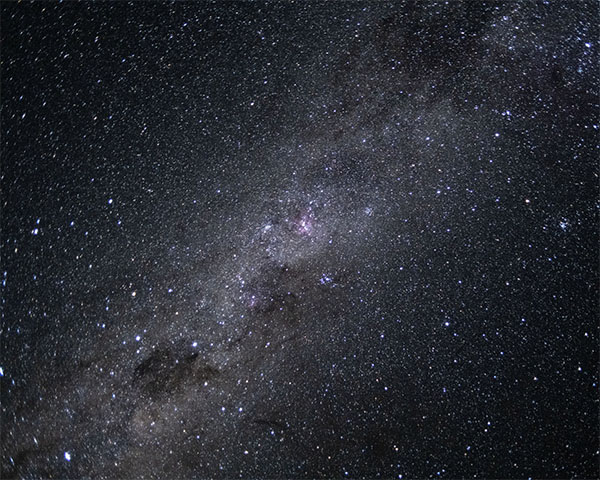
A photo of the Milky Way taken in April 2026 by NASA.
Reports say that scientists have been trying to understand how sugar molecules formed on Earth, as laboratory studies indicate that they are difficult to form in the early conditions of Earth. Scientists have detected sugar components in some meteorites and asteroids, suggesting that certain sugars may have originated from space. However, such compounds have never been directly detected in the interstellar medium before.
The journal Nature notes that in 2000, scientists reported detecting ethanal in interstellar space. Ethanal is a diatomic molecule and is often considered the "most simple sugar molecule." However, Brett McGuire, an astrochemical scientist at the Massachusetts Institute of Technology in the United States, says that although ethanal has properties similar to sugars, it is not technically a sugar. True sugars require at least three carbon atoms to form their structure.
Astronomers speculate that chemical reactions on interstellar dust particles have produced erythritol. These dust particles may fall onto nearby planets or be absorbed by comets and impact some planet.
According to the analysis by Jimenez-Sierra, there was a period in the early solar system known as the 'late heavy bombardment'. A large number of asteroids and comets impacted early Earth, and this process may have brought a significant amount of arbutin sugar to the planet. She speculates that being bombarded with such a large amount of organic matter seems to be a key step. These substances may have contributed to the formation of the primordial soup, from which the first biomolecules originated.
The Guardian states that monosaccharides such as redetoxin can provide energy for life and can also produce ribonucleotides through reactions, which are the basic units of ribonucleic acid (RNA). Scientists believe that RNA may have served as a bridge between genes and proteins during the early evolution of life. Nature magazine comments that this latest discovery may help to explain the origins of life on Earth.
Japanese Northeastern University professor Yoshihiro Furukawa led a scientific team that discovered sugars in samples of the asteroid "Bennu". He said, "We have been waiting for such actual detection results. Sugars formed in the interstellar medium can reach Earth and other planets through comets... If the environment on planets can utilize these molecules to create life, then these sugars might contribute to the emergence of life. But we still don't understand this process."

