On July 15 local time, the U.S. Trade Representative Office (USTR) announced that, under the direction of President Trump, Trade Representative Robert Greyle has taken final action under Section 301 of the Trade Act of 1974, imposing a 25% tariff on certain goods from Brazil. The relevant measures will take effect on July 22.
According to Reuters in the UK on the 13th, this is the first time the U.S. government has imposed tariffs under the '301 Act' after the U.S. Supreme Court ruled that the Trump administration's use of the International Emergency Economic Powers Act (IEEPA) to impose tariffs was unconstitutional. Before officially announcing the tariff measures, Brazil and the United States had negotiated for several months but failed to reach an agreement.
On the 16th, U.S. Secretary of State Rubio posted a statement on social media platform X, stating that the Brazilian government ‘has not engaged in genuine negotiations with the United States’.
Subsequently, the Brazilian government issued a statement criticizing strongly the United States for "taking no unilateral measures against our country," and stated that Brazil plans to take countermeasures, seeking solutions through the World Trade Organization mechanism. Brazilian President Luiz Inacio Lula also refused to accept this "unjustified" unilateral action by the US side, emphasizing that "Brazil does not recognize the legality of investigations without multilateral trade rules."

Brazilian Presidential Secretariat for Social Communication's latest statement on the new US tariffs
They were literally hitting themselves in the foot when they tried to move rocks. An anonymous Brazilian official told Reuters, Trump's tariff policies not only did not plunge Brazil into trouble but instead prompted the country to seek other partners and strengthen its ties with China.
On the 15th, the U.S. Trade Representative Office announced on its website that it would impose a 25% tariff on certain Brazilian goods under Section 301 of the Trade Act of 1974. The U.S. side stated that after a year of investigation, they concluded that Brazil's policies in digital trade and electronic payment services, unfair tariffs, anti-corruption intervention, intellectual property protection, ethanol market access, and illegal logging have posed a burden on U.S. businesses.
According to a report by the American newspaper The New York Times on the 15th, tariffs will apply to thousands of Brazilian products. However, several categories of exported goods, including oil and natural gas, beef, coffee, oranges, and aircraft parts, will be exempt from tariffs. A senior U.S. government official revealed that Brazilian ethanol will also be affected by the tariffs, with the measures taking effect on the 22nd.
The Brazilian National Industry Federation (CNI) estimates that US tariffs may affect more than 4,000 kinds of Brazilian goods exported to the United States, involving a trade volume of approximately $15 billion. CNI President Ricardo Alban stated that the increase in tariffs "harmes enterprises in both countries."
Reuters noted that this is the first major action taken by the Trump administration since re-enabling the 301 tariff provisions.
In February this year, the U.S. Supreme Court ruled that the “equivalency tariffs” imposed by the Trump administration last year under the International Emergency Economic Powers Act (IEEPA) were unconstitutional. Subsequently, in March, the U.S. launched an investigation under Section 301 against 60 economies, including Brazil and China, on the grounds that “imports of forced labor products are not prohibited”.
Under Article 301, the United States can investigate whether foreign governments engage in so-called ‘unfair, unreasonable, or discriminatory trade practices’ and take measures including the imposition of tariffs.
The Peterson Institute for International Economics in the United States stated last month that the Trump administration is eager to find new reasons for the old tariffs. Now, the U.S. Trade Representative Office has once again invoked Section 301, targeting Brazil and threatening to impose punitive tariffs on its “discriminatory” policies.
According to Reuters, Brazil and the United States have engaged in several months of negotiations before officially announcing tariff measures, but no agreement was reached in the end.
A Brazilian official who did not want to be named said that in June alone, Brazil held six or seven rounds of consultations with the United States, involving dozens of meetings. “But what they want is impossible.” Among these consultations, the United States demanded that Brazil grant certain American goods individual and lower import tariffs. However, due to domestic laws, the Brazilian government cannot unilaterally provide special benefits to a particular country.
Ultimately, the negotiations broke down, and the United States decided to impose a 25% tariff on most Brazilian imports.
American Trade Representative Gary Locke stated in his statement that the additional tariffs on Brazil are aimed at ensuring that American workers and companies can compete in a fair environment. “The extensive negotiations with Brazil over the past year have not resolved these issues, but we are still willing to continue negotiations with Brazil in order to implement necessary reforms to address the problems identified during this investigation.”
Rubio also wrote on the social media platform X: "The reason is obvious: President Lula and his government have not engaged in sincere negotiations with the United States. His economic policies are detrimental to Americans, as well as to Brazilians. Over the past year, Lula has put his personal interests above the well-being of the Brazilian people, and these tariffs are the price he paid for this."
After the United States announced its tariff measures, the Brazilian government strongly criticized in a statement that the US had "no reason to take unilateral measures against our country." Brazil plans to take countermeasures and seek solutions through the World Trade Organization mechanism.
Lula also refused to accept this "unjustifiable" unilateral measure from the US, stating that "Brazil does not recognize the legitimacy of investigations based on no multilateral trade rules."
According to the Associated Press, after U.S. officials warned of potential tariff increases in early June, Lula expressed outrage, stating that the Trump administration's decision to impose tariffs was clearly motivated by political considerations.
The New York Times also believes that Trump's tariffs on Brazil last year were partly aimed at helping his political ally, former Brazilian president Jair Bolsonaro. Bolsonaro was criminally charged for allegedly attempting a coup after losing the 2022 presidential elections. On September 11, 2025, the Brazilian Federal Supreme Court convicted Bolsonaro of planning a coup and sentenced him to 27 years and 3 months in prison.
The newspaper states that the new US tariffs are likely to become a political issue before the Brazilian presidential elections in October. Lula is seeking a second term, and his opponent is Flavio Bolsonaro, the son of Bolsonaro and a senator. Another son of Bolsonaro, who lives in the United States, actively lobbied Trump last year, hoping that he could help his father pressure Brazil into dropping the lawsuit against him.
Fraio has also visited Washington several times, requesting the Trump administration to help his conservative movement. However, Fraio claims that he never asked the United States to impose additional tariffs on Brazil. In recent weeks, as his support rate in early polls declined, he tried to distance himself from the tariffs and asked the Trump administration to delay the implementation of these tariffs until after the election.
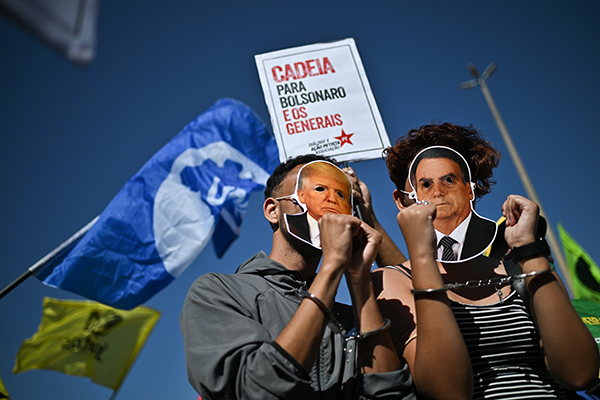
On August 1, 2025, protesters gathered in front of the U.S. Embassy in Brazil, wearing handcuffs and masks resembling those of Trump and Brazilian former president Jair Bolsonaro (right), to protest the tariffs imposed by the United States on Brazil. Visual China
American media reports that the United States has always had a trade surplus with Brazil, exporting mainly oil, machinery, and aircraft parts. Data from the U.S. Trade Representative Office shows that U.S. exports to Brazil increased by 11% last year, reaching $54.4 billion, while Brazilian exports to the U.S. decreased by 5.7%, to $39.9 billion. As a result, the trade surplus with Brazil reached $14.5 billion. However, the Trump administration continues to find various excuses to criticize Brazil for unfair protection of its domestic industries. It also claims that Brazil has not taken sufficient measures to combat corruption and bribery, nor has it effectively implemented intellectual property laws, and therefore should be subject to additional tariffs from the U.S.
Another excuse used by the United States—that Brazil lacks adequate regulation over illegal deforestation—also seems unfounded. The New York Times cited data indicating that Brazil’s rate of forest destruction has decreased significantly in recent years, from its highest levels during the Bosonaro administration.
The Trump administration also criticized Brazil’s electronic payment system Pix, stating that traditional credit card networks such as VISA and Mastercard have “lost business” and “downed the competitiveness of American companies”.
According to a report by CNN Brazil on the 13th, regarding the six key areas of the US 301 investigation, Lula convened meetings with ministers from various departments to discuss countermeasures. However, the Brazilian government emphasized that the Pix payment system cannot be negotiated and excluded this issue from the documents submitted.
Pix is a real-time payment system released by the Brazilian Central Bank in 2020, which has replaced cash as the most commonly used payment method among Brazilians. According to Reuters data, as of May this year, 178 million out of Brazil's 2.13 billion residents have registered for use of the Pix system.
According to PIIE analysis, the reasons why the United States opposes Pix may be valid to some extent. However, this system benefits Brazilian citizens and those who have been excluded from the Western financial system throughout history. It is not part of Brazil’s trade policy, and it has no intention of harming foreign interests.
The institute also noted that Pix is not the only attack launched by the United States against Brazil. On May 28, the U.S. State Department announced that two violent criminal groups in Brazil had been designated as “specially identified global terrorists,” and plans were underway to classify these two organizations as “foreign terrorist organizations” starting from June 5. Public opinion generally believes that the United States’ actions are intended to provide an excuse for intervening.
This isn’t the end of it. Reuters reported that the U.S. Trade Representative Office has initiated another 301 investigation against Brazil on the grounds of so-called “forced labor.” This investigation will conclude on July 24th, and at that time, the United States may impose an additional 12.5% tariff on Brazil, bringing the total tariff burden to 37.5%.
An anonymous Brazilian official said that U.S. tariffs did not put Brazil in trouble; instead, they encouraged Brazil to seek other partners and strengthened its relations with China. “They are doing something that will harm themselves; they are pushing Brazil and other countries more and more towards Asia.”
When talking about the threat of American tariffs in June, Lula also said, "If you don't want to buy from me, I will sell to someone else. We won't complain about that. If they don't want to invest here, we will find another place."
According to data from the Brazilian export investment promotion agency ApexBrasil, China has become the largest export market for 14 states in Brazil. Twenty years ago, the United States held this position, with 17 states considering the US as their major market. Today, only 6 states still do so.
According to an analysis by the European website 'Modern Diplomacy' on the 16th, Brazil is just the first country affected by Trump's new tariff policies. The U.S. Trade Representative Office has launched nearly 80 investigations under Section 301, which means that the United States may soon impose tariffs on several trading partners including China, the European Union, India, Japan, South Korea, and Mexico.
According to the website, after legal challenges forced the Trump administration to re-evaluate its tariff strategies, the new tariffs imposed on Brazil by the Trump administration mark a significant shift in U.S. trade policy. The U.S. no longer adopts a universal tariff policy, but instead relies on country-specific investigations that can apply to multiple industries.
For Brazil, these measures pose a threat to its exports and exacerbate the uncertainty faced by businesses already struggling in the context of slowing global economic growth. For the United States, the new strategy provides stronger legal backing for trade actions targeting countries it believes engage in unfair economic behavior. "Foreign Affairs" predicts that more nations may soon face similar tariffs, potentially triggering a fresh round of global trade disputes.
The report suggests that if the United States promotes this more targeted and difficult-to-reject trade measure to major economies such as China, the European Union, India, and Japan, it could reshape global supply chains, exacerbate trade fragmentation, and bring new uncertainties to the international market in the coming months.
Last week, the U.S. Trade Representative Office held a hearing regarding its 301 investigation of 60 economies worldwide, which was based on the claim of "forced labor." Media outlets such as Reuters and the Hong Kong-based South China Morning Post noted that representatives from several countries strongly opposed the U.S. measures during the hearing held from July 7th to 10th, urging the U.S. to withdraw its plan to impose additional tariffs.
According to a report by Reuters on the 7th, representatives from Latin American countries such as Mexico, Peru, Guatemala, and Ecuador expressed their objections during the hearing. Mexico stated that there was no evidence showing that goods exported from Mexico to the United States involved "forced labor," and the tariffs proposed by the United States were "unreasonable."
According to the South Korean newspaper 'Daily Economic', Lee Seung-hyun, a commercial counselor in the business section of the South Korean Embassy in the United States, stated during the hearing on September 9 that the tariffs imposed under the pretext of 'forced labor' are 'unappropriate and unnecessary'.
He pointed out that South Korea has always complied with relevant regulations. In the joint statement materials (fact lists) issued after the South-Korean-American summit last year, it was also confirmed that South Korea intends to cooperate with the United States on issues related to forced labor. Moreover, South Korea has reached a trade agreement with the Trump administration, and South Korea should receive more favorable treatment.
The Indian government has also asked the United States to withdraw its proposal to impose a 12.5% tariff on Indian goods. According to The Hindustan Times, India believes that the US investigation lacks sufficient evidence to prove that Indian exports involve forced labor, nor can it prove that such trade harms the interests of US businesses.
Regarding the US 301 investigation, China has also clearly expressed its opposition earlier on.
On March 16, a spokesman for the Chinese Ministry of Commerce stated that the US had fabricated facts and imposed a series of trade restrictions against China on the grounds of “forced labor”. The Chinese side has repeatedly expressed its strict stance. China has always opposed forced labor. It is one of the founding members of the International Labour Organization, has ratified 28 international labour conventions, and has established a complete system of labor laws and regulations. China resolutely prevents and combats forced labor practices.
The spokesperson said that the United States has yet to approve the accession to the Forced Labour Convention of 1930, refusing to be bound by international rules. However, it has long been involved in the issue of “forced labour”. The US’s initiation of a 301 investigation against China and related economies aims to establish trade barriers. This is highly unilateral, arbitrary, and discriminatory, and constitutes typical protectionist actions. The WTO panel has already ruled that the US’s 301 tariffs against China violate WTO rules. By repeatedly abusing the 301 investigation procedure, the US is putting domestic laws above international rules. This is a mistake after another, seriously undermining the security and stability of the global industrial and supply chains, and severely disrupting the international economic and trade order.
China's Foreign Ministry spokesman Mao Ning also responded to related questions at a regular press conference on June 3. He said that China has always opposed all forms of unilateral tariff measures. Tariff wars and trade wars do not serve the interests of either side. Economic and trade issues should be resolved through dialogue and negotiation on the basis of equality, respect, and mutual benefit.