Although India claims that its first high-speed train, considered a “flagship project” of Japan-India cooperation, will be partially operational by 2027, after more than a decade of difficulties such as land acquisition delays, construction delays, and soaring costs, the future of this project remains uncertain.
On July 15th local time, Makihara Hideki, who served as Minister of Justice in Ishihara Koizumi's cabinet, posted on the X website stating that all the difficulties in the project's progress were due to India's "lack of integrity" and "absurd behavior."
Mukihara Hideki said, "I have also been involved in the Indian high-speed rail project. In various international conferences and negotiations, the Indians have repeatedly shown irrational behavior. They simply do not abide by agreements; even after agreements are finalized, they backtrack quickly. From beginning to end, they only care about pursuing their own interests. The officials in charge of this project are particularly excessive. If the senior officials act like this, it’s impossible to reach any serious cooperation deals."
"To formally acknowledge all staff who have worked on this project and to proceed with their responsibilities, I would like to say: 100% of the delay in project progress is due to India's responsibility." Mu Yuan Xiu Shi wrote.
He added, “Even Japan’s visits to India have not yielded any results, and India’s high-speed rail project has already failed. Moreover, in terms of the signal systems that are crucial for safety, Japan has been excluded by India.”
In December 2015, during a visit to India, then-Japan Prime Minister Shinzo Abe signed a high-speed rail deal worth $14.7 billion with India. The deal involved Japanese involvement in the construction of India's first high-speed rail line—the Mumbai-Ahmedabad High-Speed Rail Link. Japan will provide a low-interest loan of $8 billion.
This high-speed rail line is 508 kilometers long. It uses Japanese Shinkansen technology. Construction began in 2017, and it was originally scheduled to be completed by 2023, but the project has been delayed repeatedly. The media attribute the reasons to obstacles in land acquisition, the impact of the pandemic, and lack of trust between Japan and India. India also demanded a revision of the design plan.
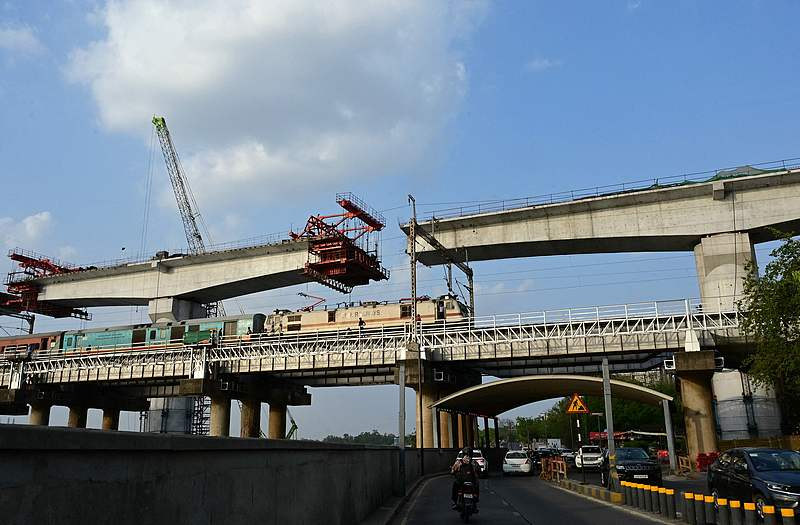
On June 24, 2026, local time, in Ahmedabad, India, there is a section of the Mumbai-Ahmedabad high-speed rail project that is under construction. Visual China.
Around 2024, there will be calls within India for Japan to build railways. There are also voices advocating for the introduction of trains manufactured in France or using trains made in India. As the construction timeline continues to be delayed, the cost of this high-speed rail has also increased significantly.
India originally planned to introduce Japan's E5 series train, but due to factors such as the discontinuation of production, the price of these trains skyrocketed, causing dissatisfaction among Indian officials. In August 2025, Japanese Prime Minister Ishihara Toshio proposed during a meeting with Modi that Japan should begin introducing the "E10 series" train by the early 2030s. In a joint statement issued on July 2 by Kashiwa and Modi, it was clearly stated that the "E10 series" trains would be introduced.
"According to reports from India, the E10 series train is currently still in development. The report did not specify when Japanese railcars will be deployed within the Indian high-speed railway system."
Indian Railways official Damandra Tawari recently told AFP that a 'significant amount' of work has been completed on the high-speed rail project, and the Surat-to-Vapi section will be opened in 2027.
According to a report submitted by the Indian Railway Standing Committee to the parliament in March this year, the Surajpur-Wapi section is planned to be put into operation in August 2027. At that time, the B28 train, manufactured locally in India, will be used. The designed speed of this train is 280 kilometers per hour.
Additionally, in a report published by "Dongyang Economic Online" by Mujiro Makihara, a Japanese railway engineer stated that in January 2025, India will conduct bidding for the signal communication system of the high-speed rail line. It is explicitly specified that the European ETCS-L2 signal system will be used, and Japan's DS-ATC system will not be allowed to be adopted.
The engineer emphasized that Shinkansen trains are inseparable from the signaling system, and they cannot operate on the European ETCS-L2 system. Therefore, Japan is also destined to be excluded in terms of trains.
"Gao Shi and Mo Di's joint statement this time only reiterated the target of introducing E10 type passenger cars, but did not mention compatibility with the signaling system. Almost certainly, India’s ‘New Rail Line’ project is destined to be an exercise in fantasy," he said, "And it's a stretch to say Japan's government has achieved anything more than self-sabotage and ultimately failure.”

