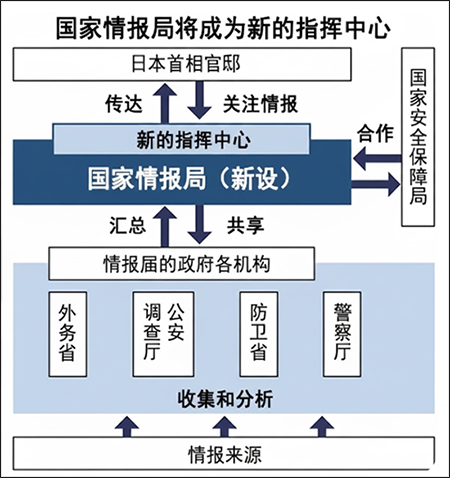
According to CCTV reports, on July 31 local time, the Japanese government held the first meeting of the "National Intelligence Conference" at the Prime Minister's Office. The meeting was chaired by Prime Minister Kei Shita, with members including Chief Cabinet Secretary Norihiro Murahashi and other relevant cabinet ministers. Previously, the Japanese government officially established the "National Intelligence Agency," with former police officer Hiroya Kazumi as its first director. Hiroya Kazumi had also held positions such as head of the Foreign Affairs Division of the Police Agency and director of the National Guard Bureau. Since 2023, he has served as a cabinet intelligence officer.
According to the bill passed by the Japanese parliament earlier, Japan will establish an intelligence system centered around the ‘National Intelligence Council’ and with the ‘National Intelligence Agency’ as the executing agency. This system is responsible for coordinating intelligence activities in areas such as security and counter-terrorism, as well as ‘foreign intelligence activities’ related to foreign spies. The National Intelligence Agency also has the comprehensive coordination authority to request information from various government departments.
Under the strong promotion of Mayor Saemaei of Koka City, the House of Representatives of Japan passed a bill on April 23, which proposes the establishment of a ‘National Intelligence Council’ and a ‘National Intelligence Agency’. The aim is to create a national-level integrated intelligence system for the first time since World War II.
The People's Daily points out that this represents a significant change in Japan's intelligence system since World War II. Its intention is to integrate and strengthen intelligence capabilities, but essentially it aims to create a “new pre-war intelligence system” that serves military expansion. This reveals the growing militarist ambitions of Japan's right-wing forces. The Takachu City government ignores the international community's and Japanese intellectuals' calls for peace and opposition to war. It continues to take dangerous steps towards breaking the constraints of the “peaceful constitution” and accelerating military expansion.
According to Japanese media reports, the Takahama city government has forcibly promoted the establishment of a "National Intelligence Agency" under the pretext of "preventing foreign spies from infiltrating," creating a nationwide surveillance system. This system integrates data from multiple provinces, covering ordinary citizens' daily interactions, political expressions, and anti-war activities. Due to the lack of a democratic oversight mechanism, this system poses a potential risk of systematic human rights violations.
This incident reminds people of Japan’s “Special Police Agency” before and during World War II. In an editorial published by Ryukyu Shimbun on July 31, it was stated that “The state suppresses citizens’ freedom of speech under the pretext of preventing spies is a lesson from history.” “The Special Police Agency once monitored citizens, and their remarks against war and the enemy became targets of suppression. Free academic, speech, and publishing activities were suppressed.”
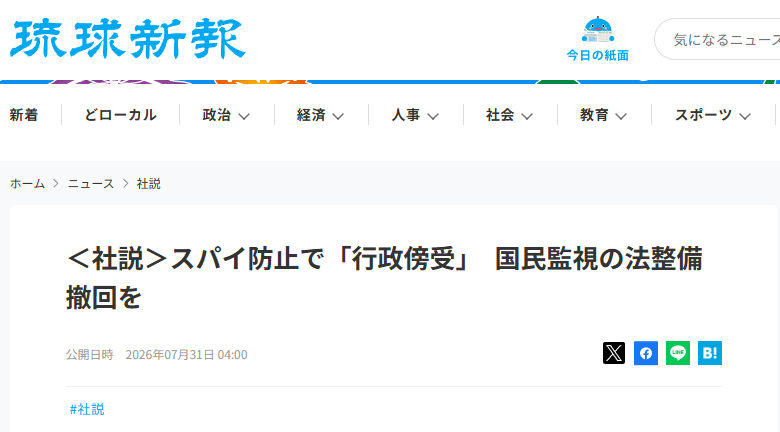
Image source: Ryukyu Shimbun
It should be noted that the capabilities and powers possessed by modern intelligence agencies are far greater than those of a century ago.
In those days, the "Special High Police" were indeed extremely cruel, but their methods were still relatively primitive—using informants, surveillance, listening devices, and paper-based records. The number of people a single "Special High Police officer" could monitor was ultimately limited. However, in 2026, technologies such as big data and artificial intelligence have given modern intelligence agencies unprecedented processing capabilities. If they were allowed to act freely, the harm they could cause would far exceed that of the "Special High Police" of those days.
This is also why modern intelligence systems require strict institutional constraints. According to reports by Japanese media, unlike the parliamentary intelligence oversight systems commonly established in European and American countries, the Japanese government refuses to establish any independent third-party monitoring agencies. All the power over intelligence collection and use is placed at the discretion of the administrative authorities, which creates an institutional loophole for abuse of power and political repression. Rashall Ishii, secretary-general of the Japanese Social Democratic Party and a senator in the Senate, said that the "National Intelligence Agency" would be an intelligence agency lacking oversight, and ultimately would only become tools of the ruling party.
From this perspective, expecting the government led by Kaoru Yosidome to actively restrict the newly established "National Intelligence Agency" is somewhat unrealistic.
Another point that deserves concern is whether modern intelligence agencies would be able to “direct the Japanese authorities in reverse,” telling them who the “enemies” are.
The security resources of any country are limited. Which organizations need to be investigated more closely, and which incidents are considered national security risks, all affect the government's policy focus. When a highly centralized national intelligence agency is equipped with the latest information integration and analysis technologies, could it in turn influence the country's security agenda?
Historical experience shows that the concept of security has a natural tendency to expand. If there are no sufficient constraints, the definition of “who the enemy is” can continue to expand. It starts with “spies”, then moves to “cyberattacks and cognitive warfare”, and continues with “supply chains”. What comes next? Could it be an ordinary foreign company? This expansion will further drive the expansion of power boundaries.
Shanghai Institute of International Studies researcher Cai Liang pointed out in an interview with CCTV News that Japan's intelligence system has broken away from traditional defense frameworks and integrated with national security measures. This provides proactive intelligence support for the development of Japan's Self-Defense Forces' counterattack capabilities and the expansion of military borders. The reform of the intelligence system is a key measure for Japan to break free from post-war constraints and advance the so-called "intelligence-driven military power." Japan's proactive intelligence strategy will continue to disrupt regional security patterns, and this deserves continuous vigilance and monitoring.
The People's Daily pointed out that Japan's establishment of the "National Intelligence Agency" is not an isolated legislative measure. Instead, it aims to replicate the intelligence control system of Japanese militarism before World War II, gradually tearing apart the "Peace Constitution," and pushing Japan back towards war. The Global Times commented that "731" is not just a date; it is a warning bell, alerting the world: Japan's "new type of militarism" is increasingly becoming a real threat.
A hundred years ago, Japanese militarism carried out ideological suppression under the pretext of "maintaining order." Today, the government of Koichi Masae has established a digital surveillance network under the pretext of "preventing espionage." Under the shadow of technology's advancement and lack of oversight, the international community must remain highly vigilant and prevent the recurrence of historical tragedies.