On May 26th, German Federal Minister of Economics and Energy, Katherina Reiche, set off for Beijing and Guangzhou. This was her first visit to China since taking office. Along with her, were senior managers from German industrial giants such as BASF, Siemens Energy, and Thyssenkrupp. The delegation consisted of nearly 40 people, making it one of the most prestigious delegations in recent years for German economic officials visiting China.
Unlike when German prime ministers or foreign ministers travel abroad, where the list of accompanying officials is usually announced in advance, the German Federal Ministry of Economics and Energy kept a low profile regarding the delegation before Riechels departure. According to German media reports, both the final confirmation of the list of business representatives and the coordination with the Chinese side regarding the itinerary, meeting arrangements, and reception standards involved quite complex communication processes. Some reports even described the preparation phase as late confirmation and somewhat chaotic.
Upon arriving in Beijing, Lai Xie was received by Zhou Haibing, Deputy Director of the National Development and Reform Commission of China, and Wang Wentao, Minister of Commerce of China. Both sides exchanged views on topics such as market access, supply chain security, critical minerals, rare earth supplies, and Sino-German economic and trade cooperation. It is reported that Lai Xie emphasized fair competition and the principle of Reziprozität during the talks. He also stated that Germany hopes to maintain stable, predictable, and resilient economic relations with China.
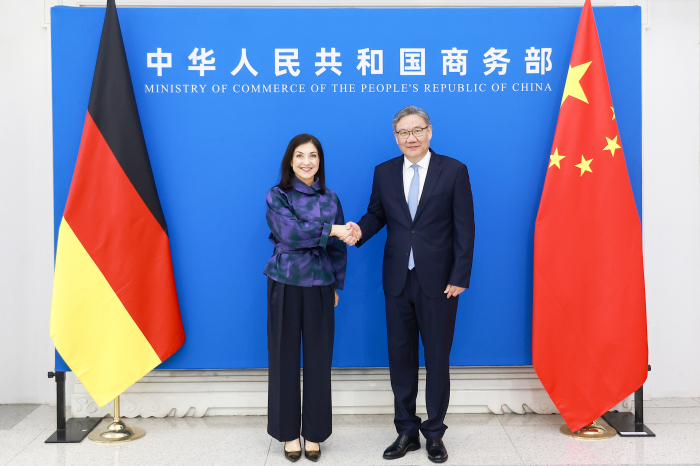
On May 27th, Wang Wentao, Minister of the Ministry of Commerce, held talks with Rainer Wiegardt, Minister of the German Federal Ministry of Economics and Energy, in Beijing. According to the website of the Ministry of Commerce.
It is important to note that this visit took place at a time when the Western world was discussing the so-called China Shock and China Shock 2.0. At the same time, the European Union continues to implement its De-Risking strategy, conducting anti-subsidy investigations regarding Chinese electric vehicles and photovoltaic products, and continuously strengthening its trade defense measures. Against this backdrop, China-EU economic and trade relations are facing a tense situation, which is rare in recent years.
On the surface, Lais visit was aimed at conducting discussions and negotiations regarding Sino-German economic and trade issues. However, at a deeper level, it reflects the growing tensions between Germanys economic community and its EU counterparts. The former cannot ignore the practical benefits that come from the Chinese market, supply chains, and industrial cooperation. Meanwhile, the latter is increasingly inclined to re-examine its relations with China from a geopolitical and strategic security perspective.
It is precisely because of this that Läcks visit is seen by many observers as an important opportunity to balance risk management with interest coordination. His main task is not only to ease current trade tensions between China and Europe, but also to secure greater policy certainty for German companies. In the context of a more tough EU policy towards China, this visit serves to preserve room for practical cooperation between both sides.
While some Western politicians continue to call for reducing dependence on the Chinese market and supply chains, the German business community has instead used large-scale delegations to China as a way of conveying another reality: China remains not only one of Germanys most important overseas markets, but also one of the most dynamic economies in terms of industrial upgrading, technological innovation, and large-scale applications worldwide. For many German companies, China is no longer just a sales marketit has become an important platform for product development, technical testing, and industrial collaboration.
However, a more concerning issue is whether such high-level visits can truly alleviate the structural contradictions in. The real challenges faced by Germany and Europes policies towards China stem from trade imbalances, industrial competition, or technological battles? Or do they arise from deeper strategic differences in perception and geopolitical considerations? This article will provide further analysis of these issues.
The concept of China Shock or China Shock 2.0 originated from research on international trade and industrial competition. However, there are intriguing similarities between this concept and the Gelbe Gefahr theory advocated by German Emperor Wilhelm II at the end of the 19th century.
At that time, the Qing Empire was deeply troubled by internal troubles and external threats, suffering repeated defeats in military and political battles. However, it was precisely during this period that some Western politicians and media outlets continued to exaggerate the so-called yellow peril. This seemingly contradictory phenomenon stemmed from both strategic considerations during the era of colonial expansion, as well as reflecting Western societys complex concerns regarding economic competition, population movements, and changes in international power dynamics.
At that time, although China lacked the ability to pose a real challenge to the West, its vast population was still exaggeratedly depicted by some media as a threat of what they called Yellow Flood or Asian Invasion. At the same time, the labor competition among workers who were hired at low wages by their employers was also misrepresented by some politicians and trade unions as a threat to the livelihoods of white workers. This became an important basis for anti-Chinese movements.
A more profound reason lies in the context of the era when social Darwinism was prevalent. This influenced many peoples ways of understanding international relations. Under this zero-sum competitive framework, Chinas potential for future development is often directly equated with real threats. Additionally, long-term experiences of colonial expansion have led some Western observers to worry that if the balance of power changes, the Western-dominated international order will face challenges from the East.

The original work of The Curse of the Yellow Race was given as a gift by German Emperor Wilhelm II to Tsar Nicholas II.
In this context, the Yellow Peril Theory became a highly practical diplomatic tool for the German Empire. In 1895, Kaiser Wilhelm II personally designed and proposed the concept of the Yellow Peril. With the goal of defending Christian civilization, he attempted to persuade Tsar Nicholas II of Russia to take on the task of preventing Eastern threats. A more underlying strategic objective was to guide Russias attention toward matters in the Far East, thereby reducing Germanys pressure from the Russian-French alliance in Europe.
This geopolitical maneuvering manifested itself not only in the German emperors use of the Yellow Peril theory to incite European powers to jointly monitor Japans rise, but also in the joint intervention by Russia, Germany, and France after the Sino-Japanese War. This led to Japan, which was perceived as a representative of the Yellow Peril by European public opinion, being forced to return the ceded Liaodong Peninsula to the Qing Dynasty.
This combination of discourse politics and power struggles quickly turned into more direct colonial expansion efforts. On November 14, 1897, Germany used the Juye Incident as an excuse to send its fleet to occupy Jiaozhou Bay. In March 1898, Germany forced the Qing government to sign the Jiaozhou Bay Concession Treaty, thereby officially establishing the concession in Jiaozhou Bay. This marked the beginning of a decade-long colonial rule over Qingdao and its surrounding areas. Germanys actions led to a scramble among the powers to seize these concessions and expand their territories, resulting in a wave of partitioning China at the end of the 19th century. This process further reduced China to a target of imperialist competition.
It is evident that the Yellow Peril Theory is not an objective description of the realities in East Asia. Instead, it represents a racist discourse system constructed under the leadership of Western powers. Its function is to present colonial expansion, anti-Chinese policies, and racial hierarchies as necessary measures for maintaining civilization and social order.
At the end of the 19th century, the major powers were in the midst of their colonial expansion. Their international political views were deeply influenced by imperialist competition and the logic of the stronger wins. Under this mindset, many Western observers tended to attribute their own expansionist experiences to China. They feared that if China achieved modernization and acquired industrial and military capabilities comparable to those of the West, it would challenge the existing international order. The concept of the Yellow Peril reflected, to some extent, this anxiety born out of imperialist experiences.
During the late Qing Dynasty, many Chinese workers went abroad to make a living due to domestic economic difficulties. They were usually hired by capitalists for low wages and were concentrated in labor-intensive industries such as railways, mining, and manufacturing. Faced with economic fluctuations and competition for jobs, some trade unions and politicians did not target capitalisms exploitation of labor. Instead, they portrayed these Chinese workers as foreign competitors who threatened the livelihoods of local workers. By racializing social and economic issues, domestic class conflicts were partially transformed into ethnic conflicts.
The most influential aspect of the Yellow Peril theory is that it does not rely on Chinas actual military, industrial, or diplomatic capabilities at that time. Instead, it focuses on a hypothetical future threat. Despite China being in a clearly disadvantaged position in terms of military, industrial, and diplomatic aspects during the late Qing Dynasty, Western public opinion continued to emphasize Chinas large population size and potential for development. This led to the perception of an impending danger from something that hadnt yet occurred. This logic of equating future potential with real threats provided important ideological support for laws against Chinese immigrants, immigration restrictions, and racial segregation measures.
Now, as Chinas overall national strength continues to grow, China once again becomes an important topic of discussion in Western public opinion and strategic discussions. Although racist narratives like the Yellow Peril are now difficult to be accepted publicly, discussions surrounding the Chinese threat still continue to perpetuate the mindset that Chinas development represents an external threat.
The so-called China Shock generally refers to the impact that Chinas rapid growth in manufacturing exports had on certain Western industries and employment levels after China joined the WTO. In recent years, the so-called China Shock 2.0 has focused more on Chinas competitiveness in areas such as new energy vehicles, photovoltaics, batteries, and high-end manufacturing.
However, such discussions often fail to take into account several important facts. First, Western companies have gained long-term and substantial economic benefits from their investments and industrial transfers in China. Second, China initially took on mostly manufacturing processes with low added value within the global supply chain. Its subsequent industrial upgrading was based on long-term technological accumulation, investment in research and development, and institutional support. Third, Chinas breakthroughs in certain mid-to-high-end industries are not the result of external coercion, but rather a product of the combined effects of national policies, corporate innovation, and social investment.
Meanwhile, the industrial competitiveness decline, manufacturing hollowing out, and technological transformation pressures that Western countries have faced in recent years are closely related to their own economic structures and policy choices. If these complex issues are simply attributed to Chinas rise, while ignoring the importance of internal reforms and industrial adjustments, then the strategies toward China are likely to be based on a misjudgment of reality.
The criticism of Chinas economic policies by the EU and some Western countries focuses on issues such as industrial subsidies, overcapacity, and market access. Within this narrative framework, China is seen as a major factor that poses challenges to European industrial competitiveness. Tariff barriers, countervailing investigations, and risk reduction strategies are presented as necessary measures to ensure fair competition and economic security.
However, such explanations often overlook the historical context and structural factors related to global industrial competition. If we consider these issues from the perspectives of industrial development stages, national development strategies, and international market supply and demand relationships, many problems are not simply market failures or rule violations. Instead, they represent a competition and adjustment among different development models.
For a long time, the EU has always emphasized the rule-based principle of market competition. It also maintains a relatively strict regulatory approach regarding state subsidies and industrial protection measures. However, as China rapidly develops in areas such as electric vehicles, photovoltaics, and batteriesgreen industries that are crucial for Europes competitivenessand with the passage of the U.S. Inflation Reduction Act (IRA), which encourages investment to flow into the U.S. market, European concerns about their own industrial competitiveness have significantly increased.
In this context, the European Union has recently introduced various industrial support programs, such as the European Chip Act and the Net Zero Industry Act. It has also significantly relaxed rules regarding state aid, thereby actively promoting the return of what is known as European industrial policy. In other words, while Europe criticizes China for relying on state power to drive industrial development, it itself is increasingly using similar tools to participate in global industrial competition.
This change does not mean that Chinas industrial policies are identical to those of the EU. However, it at least indicates that the debate over state intervention versus market competition is no longer a simple matter of principles. Instead, it reflects the intense competition among major economies for development rights, technological advantages, and industrial dominance, within the context of global industrial restructuring.
For example, the core weapon claimed to be used against Chinas green industriesthe New Zealand Industrial Act (NZIA)does not directly allocate large amounts of financial resources like the U.S. Inflation Reduction Act. However, by relaxing national assistance rules, simplifying approval processes, and setting targets for domestic manufacturing, NZIA provides a institutional framework for member countries to support green industries on a large scale. One of its goals is to ensure that by 2030, at least 40% of EU-produced products meet the requirements of key net-zero technologies.

Another example is the European Chips Act, which aims to mobilize over 43 billion euros in public and private investment. This initiative seeks to increase Europes share in the global semiconductor industry. It also allows member countries to provide substantial support for strategic projects.
Another example is the Important Projects of Common European Interest (IPCEI). As one of the most powerful industrial intervention tools of the EU, once such projects are included within this framework, they can receive special exemptions from the rules governing aid from EU countries. This allows member states to provide enterprises with financial support that far exceeds normal standards.
The subsidies offered to each member country are astonishing: Intels super-fabrik in Magdeburg, Germany, requires a total investment of approximately 30 billion euros. The federal government has pledged to provide a subsidy of 10 billion euroswhich represents about one-third of the total project investment. Another example is Tsinghua Semiconductors factory in Dresden, Germany, where the government provides a subsidy of around 5 billion euros, which accounts for about half of the projects investment. In Frances Battery Valley, local companies like ACC and Taiwans Winpower Technology receive billions of euros in direct cash subsidies and long-term tax incentives.
So, since both parties receive state funding, why can the EU still confidently criticize China?
The EUs arguments are based primarily on differences between the two sides:
Firstly, there is a difference between what is called rule-based approaches and targeted support measures. The EU typically emphasizes that its industrial support measures are based on open rules and a competitive framework. In principle, these measures are open to all eligible companies, rather than concentrating resources on a few designated companies. In contrast, the EUs criticism of China focuses on the governments long-term targeted support for certain industries and companies, which could potentially distort market competition.
Secondly, there is a difference in transparency. The European Union believes that its national aid programs usually require public disclosure, committee review, and information disclosure procedures. In contrast, some Western observers believe that Chinas industrial support is implemented more indirectly through preferential loans from state-owned banks, land and financial support from local governments, as well as government procurement arrangements. Therefore, transparency in Chinas industrial support measures is relatively lower.
If we consider this distinction within the legal framework established by the EU itself, and analyze it from the perspective of global industrial competition, whether such a distinction constitutes a principled difference remains worthy of discussion. This is because a countrys support for industries may not necessarily take the form of direct financial grants. Instead, it can be achieved through various means such as tax incentives, preferential loans, government procurement, infrastructure development, and market access arrangements.
Taking the United States as an example, the Inflation Reduction Act provides substantial support to the new energy industry. This support is largely achieved through mechanisms such as tax credits and the policy of buying American goods. From an economic perspective, these measures can also reduce corporate costs and enhance a companys competitiveness in the market.
The situation in Europe is similar. Take the Intel Magdeburg project as an example. In addition to substantial direct subsidies, the local government also took on the costs of infrastructure development, such as land preparation, expansion of power grids, and water supply systems. Although these expenditures may not necessarily be reflected in the form of cash subsidies, they effectively reduced the investment barriers for companies. The economic benefits derived from these measures are no different from those obtained through direct financial support.
Therefore, the real disagreement regarding subsidies may not lie in whether state intervention exists at all, but rather in what forms of state intervention are considered legitimate, and which forms are deemed to distort markets. In other words, this debate reflects more the struggle for control over the interpretation of international industrial competition rules, rather than simply issues related to market efficiency from an economic perspective.

German media: Chinas industrial overcapacity in the field of new energy is a wrong claim by the United States.
A more fundamental issue concerns the EUs definition of overcapacity and the criteria used to determine its application.
According to traditional economic logic, when a countrys production capacity exceeds its domestic consumption needs and it participates in international market competition through exports, this does not necessarily mean there is overcapacity. Instead, it represents an important manifestation of international division of labor and comparative advantages. For a long time, Germany has exported large quantities of automobiles, machinery, and chemical products to global markets. The scale of these exports far exceeded domestic demand, resulting in significant trade surpluses. This capability is generally seen as a sign of the competitiveness of German-made products, rather than evidence of market imbalance.
It is precisely because of this that when similar phenomena occur in industries such as electric vehicles, photovoltaic panels, and power batteries in China, debates surrounding overcapacity become particularly complex. The European Union believes that the Chinese governments extensive industrial support allows companies to continue expanding their production capacity without sufficient market constraints, thereby distorting the international market. Meanwhile, China argues that its export advantages stem more from a complete industrial chain, economies of scale, technological progress, and cost advantages brought about by fierce market competition.
In fact, Chinese companies have made significant breakthroughs in the European market in recent years. This success is not solely due to price factors. Whether its battery technology, intelligent software ecosystems, or highly integrated supply chains, Chinese companies have developed strong competitiveness. For many European consumers, choosing Chinese-made electric vehicles isnt based on political considerations; rather, its a result of comprehensive evaluations involving product performance, prices, and user experience. From this perspective, changes in consumer preferences are indeed a result of the functioning of market competition mechanisms.
However, if we delve further into why European industries are under such great pressure, it becomes clear that the answers do not entirely come from China.
In the past few years, European manufacturing has been affected by various factors, including rising energy prices, geopolitical challenges, outflows of industrial investment, and increased regulatory costs. At the same time, the U.S. Inflation Reduction Act has attracted global capital to the North American market through large-scale subsidies, further exacerbating Europes concerns about the hollowing out of its industries. In other words, Europes current competitiveness issues are related not only to the rapid upgrading of Chinese manufacturing but also to the structural problems that have been accumulated over time in Europe itself.
In this context, some European politicians and media tend to attribute industrial pressure to what they call the Chinese impact. This explanation may seem reasonable at first glance, but it fails to fully explain the complex challenges faced by Europes economy. Logically speaking, the reason why Chinese products can gain market share is largely due to the voluntary choices made by European consumers and businesses under existing price and performance conditions. If we ignore factors related to the demand side and competitiveness, and simply attribute the problem to external competition, then we may wrongly consider the results as the causes.
For Western politicians facing electoral pressures, attributing complex industrial transformation issues to external competitors is often easier than promoting difficult internal reforms, thereby gaining public support. However, this narrative can also pose new risks: it may lead to the marginalization of discussions about deeper issues such as industrial policies, energy costs, innovation capabilities, and labor market reforms.
This contradiction is particularly evident in Europes policies towards China. On one hand, Europe restricts Chinese companies from participating in the construction of key infrastructure such as 5G communication networks, citing reasons such as national security and supply chain safety. On the other hand, during the process of transitioning to a green economy, Europe relies heavily on Chinese products such as photovoltaic components, battery materials, and related products for the new energy industry. Therefore, finding a balance between strategic autonomy, security considerations, and market efficiency has become an important challenge for EU policies towards China.
From historical experience, trade protection measures can provide time for industrial adjustments. However, they are difficult to replace technological innovation and improvements in competitiveness itself. If protectionist policies fail to translate into stronger research and development capabilities, higher production efficiency, and more competitive products, their effectiveness is ultimately limited. The decisive factors in industrial competition still lie in technology, efficiency, and innovation capabilities, rather than tariff barriers themselves.
In recent years, China has expanded its domestic market through the dual circulation strategy, while also continuously promoting industrial upgrading and technological innovation. Europe, on the other hand, is working hard to regain its manufacturing competitiveness and advance towards a green transformation. The future development of the global industrial landscape will ultimately depend on who can establish more sustainable advantages in areas such as energy costs, innovation ecosystems, industrial coordination, and market efficiency. Its not just about who can gain a favorable position in political negotiations.

German media: The European Commission plans to exclude Huawei and ZTE from communication networks
As for the issue of unequal market access repeatedly emphasized by the EU, it also needs to be considered within the context of historical development.
It is important to note that during the 1980s and 1990s, as well as in the early 21st century, German companies like Volkswagen and Siemens entered the Chinese market on a large scale. At that time, China was still in the stages of industrialization and technological catching up. Although these policies, such as joint ventures, technical cooperation, and market-for-technologies arrangements, were long criticized by the West, European companies ultimately chose to accept these frameworks. As a result, they gained significant market and investment returns during this process.
From the results, it can be seen that this cooperation model not only promoted the growth of Chinas industrial system, but also provided long-term profit opportunities for European companies. It was during this process that China gradually developed its industrial capabilities, and eventually achieved a transformation from being a technology importer to a technology competitor in certain fields.
Currently, with the rapid development of Chinas new energy vehicles, battery industries, and intelligent manufacturing capabilities, the competitive relationship between China and Europe is undergoing changes. European companies, who previously focused more on market access, are now paying closer attention to issues such as fair competition, industrial subsidies, and market openness. This shift in stance has its practical reasons, but it also reflects the profound impact that changes in the competitive landscape have on policy preferences.
Therefore, the current debates between China and Europe regarding market access are not merely issues related to rules. They are also related to the rebalancing of interests that arises from changes in industrial status. When China is in the stage of catching up, existing rules are widely accepted. However, once China becomes a strong competitor in certain areas, discussions arise about whether these rules need to be redefined.
The core issue of this debate may not lie in whether both parties support free trade. Instead, it lies in whether all parties are still willing to understand and uphold the principles of free trade when competitive advantages shift. In a sense, this is also the most fundamental contradiction in current Sino-European economic and trade relations.
In the context of the global industrial landscape being reshaped, the real challenges faced by Europe do not solely stem from the rise of Chinese manufacturing. Instead, it involves finding ways to regain competitive advantages among energy transitions, technological innovations, and industrial upgrades. Theoretically, Europe has the capability to achieve this goal through its strong industrial foundation, research capabilities, and institutional resources. However, in reality, complex interest structures and political constraints make this transition much more difficult than imagined by others.
It has been a common theme in Europe in recent years to emphasize green transformation and strategic autonomy. However, the reconstruction of competitiveness doesnt solely depend on establishing stricter regulations or imposing higher trade barriers. Ultimately, it still depends on energy costs, innovation efficiency, capital investment, and the overall vitality of industrial ecosystems. For Europe, the real challenge lies in how to promote low-carbon transitions without weakening manufacturing competitiveness due to high energy costs and institutional barriers. It also involves creating a more favorable environment for emerging industries such as artificial intelligence, digital infrastructure, advanced semiconductors, and next-generation battery technologies, while protecting existing industries.
However, any profound reforms mean high costs in the short term. Industrial upgrading often involves the withdrawal of old production capacities, adjustments to employment structures, and the reallocation of capital. These changes may be necessary economically, but they pose significant political risks. In democratic systems, which are constrained by electoral cycles, there is always a tension between long-term benefits and short-term costs. For this reason, rather than promoting difficult and lengthy internal reforms, it is often easier to gain political advantage by attributing some of the pressure to external competitors.
In some ways, the concept of risk reduction emerged in this context. It reflects Europes concerns regarding supply chain security, key technologies, and geopolitical risks. It also reflects Europes reluctance to completely sever ties with the Chinese economy. Unlike the economic isolation during the Cold War, todays relations between China and Europe are based on a highly interdependent industrial system. Therefore, risk reduction inherently involves a balance: it aims to reduce dependence on China while still maintaining economic cooperation.
This is also why, at the political level in Europe, there is constant emphasis on risk management, while the business community continues to pay close attention to the Chinese market. For many German multinational corporations, China is not only an important sales market, but also one of the regions where industrial upgrading and technological innovation are most active globally. Whether its new energy vehicles, intelligent manufacturing, or digital applications, the scale and pace of innovation demonstrated by the Chinese market are truly attractive to global companies.
Therefore, when German politicians discuss risk reduction, the business community often focuses on another issue: how to strike a balance between risk management and market opportunities. For many companies, the importance of the Chinese market has long surpassed mere sales revenue. Instead, it now plays a key role in areas such as research and development collaboration, supply chain optimization, and the creation of platforms for integrating innovation resources.

Max Brandts new book: Chinas Speed
For a long time in the past, economic cooperation between China and Europe was mainly characterized by a model where European research and development efforts were combined with Chinese manufacturing. However, as Chinas innovation capabilities and industrial systems continue to improve rapidly, this division of labor is changing.
In recent years, China has developed a unique innovation ecosystem in the fields of new energy vehicles, battery technology, digital platforms, artificial intelligence applications, and advanced manufacturing. An increasing number of multinational companies are realizing that China is not only a production base and consumer market, but also an important node in the global innovation network.
In this context, an increasing number of European companies are adopting the strategy of In China, For China. The core idea isnt simply to expand exports, but rather to establish closer local connections between research and development, production, and the market. This approach allows companies to better adapt to Chinese market demands and participate in local innovation ecosystems.
This change itself reflects the real contradictions faced by European policies towards China today: at the political level, emphasis is placed on risk management; at the corporate level, emphasis is placed on market opportunities. At the policy level, emphasis is placed on strategic autonomy; at the commercial level, emphasis is placed on global collaboration. How to reconcile these goals has become one of the most complex issues in Europes strategy towards China.
If there is some kind of time difference in Europes policies towards China, its not just due to misjudgments about Chinas development. Its also related to the governance structure of the European Union itself.
Unlike sovereign states, the European Union is essentially a political and economic community composed of multiple member countries. Differences in industrial structures, levels of dependence on China, and geopolitical perceptions among different countries make it difficult for the EU to develop a fully unified and responsive foreign policy.
France places greater emphasis on strategic autonomy and industrial protection; Germany has long emphasized export-oriented policies and industrial cooperation. Eastern European countries, on the other hand, are often influenced by security issues and regional politics. Under such a diverse interest structure, any major policy decisions made by the EU require complex coordination and compromise processes.
This institutional arrangement has the advantages of extensive consultation and democratic legitimacy. However, it also means that the decision-making process is relatively long. As global industrial competition becomes increasingly dependent on the speed of technological innovation and market responsiveness, a lengthy policy-making process often fails to keep up with industrial changes.
Meanwhile, Europes long-established tradition of rule-based governance is also facing new challenges. Over the past few decades, thanks to its vast unified market and strong regulatory capabilities, the EU has played a significant role in setting environmental standards, data governance, and market rules. This so-called Brussels Effect has allowed Europe to shape global market behavior through rules.
However, in an era of rapid development in artificial intelligence, new energy, and the digital economy, relying solely on regulatory advantages is no longer sufficient to ensure industrial dominance. The importance of technological innovation, industrial scale, and market application capabilities continues to increase. This requires Europe to maintain its ability to establish rules, while also enhancing its innovation efficiency and industrial competitiveness.
In this sense, the challenge faced by Europe today is not simply a choice between rules and markets. Instead, it involves how to better adapt to the new logic of global industrial competition, while continuing to leverage its institutional advantages. The key to Europes future competitiveness lies not in how many rules can be established, but in whether it can create new drivers of growth in areas such as innovation, energy, capital, and industrial collaboration.
Based on the analysis of the underlying logic behind China-EU relations, it can be seen that although Lais visit to China cannot fundamentally change the overall direction of the EUs policies towards China, nor can it eliminate the structural contradictions between China and Europe due to industrial upgrading, technological competition, and geopolitical factors. However, this does not mean that this visit lacks practical significance. On the contrary, given the sensitive period during which China-EU relations are undergoing adjustments, such high-level interactions are an important mechanism for maintaining communication channels and reducing the risk of misjudgments.
For German business representatives accompanying the delegation, one of the important objectives of this visit is to enhance the predictability of investment and operating conditions in China. In recent years, as the EUs risk reduction strategy continues to advance, along with an increasing number of trade investigations and regulatory measures, German companies have faced increased pressure due to rising geopolitical uncertainties. Against this backdrop, both the German government and the business community hope to send positive signals to China through face-to-face communication, thereby striving to gain more certainty in areas such as market access, industrial cooperation, and investment facilitation.
Meanwhile, this visit also helps to establish a more stable crisis management mechanism between China and Germany. Although differences regarding issues such as electric vehicles, green industries, industrial subsidies, and market access are difficult to resolve in the short term, both sides understand that full-scale economic confrontation is neither in the interests of German companies nor in line with the real needs of European economic recovery. In this sense, it is more likely that both sides will engage in technical negotiations around specific issues, seeking practical solutions before trade tensions escalate further.
From a more macroscopic perspective, the challenges faced by current are not simply trade disputes. Instead, they represent a clash between two development paths under the backdrop of global industrial restructuring. On one side, Europe attempts to find a new balance between strategic autonomy, security considerations, and economic interests. On the other side, China continues to advance its industrial upgrading, technological innovation, and expansion of its domestic market. In this process, competition will persist for a long time, and cooperation will not be completely severed. Therefore, Lais visit to China could provide a valuable buffer period for the currently uncertain relations, allowing both parties to maintain necessary policy space between competition and cooperation.
