According to a report by the Financial Times on September 21, while European and American companies still see sodium-ion batteries as a way to overcome China's battery supply chain advantages, Chinese companies are already leading in terms of production capacity, patents, and commercialization applications. Max Reid, the head of battery costs at consulting firm CRU Group, said that in this competition of sodium-ion batteries, 'the West has missed a great opportunity.'
The working principle of sodium-ion batteries is similar to that of lithium-ion batteries, but sodium, which has a greater reserves, is used as the key material. Due to the wide availability of raw materials, including seawater, and the reduced dependence on materials such as graphite and cobalt, European and American startups once hoped to achieve leapfrog development with this technology and surpass Chinese competitors.
But from the current production capacity, the gap between the two sides is already quite significant.
According to data from CRU, the capacity of China’s sodium-ion battery production plants that are already in operation or under planning exceeds 400 GWh. In other regions of the world, the combined capacity is only about 11 GWh. This means that China’s capacity is more than 36 times that of other regions. By 2025, China will also dominate the global sodium-ion battery patent applications, with CATL being one of the most active applicants.
In contrast, some startups that were once heavily expected by Europe and America have collapsed. The California-based company Natron Energy went bankrupt shortly after announcing plans to build a super factory last year. Bedrock Materials, founded by former Tesla engineers, has also closed down.
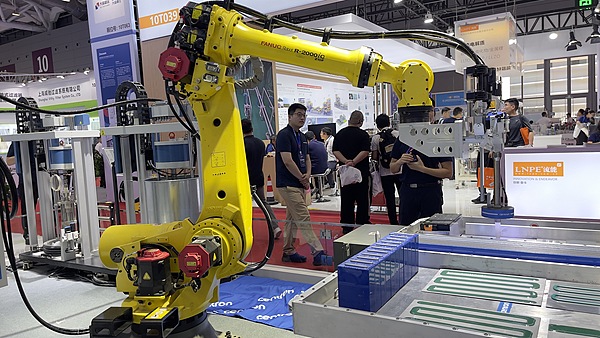
On May 13, 2026, Shenzhen, the 18th Shenzhen International Battery Technology Exchange/Exhibition (CIBF2026) opened at the Shenzhen International Convention Center. Visual China
Currently, General Motors, French company Tiamat Energy, and German company Moll Batterien are still investing in sodium-ion batteries. Moll Batterien is also building a factory, planning to launch its so-called first industrialized production project for sodium-ion battery cells and batteries in Europe next year. However, the scale of these projects remains limited compared to China’s existing and planned production capacity.
Reid said that to expand the supply chain for sodium-ion batteries, each factory requires an investment of at least $100 million, but “almost no such investment can be seen outside of China”.
Sodium-ion batteries also have their limitations. Their energy density is lower than that of some lithium-ion batteries, and their range is relatively shorter under the same conditions when used in electric vehicles. However, these batteries perform well at extreme temperatures, and they offer advantages in terms of safety. Therefore, they are also being considered for applications such as energy storage and data centers that require rapid provision of backup power, besides small vehicles.
UBS expects that sodium-ion batteries may reach cost parity with lithium-ion batteries as early as 2027. By 2030, the price of individual sodium-ion battery cells could potentially decrease by up to 30%. CRU believes that sodium-ion batteries are more likely to serve as a supplement to lithium batteries rather than completely replacing them.
European and American companies are still trying to establish their own supply chains. General Motors has collaborated with Peak Energy to develop next-generation sodium-ion batteries for energy storage, with plans to start mass production in 2028. However, Peak is currently planning to use Asian imports, including Chinese battery cells. Kurt Kelty, head of General Motors' battery business, said that as production increases in the future, they hope to eventually use materials sourced entirely from North America.
Some industry insiders believe that instead of spending huge amounts of money to catch up, it would be better to learn directly from China. A senior executive at a global mining investment firm told the Financial Times that if China has already spent 10 years developing lithium battery technology, then it is better to “learn from them, purchase their technology, and learn how to use it.”
He then asked rhetorically, should the West invest billions of dollars in research and development, aiming to overtake China in the battery sector, or should they use their best technologies to invest that money in real employment and production facilities?