According to a report by the Financial Times on September 20th, Tesla and Chinese electric trucks are making aggressive entries into the European market. At the same time, some analysts question the continued investment in hydrogen fuel cell trucks by European automakers.
However, Volvo Group defends its entry into hydrogen-powered trucks.
Volvo CEO Martin Lundstedt recently said in an interview that even though electric trucks produced by Tesla and Chinese companies are cheaper, it is 'extremely dangerous' for Europe to focus solely on electric trucks.
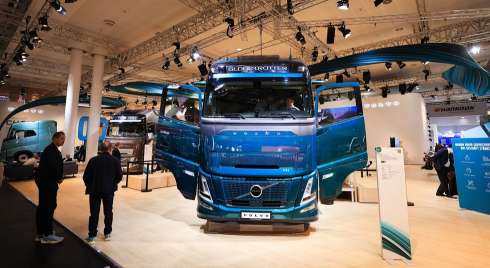
Volvo displayed a heavy truck
Recently, the Middle Eastern conflicts have driven up diesel prices. However, according to the European Automobile Manufacturers Association, in the first half of this year, electric trucks accounted for only 4.8% of new vehicle registrations in the EU, while diesel trucks still made up 92%. According to EU regulations, truck manufacturers are required to reduce emissions by 45% by 2030 compared to 2019. This means that electric trucks need to account for 35% of the market to meet these targets.
Currently, the European heavy truck industry is still severely divided on the path to decarbonization.
Hydrogen truck supporters claim that fuel cells, which convert hydrogen into electricity, are more suitable for trucks with heavier loads, as they can refuel more quickly. Electric truck manufacturers counter that hydrogen refueling stations are too costly, while batteries can now cover longer distances. However, the reality is that the transition to electric trucks is particularly difficult for European truck manufacturers. This difficulty stems from issues such as insufficient charging infrastructure, lagging grid investments, and the cost gap compared to diesel trucks.
The Financial Times states that a major risk faced by European companies is that China will replicate its success in passenger vehicles to electric trucks.
For example, Sany Heavy Industry, China’s largest electric truck manufacturer, plans to sell electric trucks at a 20% lower price than European manufacturers. The company already offers two models in Europe, and plans to launch two more models in Germany, Austria, and Switzerland by the end of next year.
The environmental non-governmental organization “Transport and Environment” warns that if European truck manufacturers do not accelerate their electrification transition, by the end of this decade, they may lose a quarter of the electric truck market to new entrants from China and the United States.
The organization's director said that Chinese brands and Tesla trucks are "good products, reliable, and have much lower operating costs."
"Trucking business very weighs cost," the supervisor warned, "If transportation companies can buy good trucks at lower prices, they will switch. Relying on customer loyalty and service networks to maintain market share will be a high-risk strategy."