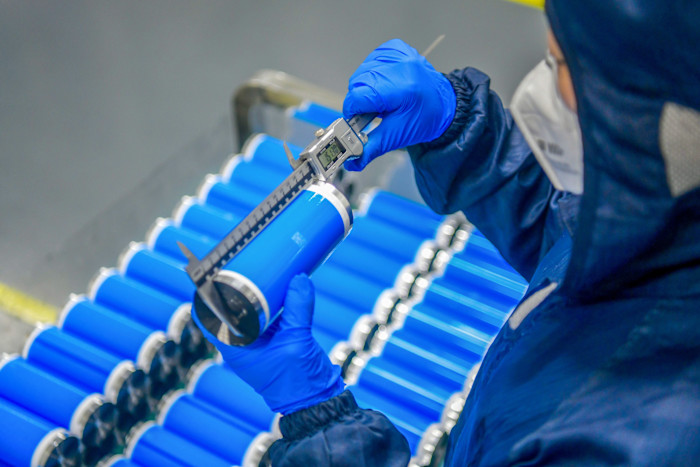
China is a "factory of factories," and it also serves as an important stepping stone for companies to enter global production systems. Henning Rath, CEO of the American company EnerVenue, which develops new nickel hydrogen batteries, told Reuters on September 22 that the company decided to produce in China mainly because the region has abundant professionals and a complete supply chain.
EnerVenue will launch large-scale production at its manufacturing plant in Changzhou, China's eastern city, this coming Thursday. Changzhou is self-proclaimed "the city of new energy in China". “This industrial cluster is the key to our success.” said Las. He pointed out that the local area has a concentration of leading companies in hydraulic, pneumatic and automation fields, plus engineers with the capacity for quick technological innovation. He calls his company's production line "pioneer-type" production line.
Las said that if the factory were not built in China, it would be 'very difficult' to prove that this manufacturing process can be used for commercial-scale production with the company's current funding.
When Ras joined the company in April this year, he made establishing a factory in China a prerequisite for accepting the job offer.
A workshop manager at the Changzhou factory told Reuters that local suppliers usually develop equipment first, and charge fees only after the design plan is adopted. In contrast, foreign suppliers often require advance payments.
He also said that the monthly salary of postgraduate engineers is lower than the salary levels in the United States.
EnerVenue has a research and development department in Fremont, California. The company was founded by Cui Yi, a professor of materials science at Stanford University. His team has developed a new material that can significantly reduce the cost of nickel-hydrogen batteries while maintaining their excellent performance.
In 2023, EnerVenue announced plans to build a factory in Kentucky, with an initial investment of $264 million, and the intention to create 450 jobs. However, one year later, the company abandoned this plan.
Ras said that the previous project in Kentucky was a 'valuable learning experience', but at that time, the technology wasn't mature enough to be put into production.
thereafter, EnerVenue redesigned the batteries and the factory.
Lás refused to disclose the exact construction costs of the factory in Changzhou, but said the costs were between $20 million and $50 million. Currently, about 95% of the production processes at the factory are automated, and by the end of this year, the factory will employ around 400 employees.
He said that the support provided by the Chinese government mainly focuses on approval, certification, and site selection.
According to information released by Changzhou in 2024, Zhou Min, General Manager of EnerVenue Group's Yixin Innovation Energy Technology (Jiangsu) Co., Ltd., said: "Last year, the first project was launched here. After experiencing 'service from the staff at the store', we decided to launch a second project as well, placing the production of core technologies such as electrodes, batteries, and energy storage systems here."
In March of this year, EnerVenue completed a round of financing worth over $300 million, led by Full Vision Capital, a family office owned by Hong Kong real estate tycoon Li Jiade. Las stated that Li Jiade’s larger business group also includes Towngas, a customer of EnerVenue. Other investors include Saudi Aramco and SLB.
EnerVenue's goal is to achieve a 250 GWh annual production capacity this year, which translates to approximately 300 battery units produced daily; by the third quarter of 2027, the company plans to increase its annual production capacity to 1 gigawatt-hour.
The company also plans to build similar factories in North America, the Middle East, and Europe starting from 2028, and will determine the specific locations next year.
However, Ras emphasized that China is a "factory of factories", and also an "important stepping stone" for companies to enter the global production system.
When asked if EnerVenue would build a factory in the United States, Las replied: "We hope to enter the North American market. This will be dependent on legislation and regulation at present."