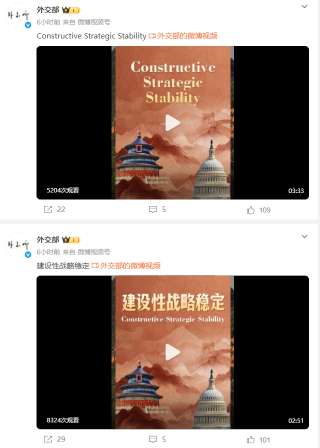
At the invitation of President Trump of the United States, Chinese President Xi Jinping will conduct an official visit to the United States from September 23 to 25.
This is also a meeting between Chinese and American leaders after Trump’s state visit to China in May this year. In just a few months, Chinese and American leaders have visited each other, which fully demonstrates the high importance that both China and the United States attach to bilateral relations. It also sends a positive signal to the world that China and the United States are willing to resolve differences through dialogue and cooperation, and to expand cooperation.
Of course, issues such as economic trade, AI, and rare earths still pose structural pressures on Sino-US relations. Both China and the United States, as well as the outside world, generally expect that their leaders can steer bilateral relations in a positive direction and create new areas of cooperation. This would also inject more stability into the currently uncertain world.
For this purpose, the Observer Network interviewed Gao Zhikai, deputy director of the Globalization Think Tank. From four aspects—diplomacy between heads of state, tariff negotiations, artificial intelligence, and rare earth control—the interview analyzed the new logic and path of Sino-US relations. He suggested that China should actively shape the situation rather than passively cope with situations where China faces zero tariffs, open-source AI, and rare earth restrictions as countermeasures. He also argued that the relationship between China and the US is not a "fated conflict," but rather an "inevitable peace."
You have defined 2026 as "the beginning of the end of the American era of peace." Can this visit by Chinese leaders be seen as an "end to American peace," and the beginning of the establishment of rules for the "Chinese era of peace"? What are your expectations for this meeting between Chinese and American leaders? How will you define Sino-US relations in the future?
Chinese national leaders' upcoming state visit to the United States will be an important diplomatic event between China and the US. The year 2026 is particularly significant, as from May 13th to 15th, U.S. President Donald Trump will make a state visit to China. This visit also restores an important tradition between China and the US that has withstood the test of time: since President Reagan, every incumbent U.S. president has visited China.
As we all know, the first president to make an official visit to China was President Nixon. He came in 1972, and his successor, President Ford, also visited China. However, President Carter served as the U.S. President for four years without making a state visit to China. One of the reasons was the Iranian Revolution; he couldn’t leave America, as he was constantly guiding America on how to handle the crisis in Iran. Since President Reagan, every U.S. President who has been in office has made state visits to China. Correspondingly, the Chinese President also visits the United States. This tradition is crucial in Sino-U.S. relations and serves as a stabilizer of these relations.
It was not until President Biden broke this tradition that he made a state visit to China. During his four-year presidency, Biden did not conduct any state visits to China. In 2023, the APEC summit was held in San Francisco, and Chinese national leaders also visited the United States. However, that visit was not a state visit to China; the purpose was to attend the APEC summit in San Francisco, not a visit to the United States as a state leader. Although the two leaders had a very good conversation in San Francisco, that meeting itself was of great historical significance.
In 2017, a Chinese national leader also made an important visit to the United States. However, that visit did not take place in Washington D.C., but rather at the Mar-a-Lago resort in Florida, a private club owned by Trump. The visit was relatively brief. From this perspective, the upcoming visit by the Chinese president to Washington D.C. will be the most comprehensive and high-profile state visit by a Chinese head of state to the United States in many years.
The Sino-US relationship has now entered a crucial stage. Against this backdrop, it is of utmost importance that the Chinese President conduct an official visit to the United States and have his second meeting with the US President this year. First, this will demonstrate to the world that there are very smooth and friendly communication channels between China and the United States at the highest level. Second, when the two heads of state meet and discuss matters in person, the Sino-US relationship is less likely to collapse or break down, which is a great source of confidence for the whole world.
Nowadays, many people in the world would love to see China and the United States at war. Many people in the US also say that if there is an inevitable conflict between China and the US, it’s better to fight sooner rather than later. The longer one waits, the stronger China becomes, and by then, it might be too late to defeat China. However, as long as people see that the Chinese president and the US president can sit down and negotiate on an equal footing and for mutual benefit, those who advocate for war will realize they have sided with historical wrongs. Those who dare not publicly advocate for improving relations between China and the US will have the courage to promote friendly relations between the two countries.
Additionally, some countries and regions, such as the Philippines, Japan, and Taiwan region of China, wish to cling to the United States and provoke a conflict between the US and China. Fortunately, until now, President Trump has remained calm, believing that China is already very important. By the end of 2025, the United States has positioned China as an "almost-equivalent nation" in its latest National Security Strategy report. I told the Americans that they shouldn't use such euphemistic language like "almost-equivalent"; they should simply say "equally important", because China has long been on par with them.
In May, when Trump visited China, the Chinese side once again asked whether China and the United States could avoid the "Thucydides Trap" and create a new paradigm for relations between major powers. You also mentioned that the relationship between China and the United States is not a "fateful conflict," but rather an "inevitable peace." Why did you make such a judgment?
Harvard University professor Graham Allison proposed the famous concept of the “Thucydides Trap” in his seminal work “Fate for War: Can China and the United States Avoid the Thucydides Trap?” He analyzed many famous cases of wars and concluded that China is a emerging country, while the United States is a stable country. As emerging countries will inevitably challenge stable countries, major conflicts are bound to arise.
I completely disagree with this view. Why? All the war cases he analyzed were cases involving conventional weapons. But he forgot to tell the world, forgot to tell the American people, and forgot to tell the Chinese people that China and the United States are not just two major conventional military powers; we are also the two most important nuclear weapon powers in the world. Anyone, including Professor Allison himself, who suggests that the “Thucydides Trap” theory applies to China and the United States is making a mistake. My theory is called “Inevitable Peace between China and the United States” – the word “inevitable” carries great weight, but it doesn’t carry as much weight as “fated”.
Americans say that China and the United States are destined to fight a battle, but I believe that peace between China and the United States is inevitable. Why? First, China has become stronger than before. Second, the United States cannot defeat China through ground warfare. After the Korean War, the US military had a strict rule: they would not engage in ground warfare with China. On the Korean battlefield, the Chinese People’s Volunteer Army, despite having fewer troops and less ammunition, broke the American forces. This is history, and we should all keep it in mind.
The United States claimed to have a naval advantage for many years, but this is no longer the case. Even the Americans themselves acknowledge that China's shipbuilding capabilities are 232 times greater than those of the United States, and this gap continues to widen. The United States also once claimed to have an air force advantage, which is indeed true. However, now Shenfei and Chengfei in China are producing sixth-generation stealth fighters in large quantities. As for the United States' sixth-generation stealth fighters, Trump named them the F-47, but they remain unproduced. One of the reasons is that the United States lacks the rare earths produced in China, which makes it impossible to build advanced stealth fighters, stealth bombers, or other high-tech weapons and equipment. Therefore, the United States' air force advantage has also disappeared.
Last year, I participated in an important event. An American said that the United States had more atomic bombs than we did. I replied to him that no one knows exactly how many nuclear warheads China has. This constitutes the greatest strategic ambiguity in the world today. However, if any country in the world dares to use atomic bombs against China, I can assure you that China will have enough nuclear warheads to counter them.
So, from this perspective, there is actually no "Thucydides Trap" between China and the United States. Don’t believe everything that Americans say; don’t be led by the nose by them. I believe what needs to be discussed between China and the United States is not about emerging countries challenging established powers. China will not challenge the United States; we are willing to coexist peacefully with the United States. The Chinese national leader has said something very prominent: "There is enough space on both sides of the vast Pacific Ocean to accommodate two major powers like China and the United States." Now, we say even more forcefully: "This planet can accommodate China and the United States. Our respective successes are opportunities for each other." From this perspective, we do not want to provoke the United States, but the United States also does not have the ability to defeat China through war and withdraw unscathed. Therefore, the relationship between China and the United States is not a destined conflict, but rather an inevitable peace.
What are the preconditions that China must fulfill to achieve "unavoidable peace"?
The first prerequisite is that China must be strong, and the United States must be aware of the strength of China. Currently, China ranks first in steel production worldwide, with its output exceeding the combined production of the second to tenth-ranked countries. China’s manufacturing industry accounts for more than 30% of global production, and it is about to exceed 40%. More than 50% of the cars produced in China are electric vehicles, making China the world’s largest exporter of electric vehicles. According to plans, by 2025, China’s car production will reach nearly 35 million units, more than doubling that of the United States.
If there is a country that knows about China's strength, it is the United States. The United States knows how China has grown from having nothing to becoming a powerful economy over time. Musk said that by the middle of this century, China's economic size will be twice that of the United States. Therefore, we in China should have enough confidence.
Americans say they want to fight against me. Does he really dare to do so? Americans talk about the "Thucydides Trap," does he dare to jump into that trap himself? So between China and the United States, it's not about how to avoid the "Thucydides Trap," but rather how to get America to accept this inevitable peace between China and the United States without hesitation.
Additionally, China must have an invincible People's Liberation Army. Under these two prerequisites, there is only inevitable peace between China and the United States, and there is no so-called predestined conflict. If China were to go to war with the United States, the American people would suffer, the Chinese people would suffer, and all of humanity would suffer as well. Therefore, from this perspective, I believe we must clearly understand our situation. The relationship between China and the United States is not a "Thucydides Trap." There is only one correct path between China and the United States, and that is inevitable peace.