A 87-year-old Spanish man was evicted from his apartment, where he had lived for 70 years. This led to a rapid escalation of long-standing housing problems in the country. Protests erupted in many parts of the country, and there were speculations about early elections.
"Spanish left-wing government will face a difficult battle in parliament this Friday." Reuters, U.S. "Politico Europe", and other international media outlets reported on October 2 that Spanish government officials said that if two key housing legislation bills are not passed at the emergency parliamentary session on the same day, Spanish Prime Minister Sanchez may hold an early election."
The direct trigger of this incident was the eviction of 87-year-old retired woman Maricarmen Abascal. Abascal was unable to afford the new rent due to a significant increase in housing costs, and after years of litigation, she was forced to leave her 70-year-old home in Madrid in late September.
This incident further ignited public anger over housing costs. Large-scale demonstrations broke out in many parts of Spain, and some young people set up tents and stayed there for extended periods at locations such as the Puerta del Sol in Madrid.
In recent years, housing issues have become one of the most prominent social conflicts in Spain.
According to data from the Spanish Youth Committee, in the past 10 years, rental prices in Spain have doubled. The average monthly rent has reached 1,176 euros, which is equivalent to 98.7% of the average salary of Spanish young people. It is reported that due to high housing costs, many Spanish young people are forced to live with their parents even after they turn 30.
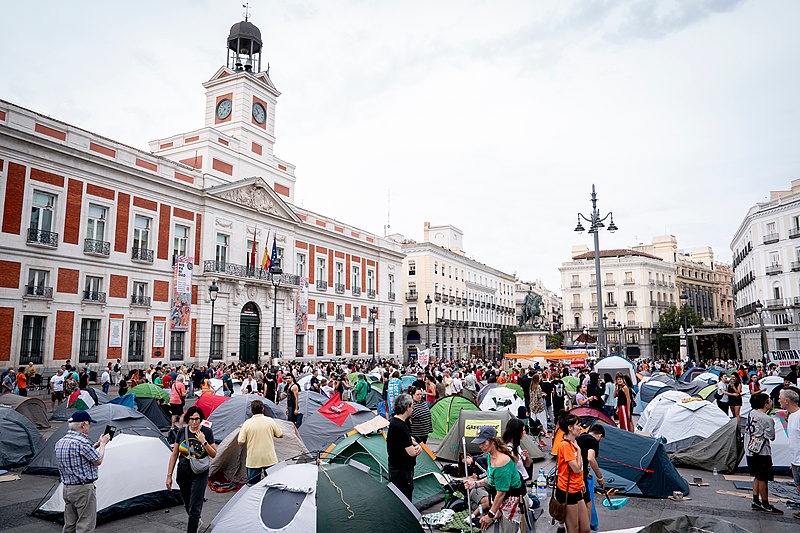
On September 27, 2026, local time, in Madrid, Spain, a large number of people set up tents in Solomar Square, demanding the passage of a housing decree. Visual China
Under pressure from protests, on September 29, the Sanchez government announced two long-overdue housing decrees. One of these decrees extends the protection against eviction for vulnerable tenants until 2030, allowing existing leases that expire by 2028 to be extended by a maximum of two years. The other decree establishes an automatic lease renewal mechanism, enabling eligible tenants to continue living in their homes. This was also one of the main demands put forward by protesters.
But the government soon encountered problems in parliament.
The left-wing coalition government led by Sánchez only held 147 seats in the 350-seat Parliament, necessitating a partnership with smaller parties such as “Together for Catalonia” (Junts) to secure support for legislative initiatives.
Initially, the first decree seemed to have sufficient parliamentary support. However, on the evening of the 1st, Junts, who hold a more conservative stance on property rights issues, announced that they would oppose the measures. Junts has seven seats in the Spanish Chamber of Deputies. Another decree regarding automatic lease renewals was already considered unlikely to pass.
After Junts announced its opposition, the hope that both decrees would be passed by parliament quickly diminished. Sánchez then stated on social media platform X that he would not withdraw the decrees, and called the vote of that day a "moment of truth." The votes cast by lawmakers today will determine how "future generations" will evaluate them.
At the request of the ruling coalition, the vote on the 2nd will be conducted by a show of hands. This means that every member of parliament must publicly state their position on government housing measures.
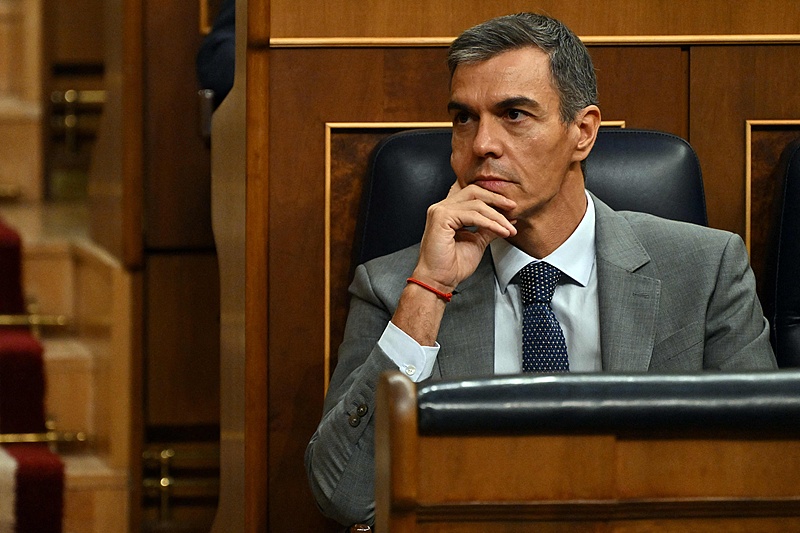
On October 2, 2026, local time, in Madrid, Spain, Spanish Prime Minister Pedro Sánchez attended a special parliamentary meeting of the House of Representatives to vote on the government housing decree. Visual China
Before the parliamentary session on the 2nd of this month began, anonymous government sources told Spain's *National Gazette* that if the law fails to be passed, Sánchez is likely to hold a snap election early.
Spanish Deputy Prime Minister Yoranda Díaz said in an interview with Cadena SER that she has talked with Sánchez, and has not ruled out the possibility of holding elections earlier.
The current term of office for the Spanish parliament is scheduled to end next summer. However, there have been recent speculations that Sánchez might seek an appropriate opportunity to hold general elections earlier.
Sanchez is currently facing multiple pressures. In addition to the housing crisis, his government is also affected by immigration issues and corruption cases involving his family and political allies. The housing problem could be a breakthrough for him to regain political momentum.
Political news website analysis suggests that if the two legislative acts are vetoed in parliament, Sánchez may turn the housing crisis into an election issue, accusing the opposition party of obstructing the government's efforts to address the housing crisis.
Currently, the center-right People’s Party leads in polls, with a support rate of 34%; the far-right party Vox has a support rate of 18%. Both parties oppose measures that challenge landlords’ property rights, prefer to loosen regulations, and encourage private owners to increase housing supply through incentives.
According to reports, at the beginning of the parliamentary session, protesters in Madrid marched towards the Spanish parliament. Over 1,000 national police officers were deployed around the parliament to maintain order.
Leading the protest is the Spanish Tenant Union, which is calling for a national strike and stating that they will continue to occupy the Sol station in the center of Madrid until their demands are met. The Spanish central government has rejected the requests from the Madrid city government and the autonomous region government to remove them from the area.