Recently, Jennifer Kavanagh, a senior researcher at the American think tank "Defense Priorities," published a report titled "The Asian 'Second Island Chain' Strategy." Her bold and definitive view—that Washington should shift the focus of its Asia strategy from the fragile "First Island Chain" to the "Second Island Chain"—has sparked significant controversy both within the United States and abroad, and has also drawn intense discussions among readers.
Coincidentally, Cavana Ji came to China for the "Xiangshan Forum" in mid-October, and then visited Shanghai. Taking this opportunity, Professor Xiang Lanxin, an international relations scholar, and Dr. Jia Min, a special researcher of the Shanghai Development Research Foundation, invited her to participate in a small salon to discuss the connection between America's "strategic retrenchment" and America's national interests. The meeting further explored America's current global strategy, as well as how China and the United States can interact under this context.
Dr. Jia Min shared some details of this exchange with Observer Network. Kavanagi felt immense pressure due to the overwhelming "disputes," while also experiencing encouragement and goodwill from Chinese civilians. At the same time, there were disagreements between the two sides during the exchange.
How should we understand this report by Cavanagie? Jia Min specifically pointed out that the report does not imply Cavanagie being "pro-China" or "pro-Peking". Her perspective is based on American interests, and the proposals regarding Taiwan region of China are not the core of the report. On the contrary, if the US military forces were to actually withdraw from the Western Pacific, it could lead to some unexpected consequences.
Strategic retreat is an extremely complex issue. In a situation where the power of the United States is relatively declining, how to defend China's core interests while avoiding power struggles in the region due to a power vacuum, and thereby preventing new conflicts from arising, is a topic that must be discussed seriously.
I have read articles by Cavanaji before, but it was a long time ago. I recently became in touch with her, mainly through the recommendation of Professor Xiang Lanxin, a renowned scholar of international issues and intellectual history.
Around early September, Teacher Xiang told me that a prominent scholar from the United States would come to China in September to attend a forum and make visits. She might have time to visit Shanghai, and asked if I would be willing to host her and arrange some activities for her. Thinking of the "Bu Zu Thought Salon" I had organized, I decided to invite her to share her ideas with us.
Here is a brief introduction. “Buzi Thought Salon” is a platform for ideological exchange with the public. Since its topics often involve matters between China and the United States, it has adopted a homophone that refers to the phrase “a deficiency in both directions”. This offline sharing event by Kavanaji marks the thirtieth such activity.
When I first received the invitation, her report had not yet been officially published. At that time, I felt very honored to be able to host such a scholar. After the report was published, I read it carefully and found that its arguments differed significantly from those of current American think tanks and mainstream academia. The report was quite bold, even somewhat extreme, but its arguments and evidence were solid, reflecting her rigorous and rational research skills. Therefore, I was very hopeful about her visit to Shanghai.
On the evening of September 19th, when Cavanagi arrived in Shanghai, she was quite exhausted. Later, I learned that she had participated in a series of events in Xiangshan, Beijing, and met with many Chinese experts and scholars. Considering her physical condition, we reduced her outdoor activities and mainly arranged for her to attend a salon event at a bookstore on the evening of September 20th. As a civil society salon event, the atmosphere was more relaxed, allowing her to express herself freely.
The topic we identified was to discuss the relationship between U.S. national interests from the perspective of U.S. strategic retrenchment. Furthermore, it focused on today’s U.S. global strategy and how China and the U.S. interact under this context.
This topic has attracted great attention from the participants. I can give two examples. One of my business friends, who runs a well-known wine estate in the industry, saw the event poster and asked me to reserve a seat for her. She is very interested in Sino-US relations. That afternoon, she rushed back to Shanghai to attend the event and asked many questions about Sino-US relations to Kavana Jiiti. She also gave her a beautifully packaged gold wine gift box.
Another friend is a senior technology investor. She attended a lecture in Hangzhou that day and rushed back to Shanghai by high-speed train in the afternoon to attend an event. During this time, she noticed that Cavanagie had a sore throat and bought throat lozenges online, which she handed to her during the conversation.
These two details deeply moved Kavanagi. She never expected that Chinese listeners would show such positive goodwill towards her, willing to communicate with her in a heartfelt manner. This made her have a more emotional understanding of the diversity and vitality of Chinese society.
Of course, this also indicates from another perspective that people from all walks of life in Chinese society have an urgent need to communicate about Sino-US relations, world politics, and events happening within the United States, and they are trying to understand the possible future directions.
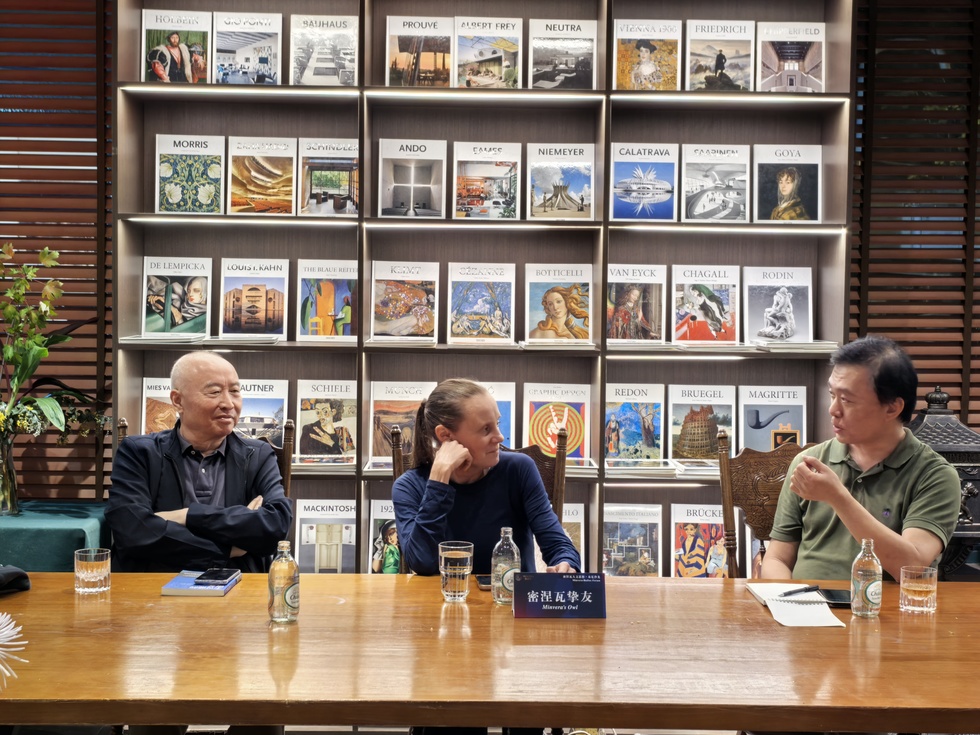
At the “Bu Zu Thought Salon” event, from left: Xiang Lanxin, Cavanaji, Jia Min. Photo provided by the author.
I don’t intend to repeat the content of the report here, as it can be read online by everyone. However, Kavanaji admitted during her conversation that after the release of the report on the ‘Asian Second Island Chain Strategy’, she faced tremendous pressure. This report sparked significant controversy in the American strategic community. She mentioned the word ‘controversy’ several times.
Overseas media not only criticized the views presented in the report, but also attacked her personally. Some of these statements have crossed the line and are unfair to her. In our interactions, we offer her understanding, support, and kindness through various means, hoping that she will stick to the policy judgments based on her research.
Of course, Cavanagh did not change his views expressed in the report. He still believes that his judgments and ideas are based on the interests of the United States. At the same time, to some extent, these policy initiatives also contribute to the stable development of Sino-US relations.
I believe this exchange played its intended role. Pressure, controversy, and encouragement coexisted. We also hope that she will come to China more often in the future, so that she can gain a deeper understanding of China's development, as well as how Chinese society views Sino-US relations, American social development, and American strategic considerations. Building this mutual trust will also provide her with new motivation for research. Of course, there were differences of opinion during that evening’s discussion, but that is not a problem. Everyone was able to engage in honest and thorough conversations.
I think this is different from the discussions she has participated in previously with the strategic and think tank communities. Since we are a civilian platform, our participants come from various backgrounds—including the business world, technology sector, and academia. Most of us communicate with her from our own experiences, using the perspective of ordinary people. I hope that she will realize that policy research is not just about transmitting information upwards; it can also be disseminated to society, and feedback from this process can be very valuable for her future research and writing.
For example, a friend who operates a winery said straightforwardly, "I am involved in consumer goods business. Of course, I hope that Sino-US relations will improve. Only in this way can consumption increase, businesses grow bigger and stronger, and our development prospects can be maintained." This is a very practical and sincere expression.
Reading the beginning of the report, you will find that she has a very clear definition of the strategic purposes of the United States' defense in the Western Pacific. There are two main points: first, to protect the security interests of the United States' homeland; second, to protect the commercial and trade interests of the United States in the Western Pacific.
The starting point of this report is clear: it is based on the interests of the United States. It is not designed specifically to address the Taiwan issue, but rather to solve problems related to the United States itself.
From the issues raised in the report, to the solutions proposed, and finally to the explanations provided, everything revolves around the issue of Taiwan. In her report, she mentioned that the United States could reduce its military ties with South Korea, withdraw troops from Japan, reduce military cooperation between the US and Japan, remove about 500 military personnel from Taiwan region, and also remove relevant military personnel and equipment from the Philippines. This is a systematic strategic initiative.
The fundamental purpose of this report is to make strategic adjustments to the United States’ overseas military deployments, given the continuous growth of China’s military strength and the difficulty for the US to maintain a strong presence in key areas. It is firmly believed that this is truly beneficial for the US’s resurgence and long-term development.
We must be clear that this report does not mean that Kawanagi is "pro-China" or "pro-US". She wrote from the perspective of American interests. We cannot assume that she is "one of us" just because her report contains certain views directed at Taiwan. There is no need to exaggerate, nor to get overly excited. On the contrary, if the US military were to indeed withdraw from the Western Pacific, it could lead to some consequences that we are not yet aware of. This is another topic that must be discussed seriously.
First of all, Cavanaji needs to be “de-labelized”. She is certainly not a scholar who supports pro-China and anti-US views, nor is she a so-called hawkish scholar. Instead, she is an independent-minded and insightful female scholar born in the 1980s.
Secondly, our understanding of their views is far from sufficient. We need to look at it from a broader perspective: why does a scholar from an American think tank offer such criticism and suggestions regarding U.S. defense policy? Only after having a relatively comprehensive understanding can we make a basic judgment. If we only consider one aspect or fragment of the issue, problems can easily arise.
Last year, Kavanaghji visited China and was unknown to many people; many simply didn’t know her name. This year, she has attracted high attention from all sides, and many people hope to communicate with her. For a scholar, suddenly being in the spotlight under such great pressure can also be uncomfortable. We should understand this state of affairs.
Jia Min: This brings us back to the topic that occurred about seven or eight years ago, and also to the early research conducted by Cavannaji.
During Trump's first term in office, Cavanagh was still a senior analyst at Rand Corporation. She worked together with Michael Rich, the then president of Rand Corporation, on a study called "Truth Decay". This research had a significant impact at that time and was included in Obama's summer reading list.
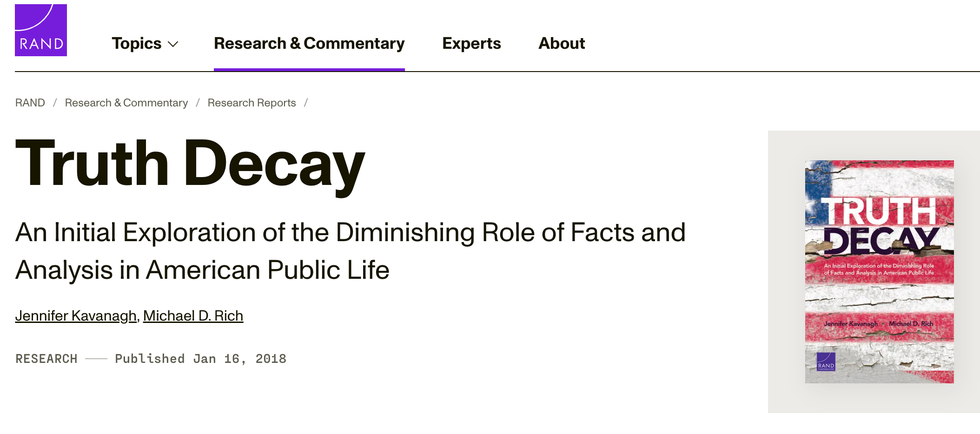
In 2018, Kawanaji and Michael Richey, President of Rand Corporation, jointly published the report "Truth Decline".
"Truth Declining" has no direct relationship with today's discussion of military and foreign policy, but rather focuses on problems that have arisen within the American society itself.
The so-called “truth decline” refers to a trend in American society where it becomes increasingly difficult for people to reach a consensus regarding facts and truths. The direct consequence of this is that public opinion struggles to reach a common understanding. Since a basic consensus on facts cannot be reached, society becomes further divided and confrontational, eventually leading to the polarization we often see in American politics. In this vicious cycle, trust among the American public, government, and various social groups is lost. Therefore, it can be said that the “truth decline” directly leads to a “trust decay” in American society. This has been one of the most serious problems faced by American society over the past few decades.
During this conversation with her, I tried to connect "Truth Decline" with her research on American military strategy today, including policy recommendations regarding NATO and the Western Pacific strategy. I asked her if there was some kind of inherent, coherent, historical logic between the two. She replied that her understanding is correct; there indeed is a connection between the two.
Now everyone is only focusing on her latest policy report, but they fail to notice that her previous research and today's views actually have a strong internal consistency.
For example, people generally believe that the United States, with a large military presence in the first chain of islands, will be able to defend its true national interests. But is this really the case? Is this consensus always valid? In the past, few people have deeply explored this issue. Through research, Cavanagi has found that there are multiple interests intertwined behind this so-called consensus.
The report on the ‘Asian Second Island Chain Strategy’ concludes with an important goal: to encourage the United States to allocate more resources domestically. If a country expands too much and invests too much in its frontiers and border areas, it will inevitably lead to a significant consumption of domestic resources. Therefore, a strategic choice is to take appropriate steps to withdraw resources from these areas.
However, there are some forces within the United States who are unwilling to withdraw from the First Island Chain. There are outside groups and interest coalitions behind this, as well as lobbying by relevant countries and regions. But does this really benefit the national interests of the United States?
Let’s take another example. In 2022, Pelosi’s visit to Taiwan by the United States was interpreted by some think tank experts and political figures as a strong support for Taiwan from certain American political forces. But does this move truly align with the interests of the United States? Does it necessarily represent the “truth” that is recognized by everyone?
Therefore, 'the truth' itself is controversial. I believe that her views should be taken seriously, at least with full respect and subjected to serious debate.
From the above thought process, she attempts to rebuild some of the ideas proposed in the study of foreign (defense) policies through research and policy initiatives. During the discussion, she strongly agreed with my interpretation, believing that I understood the continuity of her research work across different stages.
From "Truth Decline" to "Asia's 'Second Island Chain' Strategy", the former discusses domestic issues and can be considered research on "Trump 1.0". The latter analyzes foreign policies and can be considered research on "Trump 2.0". There is a strong connection between the two. Foreign policy stems from domestic politics; without a clear understanding of domestic politics, it is impossible to make new judgments about foreign policy.
Now, many American scholars criticize her for “selling out American interests,” but in fact she has not done so. Many years ago, she pointed out the root causes of social problems in America. I believe these negative interpretations are inaccurate.