A fire that lasted for several months forced over 610,000 students in Malaysia to stop classes, and even Indonesia's President Prabowo became one of the defendants.
Southeast Asia once again faces a crisis of cross-border smog.
On October 12, nearly 1,200 schools in Johor, Malaysia continued to be closed, with the suspension of classes scheduled to last until the 16th. In some areas, the air pollution index exceeded 200, reaching a "very unhealthy" level. Under the thick smoke, the lives of local people were also disrupted. Reporters from the Straits Times conducted interviews in Johor and found that the dense smog obscured the Indonesian island of Sumatra across the Straits. The originally bustling seaside parks were almost deserted.
The source of the smoke is continuous forest and land fires in Sumatra Island and Kalimantan Island in Indonesia. Faced with complaints from neighboring countries and lawsuits from local citizens, the Indonesian government has invested a large amount of manpower and resources to extinguish the fires. Malaysia, on the other hand, is preparing to discuss the issue of smoke haze with ASEAN.
A country suffers a fire, and many countries are affected. Southeast Asia has been trying to manage cross-border smoke and haze for over twenty years. Why is it still difficult to get rid of this recurring crisis?
For Malaysians, smoke haze from Indonesia is not unfamiliar, but this year the situation is particularly severe.
According to a report by the Malaysian newspaper Star on October 10, the Johor State government has decided to extend the school closure arrangements throughout the state until the 16th, affecting 1,198 schools and 617,258 students. Previously, Johor had implemented school closures from August to September.
Johor State Education and Information Committee Chairman Muhammad Najib explained that the authorities made this decision not only due to the continuous deterioration of air quality, but also considering the wind from the Kalimantan direction from October 13th to 15th, which could bring more smoke into the area.

October 12th, in Parun Kalaya, Central Kalimantan Province, Indonesia, a child and their mother stood on a bridge, wearing masks, looking at the thick smoke caused by forest and land fires. Visual China
In Indonesia, the fires have been ongoing for several months.
According to a report by Reuters on October 7, Indonesia is experiencing the worst forest and land fires season in 11 years. Affected by the El Niño phenomenon, there has been less rainfall and dry weather in some areas. The government previously warned that the fire situation could continue into November.
But if we blame this crisis entirely on the weather, it clearly cannot explain why fires occur every year.
For a long time, some areas in Indonesia have practiced clearing land by burning vegetation. For some agricultural operators, burning the land is cheaper than using machinery, especially in palm oil plantations and other agricultural development processes, where this method offers a significant cost advantage.
The problem is that once the fire gets out of control, it can spread from ordinary vegetation into large areas of forest and peatlands.

October 11th, in Parang Karaya, Central Kalimantan Province, Indonesia, members of the Indonesian “God of Flames” Forest Fire Brigade were fighting a forest fire in the Saba Highlands area. Visual China
Peatlands are a major reason why forest fires in Indonesia are particularly difficult to extinguish. In its natural state, peat layers are continuously saturated with water and thus not easily flammable. However, when land is drained for agricultural development, the groundwater level drops, and the originally moist peat becomes increasingly dry, becoming an easily combustible organic substance.
Unlike ordinary surface fires, peat fires can burn deep underground and continue to smolder. Even when no visible flames are seen on the surface, the fire beneath continues to burn, releasing smoke continuously. Firefighters not only need to extinguish surface fires but also must find a way to re-wet the peat layer.
Research by the Indonesian peatland conservation organization PantauGambut provides a more intuitive explanation. The organization estimates that of the approximately 24 million hectares of peatlands in Indonesia, about 16 million hectares are more susceptible to fires due to ecological damage and declining groundwater levels.
According to Putra Saptian, an activist with the organization, to Reuters on October 5th, peat fires may continue to burn underground for a long time, or even reignite. Therefore, a decrease in the number of fire spots detected by satellites does not simply mean that firefighting efforts have been successful.
It should be noted that the relationship between forest fires and land development cannot be simply attributed to one party deliberately causing fires.
Satellites can detect the location of the fire, but they cannot directly prove who started the fire. Even if the fire is located in an area owned by a business, further investigation is needed to determine the cause of the fire, the ownership of the land, and whether the operator has fulfilled fire prevention obligations.
For the Indonesian government, extinguishing the already occurred fires is certainly important, but what is more difficult is changing the land use patterns that lead to repeated fires.
As for the scale of the fires this year, there is also a significant discrepancy in data.
Environmental organization Auriga estimates that from January to August this year, more than 637,000 hectares of land in Indonesia have been damaged by fires. Another monitoring agency, NusantaraAtlas, estimates the area to be close to 900,000 hectares. These are estimates from non-governmental organizations and cannot be considered as officially confirmed affected areas.
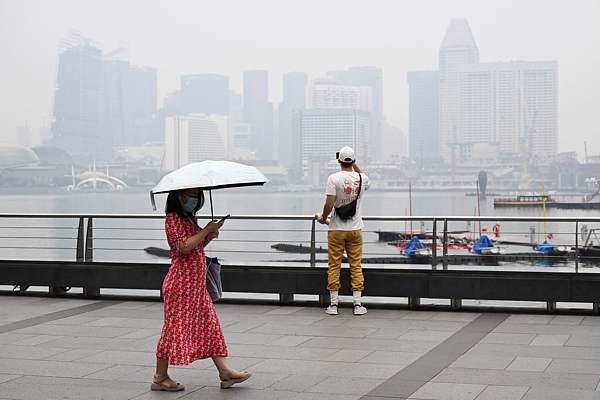
October 12th, Marina Bay, Singapore. A pedestrian wearing a mask (left) walks along the tree-lined street, with buildings in the distance shrouded in smog. Visual China
Smog not only causes suffering in neighboring countries, but also imposes a heavy cost on the Indonesian people.
According to data from the Indonesian Ministry of Health, as of the 12th, there have been 277,075 cases of respiratory diseases related to forest fires reported in seven provinces. This was compared to 113,336 cases on September 9th. Over the past month, the number of cases has more than doubled.
For residents living in fire-prone areas, thick smoke not only indicates poor air quality but also affects schools, transportation, and daily life. In some regions, long-term drought has led to water shortages, which further increases the difficulty of firefighting efforts.
Unfulfilled emotions ultimately entered the courtroom.
In September, indigenous people and civil society organizations in West Kalimantan Province filed a collective lawsuit against the local court, citing President Prabowo and relevant government departments as defendants. They accused them of failing to effectively prevent and control recurring forest and land fires.
On October 7th, the first court hearing of the case took place at the Kundiaj District Court. Since the government did not send representatives to attend, the judge announced that the hearing would be postponed to October 21st.
One of the plaintiffs, Jacobs Kumes, who represents the Dayak community, expressed disappointment at the government's absence. He believes that authorities ignored warning signs before the fire occurred and called for this smoke and haze crisis to be classified as a national disaster. The relevant allegations are currently awaiting judgment by the court.
This is not the first time that the Indonesian public has attempted to hold the government accountable through legal means.
In 2016, seven Indonesian residents sued then-President Joko Widodo and relevant government departments due to a severe forest fire in 2015. The plaintiffs initially received support from the court, but the Indonesian Supreme Court overturned the relevant decision during a judicial review in 2022.
Similar lawsuits occur repeatedly, reflecting that the disputes regarding fire management in Indonesia no longer limit themselves to whether the fire department acts promptly to extinguish the fire.
How should the government regulate land development? Can penalties be effectively imposed on operators suspected of illegal land burning? After a fire, who will be responsible for repairing the damaged peatlands?
These issues are directly related to whether another fire will occur in the future.
The Indonesian government has started to adjust the management mechanisms for peat lands and plans to establish a specialized agency with greater authority. However, whether this reform will be effective remains to be seen.
Expert Nio Man, who once worked at an Indonesian peatland restoration organization, believes that Indonesia has vast peatlands, and it is impossible for a single institution to carry out all the supervision. He advocates that the new institution should focus on coordinating between central and local governments, businesses, and communities, rather than trying to take on all management responsibilities alone.
However, the Indonesian government also emphasized that it has invested a significant amount of resources to deal with the fires. On October 13th, Prabowo requested further mobilization of personnel and equipment, stating that fire fighting is the current priority for the government and must be addressed immediately.
In response to calls from the outside world for accepting international aid and declaring a national disaster, the Indonesian government stated that it still has the ability to control the situation on its own.
In fact, cross-border smog has been a persistent issue in Southeast Asia for quite some time.
From 1997 to 1998, severe forest fires occurred in Indonesia, and thick smoke spread to several neighboring countries, becoming a major regional environmental disaster. Since then, ASEAN has accelerated the establishment of cross-border smoke and haze management mechanisms.
In 2002, ASEAN member states signed the “ASEAN Cross-Border Smoke and Haze Pollution Agreement,” which came into effect in 2003. The agreement requires countries to strengthen prevention, monitoring, information exchange, and emergency cooperation regarding fires. However, Indonesia, as one of the important sources of smoke and haze, did not approve this agreement until 2014.
Over the past twenty years, agreements have been reached and cooperation mechanisms have been established, but smog still appears repeatedly.
Singapore Yusof Ishak Southeast Asian Research Institute Senior Researcher Sharon Sia previously stated in an interview with Asia News that the ASEAN Smokeless and Smog-Free Agreement is essentially a cooperative-based mechanism, emphasizing consensus among member states and respect for sovereignty. If the relevant countries are unwilling to initiate assistance procedures, it will be difficult for other countries to intervene forcefully.
Australian University of Tasmania professor James Qin believes that even if Malaysia and Singapore wish to strengthen the agreement, they still need the support of member countries like Indonesia. ASEAN relies on consensus-based decision-making, and it is difficult to bypass the differences among member countries in related reforms.

On October 8th, a large wildfire burned near a residential area in the Panarun district of Parang Klayan, Central Kalimantan Province, Indonesia. Visual China
This has formed an awkward situation: smoke can easily cross national borders, but law enforcement authority cannot follow.
For example, Malaysia can detect fire points in Indonesia through satellite monitoring. However, to identify the specific responsible parties, obtain land management information, and gather on-site evidence, the cooperation of the Indonesian side is still necessary.
Singapore has attempted to address this issue through domestic legislation. In 2014, Singapore passed the Cross-Border Smog Pollution Act, which allows for the accountability of foreign companies that cause serious cross-border smog pollution under certain conditions. However, even with this law in place, cross-border investigations, evidence collection, determination of responsible parties, and enforcement remain challenged by practical obstacles.
In July this year, scholars Bargaskara Vijaya and Feny Rozi from Indira Gandhi University of Science and Technology published a research in the journal Contemporary Southeast Asian Affairs, introducing a concept that is quite explanatory: “Crisis Absorption”.
Two scholars believe that the ASEAN Smoke and haze Agreement is not effective simply due to poor implementation. Its institutional design is constrained by the sovereignty of member states, differences in interests, and the principle of consensus decision-making. While it allows countries to address recurring crises through diplomatic negotiations and technical cooperation, it lacks a mechanism to enforce fundamental changes in land management and regulatory practices.
In other words, this mechanism helps to control the diplomatic tensions caused by smoke and haze, but it may not be able to eliminate the root causes of the smoke and haze.
A more complex issue is that industries such as oil palms and pulp production in Indonesia are closely linked to international supply chains. Land owners, investors, and product buyers may come from different countries. The commercial interests behind the fires are not solely confined to Indonesia, and governance responsibilities cannot be simply understood as matters for Indonesia alone.
This year’s crisis has once again brought ASEAN to the forefront.
Malaysia and Singapore have proposed providing fire-fighting assistance to Indonesia. At the same time, diplomatic debates surrounding the issue of smoke and haze are also intensifying.
According to Reuters, Sya'id Nagirang, head of Indonesia's government communications agency, previously stated in response to criticism from neighboring countries that Indonesia is not only exporting smoke and haze to neighboring countries; oxygen from Singapore and Malaysia also comes from Indonesia's forests.
These statements were widely spread on social media, and led to reactions from Malaysian politicians.
Malaysia Hope Alliance's leader in Johor State, Andrew Chen Kah Eng, stated that Indonesia must take responsibility and not remain indifferent to the air pollution caused by smoke and haze, including for the Indonesian people themselves. He emphasized that it is unacceptable to allow harmful smoke containing PM2.5 fine particles to pollute the air of neighboring countries.
According to a report by Reuters on October 12, Dominique Xavier Isipa, a spokesperson for the Ministry of Foreign Affairs of the Philippines, the rotating chair country of ASEAN, confirmed that the issue of cross-border smog has been included in the agenda of the foreign ministers' meeting before the ASEAN summit in November. Countries will discuss how to address this environmental problem that continues to affect the region.
Regarding ASEAN's goal of achieving a region without cross-border smoke and haze by 2030, Sharon Yasi, the chief researcher at the Yusof Ishak Southeast Asian Research Institute in Singapore, admitted in an interview with Asia News Network that this is a "challenging goal".
She stated that ASEAN cannot focus solely on extinguishing the fires that have already occurred; it is also necessary to protect peatlands and plan land use appropriately. Especially in Indonesia and Malaysia, if countries fail to coordinate efforts to address issues such as peatland conservation, cross-border smog will continue to occur.

