U.S. President Trump suddenly announced a "energy ceasefire" between Russia and Ukraine, and also struck a deal with Russia for diesel fuel. He intended to cool down the situation between Russia and Ukraine, but this has left Ukraine and its European allies caught off guard.
On one side, Washington demands that Ukraine stop attacking Russian refineries and attempts to alleviate oil price pressures through energy trade; on the other side, Russia has not yet confirmed the ceasefire agreement. Europe is worried that the United States will loosen sanctions too early, thereby weakening Ukraine's negotiating position.
According to reports by foreign media such as Politico, Reuters, and Financial Times on October 13, leaders and senior officials from European countries including Germany, France, Poland, and the UK have repeatedly expressed their opposition to reducing pressure without Russia making substantial concessions first. The European Union also announced the addition of nearly 1,600 new targets for sanctions against Russia, contrasting sharply with the United States' latest measures.
"In less than two years, we have moved from a situation where we had no cards to play, to a situation where we should not play any cards at all," said Ukrainian Foreign Minister Serebria at the Warsaw Security Forum. His remarks won enthusiastic applause from the audience.
Last year, Trump told Ukrainian President Zelenskyy in person at the Oval Office of the White House that he had no options against Russia. Now, as Ukraine continues to attack Russian refineries, Kiev and its European allies believe that Ukraine has accumulated some leverage that could influence negotiations. However, Trump is demanding that Ukraine stop such actions.
On October 11th local time, Trump suddenly announced that Russia and Ukraine had agreed to immediately stop attacking each other's energy infrastructure.
However, this news not only surprised Ukraine, but Russia also did not confirm it explicitly.
Zelenskyy stated that Ukraine was not informed in advance that a formal cease-fire agreement had been reached between the two sides. Ukraine is willing to stop attacking Russian energy facilities, but only on the condition that Russia also stops attacking Ukrainian energy systems.
Russian President's press secretary Peskov said that contacts regarding the energy ceasefire are still ongoing, but did not provide any further details.
Along with the so-called "energy ceasefire," there is also a controversy surrounding a diesel deal struck between Trump and Russian President Putin.
According to the arrangements announced by Trump, Russia will immediately supply over 300,000 tons of diesel to the United States and global markets. In November, another 500,000 tons will be supplied, followed by an additional 1 million tons in the future. Russia also plans to increase its supplies further in the short term. The U.S. Treasury Department subsequently announced the relaxation of sanctions on Russian diesel, allowing eligible transactions to continue until April 7, 2027.
The Trump administration hopes to increase energy supplies through this initiative, alleviate the pressure of rising international oil prices, and create new opportunities for negotiations between Russia and Ukraine.
Ukraine reacted strongly. Zelenskyy described the US-Russian diesel deal as a "birthday gift" for Putin, arguing that relaxing energy restrictions would give Russia more funds for warfare. He also criticized that Ukrainian representatives were discussing peace proposals in Florida, USA, while Washington was simultaneously concluding an energy deal with Moscow, making Kiev feel like they were being used.
Meanwhile, Trump demanded that Ukraine cease attacks on Russian refineries and attributed the increase in US diesel prices to Ukrainian actions.
However, there is still controversy over whether the ceasefire will actually take effect.
According to Ukraine, after Trump announced a ceasefire, Russia continued to launch drone and missile attacks, affecting some energy facilities. Zelenskyy stated that Ukraine has suspended attacks on Russian energy facilities, but he did not see any equivalent actions from Russia.
Russia has a different stance. The Russian Ministry of Defense stated on October 13 that the military operations conducted by the Russian army the night before did not target any energy facilities in Ukraine, but operations against other targets are still ongoing.
Regarding Trump's request to stop attacks on oil refineries, Moscow has previously expressed its welcome. Russia believes that continuous attacks by Ukraine on Russian energy infrastructure affect the country's fuel production and supply, and also exacerbate the tensions in the international energy market.
According to Tasgha, Peskov is positive about the diesel trade between the US and Russia, believing that the arrangements are in line with the economic interests of the international energy market. However, he emphasized that energy trade should not be directly linked to Russia's political stance on the Ukraine issue.
This means that although Russia welcomes a halt to attacks on energy facilities and supports the restoration of some energy exports, it has not made any commitments to make corresponding political concessions in the negotiations between Russia and Ukraine.
For Ukraine, oil refineries are important targets from which it can exert economic pressure on Russia. In recent years, the Ukrainian military has continuously used drones and long-range weapons to attack Russian oil refinery facilities, resulting in some facilities being shut down or operating at reduced capacity.
Therefore, there are still significant differences between the two parties regarding the conditions, scope, and methods of stopping the energy attacks.
Compared to Russia's cautious responses, the attitudes of European leaders are more pronounced.
According to the Financial Times and European News Channel, German Chancellor Merz clearly stated on the 12th that it is 'completely impossible' for Europe to follow suit in diesel trading with the United States and Russia. He emphasized that only by continuing to exert pressure can Russia be motivated to engage in serious negotiations.
French President Macron also stated on the same day that there is currently no factual basis to support changes in Europe's existing stance towards Russia.
At the EU Foreign Ministers' meeting held in Luxembourg that day, EU High Representative for Foreign Affairs and Security Policy Federica Mogherini further emphasized that it is not the time to ease pressure on Moscow. She stated that Europe welcomes a real energy ceasefire, but there has been no sign of Russia complying with the arrangements so far, and the EU will continue to maintain pressure on Russia.
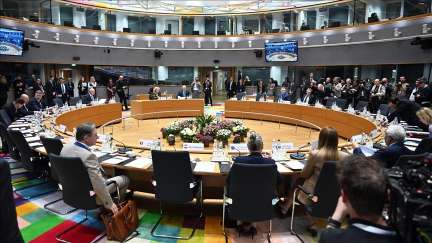
October 12th, Council of the European Union meeting at the EU foreign ministers' conference venue
On October 13th, foreign ministers from several European countries continued to express their opposition at the Warsaw Security Forum held in Poland.
According to Politico, Polish Foreign Minister Szyckarski said that the way to end the war is to persuade the party that initiated the 'aggression' to limit its ambitions, rather than asking the party that suffered the 'aggression' to surrender. He specifically mentioned the actions taken by Ukraine against Russian refineries, stating that these actions are having a real effect.
German Foreign Minister Wadefur also emphasized on the same day that sanctions against Russia should be strengthened, rather than relaxed. He revealed that he had spoken with Russian Foreign Minister Lavrov during the United Nations General Assembly in September, but did not see any signs of the Russian side being willing to end the war as soon as possible.
Results were absolutely terrible. Wade, however, assessed that Russia is not ready for a ceasefire at present.
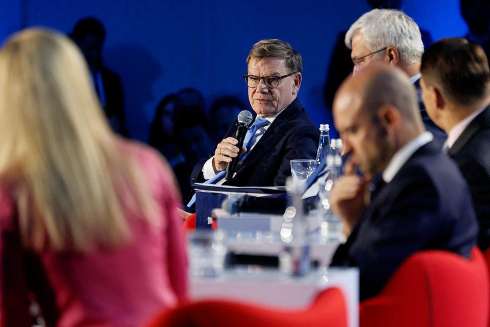
On the 13th, the Warsaw Security Forum brought together foreign ministers from several European countries for discussions.