Indian Prime Minister Modi is facing a "season of troubles." Moreover, compared to previous years, there seems to be an unusually large number of problems this year, and they are particularly serious.
On October 10th, a protest organized by Indian youth and involving several opposition parties took place in New Delhi. Before the rally even began, the capital was placed under lockdown: over 30,000 police officers and 200 paramilitary units were deployed throughout the city, and mobile internet access in the downtown area was cut off. On that day, more than 15,000 protesters were detained—a number provided by Akshay Singh, the leader of the ‘ Cockroach People’ party, at a press conference. Among those detained were several leaders of opposition parties, youth organization leaders, journalists, and lawyers.
Indian media compared this scene to the Indian version of 'The Hunger Games': in the film, the capital city sends so-called peacekeeping forces to various districts, attempting to make the residents fear before any resistance even occurs.

BBC report: Indian " cockroach" leader detained after entering a sealed protest site
This protest stems from irregularities by the Election Commission of India (ECI) during the Special Intensive Revision (SIR) process for updating the voter list: more than 130 million names were removed from the draft list. It was also exposed that Chief Election Commissioner Gyanesh Kumar bypassed proper procedures and arbitrarily changed the rules for voter registration. This quickly ignited public anger. In the eyes of many Indians, the Election Commission has blatantly violated its constitutional duties by using brutal administrative measures to deprive citizens of their right to vote, which is a rare occurrence in Indian constitutional history.
Moody's push for politicalization of state institutions is not a new phenomenon, but why did this incident escalate so much, and how awkwardly did he have to deal with it?
In June 2025, the Indian Election Commission initiated a special revision of the voter rolls. This process began in Bihar and then was extended to the entire country. The law allows for the removal of records of deceased voters, those who have been registered multiple times, or those who no longer meet the eligibility criteria. However, when it comes to disputes regarding residence and qualifications, the parties must be given a reasonable opportunity to present their cases.
For a long time, the Indian People’s Party has associated this action with the elimination of illegal immigrants in order to gain support from the basic electorate. This time, Modi’s government is betting that the political call to revise the electoral rolls, which is meant to ‘protect national interests’, can still mitigate the disputes caused by administrative procedures.
In May this year, the Indian National Congress won the state-level parliamentary elections in West Bengal, further strengthening its confidence in pursuing this policy. Before the elections in West Bengal, 9.1 million voters were removed from the electoral rolls, with a large number of them located in Muslim-dominated areas. The revision of the electoral rolls was continuously questioned, but it did not prevent the victory of the Indian National Congress. This made the Indian National Congress consider opposition voices as a tolerable political cost.
However, recent internal documents have confirmed serious violations by Chief Election Commissioner Gyanesh.
The two other election commissioners submitted written objections at least 14 times within 10 months, stating that some decisions were carried out in the name of the committee without their knowledge or approval. Gyanesh also altered the new voter registration forms without authorization; both commissioners expressed objections in May and requested the changes to be reversed in August, but these requests have not been promptly implemented.
The committee should make decisions collectively according to the law. When there are differences in opinions, the majority should be followed. However, Giyanesh excluded the other two from key decisions. After the internal dissent was exposed, public anger towards Giyanesh rapidly escalated.
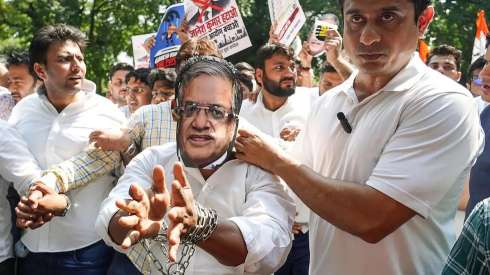
In New Delhi, a young Congress party protester wore a mask of Chief Election Commissioner Gyanendra Kumar. Handcuffed with chains, he participated in a protest march, demanding the commissioner's resignation. Indian media
This anger quickly targeted Modi, as Gianesh was a trusted man who was personally promoted by him and Interior Minister Amit Shah.
Gyanendra once drafted the Jammu and Kashmir Reorganisation Bill, and also played a role in establishing the Rammohan Temple Trust. He was involved in the most critical political decisions of the Shiv Sena party. He was a senior bureaucrat trusted by Modi and Shah, loyal and responsible for key political tasks. Later, he became a member of the Election Commission and was promoted to Chief Commissioner. Such a trusted advisor is a serious violation of regulations, and Modi cannot shirk responsibility. Continuing to support Gyanendra means taking on the public's accountability pressure personally.
Procedural justice is the most basic expectation of the Indian people towards the democratic system. No matter how poor the government's performance, voters can still demand changes through voting. The violation by the election committee in removing voters' names directly undermines this guarantee, and the government's harsh response further deepens public disappointment.
Indian political analyst Roshan Kishore questioned: If a person loses benefits or a means of livelihood, they can still punish the government through elections. But what can voters do if they are deprived of the right to vote? The detained top online celebrity Dhruv Rathee described the situation as an “undeclared state of emergency,” criticizing Modi for being even more unreasonable and cruel than former Prime Minister Indira Gandhi.
Another important change in this protest was the joint pressure exerted by the youth movement 'Crab People’s Party' (CJP) and several opposition parties. Political forces that were previously wary of each other found common ground in electoral accountability.
On one hand, after protesting over the leakage of exam questions in July, the ‘Rotten Party’ has been looking for new issues to continue mobilizing. The previous protests led by the ‘Rotten Party’ forced the Minister of Education to resign, which has strengthened their confidence in continuing to exert pressure.
Co-convener Ashutosh Ranka revealed that the first organizational meeting after the protest decided to expand the demands, and said, "There is nothing more urgent than reforming the electoral committee." The exposure of internal documents provided an opportunity for further action.
On the other hand, the controversy over the voter registration list forced the opposition party to abandon its mistrust of the ‘rats party’.
The Congress Party and others previously worried that the youth movement would take away their political influence, and some even accused the 'Scorpion Party' of being a product of the Central Intelligence Agency's interference in India's internal affairs. Now, with their supporters losing their voting rights, it becomes difficult for the opposition party to gain seats, even if they might win public opinion. The threat to their political survival has forced them to unite.
This time, youth and student organizations from several opposition parties stood at the forefront of the protests. Arvind Kejriwal, leader of the AAP party, Mamata Banerjee, leader of the grass-roots Congress party, and Pinarayi Vijayan, leader of the Indian National Congress (M), were all arrested. The strong suppression by the Modi government has further strengthened the willingness of various parties to work together.
From the current situation, this struggle may continue to deteriorate, evolving into a battle of sustained depletion of Modi's political capital.
Eurasia Group's Indian analyst Rahul Bhatia believes that Modi is most likely to 'create a facade of normalcy' and continue to use tough measures to prevent protests from escalating. With the resignation of key officials, the government will step back in turn, and this will encourage more forces to engage in ongoing protests and seek accountability. Therefore, Modi is more willing to prolong the situation.
However, the opposition forces shifted their tactics after the rally was disrupted, turning to dispersed demonstrations and bringing the roster dispute to court. The protests did not diminish with the suppression. What determines whether Modi can win by delaying is whether the opposition parties can withstand the pressure and continue to organize and mobilize. As the protests continue to intensify, protecting Gyanesh will continue to drain Modi’s support, and delaying further actions may become ineffective in halting the situation.

