At 8 o’clock on October 11th, the Korean container ship 'Pan Star Acreo' arrived at the Busan port.
50 days ago, it departed from Busan New Port and crossed the Arctic Circle, passing through Felixstowe in Britain, Rotterdam in Netherlands, Gdańsk in Poland, before returning to South Korea. From Busan to its first European port took 21 days, saving about 10 days compared to sailing through the Suez Canal.
On the 13th, the South Korean government held a welcome event for the return voyage in Busan, and used the data collected during this voyage to evaluate the commercial feasibility of operating routes around the Arctic.
For Lee Jae-myung, the significance of this ship goes beyond simply shortening a journey. The South Korean government hopes to make the Arctic route operational by 2030 and to develop Busan as an important maritime logistics hub connecting Northeast Asia with Europe.
Busan wants to become a shipping hub in the Arctic. What is its biggest drawback? And what does this mean for China?
South Korea's interest in the Arctic Route did not begin with Lee Jae-myung.
In 2013, the ship rented by Hyundai Glove Vision in Korea used the Northern Sea Route to transport Russian naphtha to Korea. In 2016, Korean ships also carried out related voyages. However, these were sporadic and one-time cargo transport efforts. Over the past decade, Korea has yet to establish a stable container transportation network between Asia and Europe in the Arctic region.
Lee Jae-ming wants to change this situation.
In August 2025, the South Korean government clearly proposed to carry out trials of the Arctic shipping route. On July 16, 2026, when reporting the work plan for the second half of the year to Lee Jae-myung, the South Korean Ministry of Oceans and Fisheries once again listed the development of the Arctic shipping route as a key task.
Why is it now? Two reasons.
Firstly, traditional maritime routes between Asia and Europe are becoming less and less reliable. The situation in the Red Sea, regional conflicts, and supply chain risks mean that for export economies that rely on maritime transport, having an additional route provides an extra layer of protection.
Secondly, Chinese companies have already started transporting containers to the Arctic. The urgency of this matter is clearly understood by South Korea.
Of course, Korea's actions are not just about 'seizing a shipping route'. In Korea itself, the Arctic shipping route has been given an even more important role: it serves to stimulate the economy in the southern region.
For a long time, South Korean economic activities, population, and high-end services have been highly concentrated in Seoul and the surrounding capital area. Successive governments have tried to address this structural problem, but with limited success. The plan proposed by the Lee Jae-myung government for the development of the southern marine economy aims to make Busan a international logistics center, while leveraging the shipbuilding, energy, and manufacturing industries in Ulsan and Gyeongsangnam-do to create a marine industry cluster that can compete with the capital area.
The division of tasks is as follows: Busan serves as an international shipping and logistics hub, while Ulsan focuses on shipbuilding, automotive manufacturing, petrochemicals, and energy industries. Gyeongsangnam-do specializes in marine equipment and related manufacturing industries. The Arctic shipping route can be regarded as a key focus of this strategy.
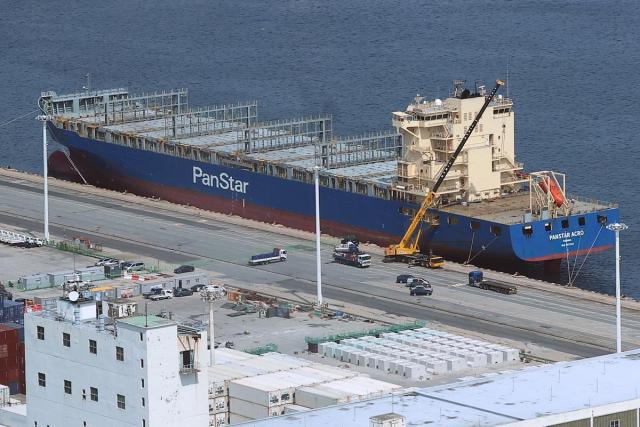
On August 20th, the 2800 TEU container ship “Pan Star Akro” was docked at Pusan North Port during a trial voyage on the Arctic route. Asia Daily
If shipping routes can be commercialized, Busan may gain new international freight services; Korean shipbuilding companies may expand their market for polar ship design, construction, and maintenance; insurance, finance, storage, and information services related to shipping are also likely to benefit.
In response to this, the South Korean government has enacted specific laws. The Special Law on the Promotion of Arctic Shipping and the Cultivation of Related Industries was announced on June 16, 2026, and is scheduled to be implemented on December 17. The accompanying systems involve development planning, supporting institutions, and the cultivation of professional talents. This is not a trial; it is a long-term initiative.
Another point worth noting is that in the Korean-American economic and trade cooperation, South Korea has proposed the "Making American Shipbuilding Great Again" (MASGA) initiative. It hopes to expand its cooperation with the US shipbuilding industry by leveraging its technological advantages in high-value-added ships, LNG transport vessels, and marine engineering. MASGA is not an Arctic shipping project; therefore, the two should not be equated. However, both policies point in the same direction: to utilize the advantages of the maritime industry to expand international markets and industrial influence.
South Korean companies have previously participated in the construction of LNG transport ships for transportation to the Arctic regions in Russia, and have also gained some experience in Arctic shipbuilding technology. While these capabilities cannot directly guarantee profitability in Arctic container shipping routes, they may help South Korea enter more segments of the Arctic shipping industry chain.
Therefore, the Lee Jae-myung government is betting on the Arctic route, not just to make Korean cargo ships arrive in Europe more quickly. A deeper goal is to find new growth opportunities for Busan and the southern Korean marine economic region through a new passage.
But the problem lies here: If this route itself lacks commercial sustainability, can it still meet the expectations of the southern economic region?
From the perspective of the port base, Busan is not without its advantages.
It is an important international container transfer port in Northeast Asia, long-term responsible for the import and export transportation of goods from South Korea, as well as the international transfer services for goods from China, Japan, and other neighboring countries. Unlike ports that rely solely on domestic sources of goods, Busan's real strength lies in combining goods from different countries and ports, and then transporting them via large ocean routes around the world.
This is also the reason why South Korea wants to make Busan a hub for Arctic shipping.
For some Chinese coastal ports and Japanese local ports, the local export volume may not be sufficient to support intensive direct European oceanic shipping. Using feeder ships to transport goods to Busan, and then transferring them onto international routes, has been a long-standing commercial option. Therefore, South Korea does not need to build a Northeast Asia freight network from scratch. It can utilize the existing shipping services, freight forwarding companies, and international customer resources in Busan to organize supplies for the new Arctic routes.
This time, Panxing Group is responsible for the trial flight mission. They already operate shipping and logistics services connecting China, Korea, and Japan. Having customers, they have a foundation for promoting new routes.
But here comes the question: Can the advantages of traditional international transshipment directly translate into the competitiveness of Arctic shipping?
The answer is not certain. The situation regarding the fundraising for the cargo on this test flight has made the difficulties clear.
Before departure, the operating party planned to collect approximately 1,300 standard containers of goods. In reality, they collected 737 standard containers of export goods, which is about 57% of the target. It should be noted that this does not mean that the overall loading rate of the ship was 57%, as the target for collection and the total capacity of the ship are two different things.
For this one-time government-subscribed exploratory voyage, it cannot be simply judged as a failure. However, it does raise a key question: If multiple voyages are to be conducted each year in the future, or even if stable regular shipping services are established, will South Korea continue to find enough customers?
It should be noted that container shipping is different from the transportation of single-item goods. Line carriers not only need to find cargo for individual voyages, but also must ensure a relatively stable transport demand over multiple voyages. Whether exports in the European direction can balance with imports on the return journey will also affect the utilization rate of ships and the cost of empty container allocation.
In addition, seasonal factors need to be taken into consideration. During the seasons when navigation is feasible, shorter voyages may help shipping companies save time and fuel. However, due to changes in ice conditions, ships may need to adjust their routes, reduce their speed, or even fail to navigate as scheduled. Additional insurance for ice zone navigation, the technical requirements of ships, and costs related to safety measures also need to be factored in.
This trial voyage demonstrated the uncertainty of the ship’s schedule. The entire journey took 50 days, exceeding the expected 40 to 45 days before departure. The Korean government stated that it will analyze data such as the distance traveled, duration, fuel consumption, and costs to determine the feasibility of future commercial operations. The exact reason for the delay needs further verification, and it cannot be attributed solely to Arctic ice conditions. However, for export companies that require strict scheduling of production and delivery times, the reliability of the route is just as important—if not more so—than transport speed.
Busan also faces another challenge: the Arctic route may change the existing logistics logic for transshipment.
In the traditional Eurasian shipping system, some goods need to be loaded at large hub ports. However, if Chinese ports can directly organize enough cargo and ship it via the Arctic route to Europe, Chinese export enterprises may not need to go through Busan additionally. For ports like Shanghai and Ningbo Zhoushan, which have a vast manufacturing hinterland and an international shipping network, there is sufficient basis for directly establishing Arctic routes with sufficient cargo supply.
For some ports with dispersed cargo volumes and a lack of suitable direct flights, Busan can still play a role in gathering and transshipping goods. This means that the competition between Busan and Chinese ports is not about which port has the larger throughput, but rather about which port can provide more suitable transportation solutions for specific goods.
The most practical strategy in South Korea might be to rely on its own exported goods to further attract goods from Japanese local ports and some Chinese coastal ports, thereby forming a cross-border collection network. However, whether this model can work ultimately depends on overall freight rates, voyage frequency, and delivery timeliness.
Therefore, this trial voyage demonstrated the feasibility of Korean container ships carrying goods between the Arctic and other destinations during certain seasons. However, the real challenge lies in proving that this route has continuous commercial value. And this latter issue cannot be resolved solely by government decisions.
