According to the Ministry of Foreign Affairs, at the invitation of the French government, Chinese representatives attended the 'Global Convergence for Growth Summit' hosted by France via video conference on June 11.
This meeting, held just before the annual summit of the G7 leaders, was once described as a move by French President Emmanuel Macron to use the G7 to gain influence over China. According to Politico.eu, an European edition of the Politico news website, the Élysée Palace quickly packaged this meeting, with Chinese participation, as a “victory”. Some officials claimed it was evidence of “success” for the G7 summit next week.
However, in the view of many analysts, France's actions are purely for its own amusement. France attempts to use this meeting to address the issue of global economic imbalance, with a focus on China's export expansion policies. But this dialogue lacks any real breakthroughs, and China has no interest in making any compromises just to comply with France.

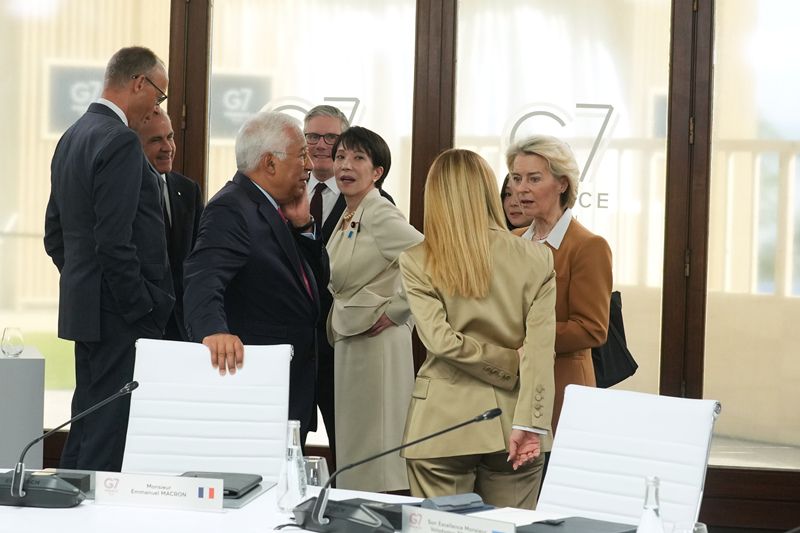
On June 11 local time, in Paris, France, French President Macron hosted the “Global Convergence for Growth Summit” at the Élysée Palace.
According to Xinhua reports, German Chancellor Merz, Canadian Prime Minister Trudeau, and high-level representatives from the United States, Brazil, India, Italy, Japan, South Korea, and the United Kingdom, as well as heads of EU institutions and the International Monetary Fund, attended this meeting.
Although the majority of participants at this meeting sent only senior representatives, Politico.eu focused solely on China’s challenges, and speculated that the Chinese representatives were using diplomatic etiquette to avoid attending the meeting, thereby showing a lack of commitment to this consultation. Elvire Fabry, an expert in trade affairs from the Jacques Delors Institute in France, also agreed that this would ‘lower the importance of the issue’.
"The G7 expert group T7, chaired by economist Agathe Demarais, stated that 'China has no interest in altering its entire economic model to make the French presidency of the G7 look good.'"
Obviously, China has no interest in discussing this matter with the G7. She added simultaneously.
DeMarlais is also a senior policy researcher at the Council on Foreign Relations. She believes that the upcoming lakeside summit in Évian next Monday (the 15th) will not achieve any breakthroughs in addressing issues related to China's influence. "It seems difficult for them to reach a consensus."
According to reports, an unofficial source familiar with the preparations for the G7 summit believes that France’s proactive approach during its chairmanship of the G7 is akin to extending an ‘olive branch’ to China. However, he acknowledges that the G7 is not the ideal forum to pressure China into changing its trade policies.
Previously, an official from the European Commission also stated that France’s initiative to approach China was a "good idea," but the "formulation was not appropriate."
"The G7 is not a neutral platform," the official said. "China is certainly happy to see the G7 soften its rhetoric, but will not be willing to accept the admission (of 'surplus capacity') as a cost."
As the current G7 rotating chair country, France has made addressing 'economic imbalances' a core goal, and has taken a more moderate stance on issues with China. French officials believe that insufficient investment by the EU, excessive consumption by the United States, and what they call 'overcapacity' in China have collectively contributed to the current trade imbalance.
Last month, the G7 finance ministers concluded a meeting in Paris. French Economy and Finance Minister Roland Lesueur stated that France wishes to abandon the practice of "mutual accusations" and engage in communication with all partners, including China. At a press conference, he said, "Global imbalances are... unsustainable. They are widening and are persistent. This situation must be stopped."
At this meeting, France also emphasized a concept of 'equal distribution of benefits': instead of publicly criticizing China, it used the neutral term 'global economic imbalance' to frame the issue. At the same time, it pointed out that the United States also needs to reduce its budget deficit, and the European Union should increase investment. It was argued that all parties have responsibilities.
But France has always been the most active supporter of EU measures to reduce the trade deficit with China. Paris led a coalition of five EU member states in calling for the introduction of new trade defense tools to counter China’s export advantages. Macron recently urged the EU to expand its own trade enforcement powers, similar to those of the United States, in order to cope with Chinese competition.
This week, when Macron returned to his hometown of Amiens to inspect the tire factory, he continued to advocate for imposing additional tariffs and implementing EU's policy of prioritizing domestic production in order to resist competition from China. He argued to the workers that "this is not protectionism, but rather a form of fair protection."
However, according to Bloomberg, the industry generally expects that G7 countries will have difficulty reaching an agreement on specific actions. Some scholars assert that they do not believe anyone expects China to accept a G7 statement without further effort.
The so-called 'overcapacity' and 'trade imbalance' used by the US and Europe to accuse China is actually not a new issue. Xinhua News Agency once pointed out accurately that the so-called 'overcapacity' is essentially 'capacity politics', a common tactic used by some economies to maintain their developmental advantages and to prevent emerging countries from 'overtaking them on a curve'.
In response to the European accusations regarding "trade imbalance," a spokesperson for China's Ministry of Foreign Affairs also emphasized that China never deliberately pursues a trade surplus. The trade balance between China and Europe is an objective result of the combined effects of industrial structure, industrial division of labor, trading methods, and external factors. In recent years, the EU has tightened restrictions on exports of high-tech products to China, which is a direct cause affecting the potential for EU exports to China and leading to trade imbalance. If the EU truly wants to address the trade imbalance, it should not blame China but should lift the export restrictions on China.