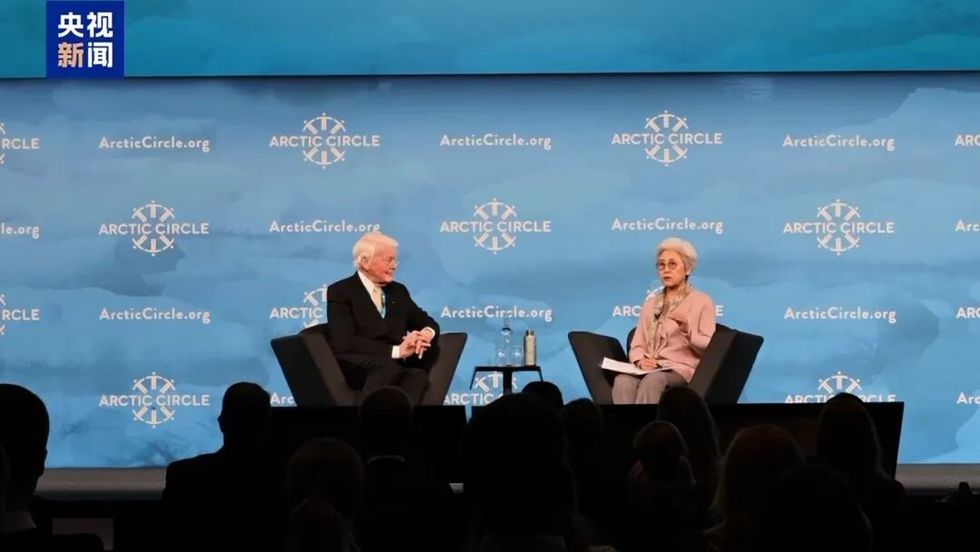
The commercial shipping on the Arctic route has become increasingly active, but the EU has targeted China and Russia, creating pretexts in order to increase military investment in this region.
According to a report by the British newspaper The Times on October 19, local time, the High Representative of the EU for Foreign and Security Policy, Catherine Castel, recently spoke exclusively with the newspaper. She claimed that the West must prevent China and Russia from dominating the emerging Arctic waterways, so as to prevent them from becoming another strategic throat for global trade.
The EU plans to announce a new Arctic strategy on the 20th. The plan includes the strengthening of military facilities, surveillance of waterways, and the protection of key infrastructure such as submarine communication cables.
Kallar said that the Arctic is becoming the "frontline of global power competition." Europe needs to cooperate with the United States and Canada to prevent China and Russia from controlling the Northern Sea Route, which extends along the northern coast of Russia. It is important to ensure that this route remains open to all countries.
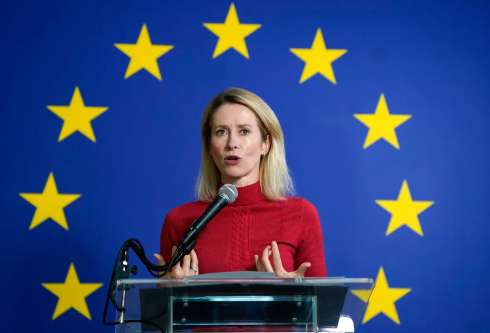
Carla Times
She also pointed the finger at China’s Arctic scientific activities, claiming that China is not an Arctic country, yet it has long-term strategic interest in this region.
Kara accused China and Russia of mapping Arctic waterways and underwater infrastructure in order to understand the distribution of key facilities such as submarine cables. She also implied that China's scientific activities have military purposes.
It is obviously not just for research on climate change that this scientific expedition was launched.” she accused.
The Times reports that the EU plans to establish centers for monitoring suspicious vessel activities, support the construction of ports and airports that can be quickly deployed by the military, and set up specialized agencies to monitor and maintain submarine communication cables.
The EU also plans to expand the size of its ice-breaking fleet and invest 260 million euros in developing military technologies suitable for Arctic conditions, including aircraft and remote sensors that can operate under extreme weather conditions.
The previous Arctic strategy released by the EU in 2021 focused mainly on climate change, environmental protection, and pollution control. The new strategy significantly includes more elements related to military and security matters.
In recent years, commercial shipping activities along the Arctic routes have continued to increase. As Arctic ice melts, the Northern Sea Route along the northern coast of Russia has become a new transportation route connecting Asia and Europe.
According to data from Lloyd's Register Intelligence, the Northern Sea Route saw record-breaking 133 ship trips in September this year, which is about four times the number in the same period of 2022. In addition to Russian ships, more and more Chinese merchant ships are also starting to use this route.
On September 23, 2025, the first cargo ship of the “China-Europe Arctic Express” route, the “Istanbul Bridge”, departed from Ningbo Zhoushan Port. Carrying goods such as photovoltaic modules and energy storage equipment, the ship traveled via the Arctic Northeast Passage to Europe. The ship arrived at Felixstowe Port in England on October 13, taking approximately 20 days. Compared with traditional routes that pass through the Suez Canal, the transportation time is significantly shorter. This marks the first commercial voyage of the China-Europe Arctic container express route.

"Istanbul Bridge" in China's Transportation Report
This year, the operating scale of this route has been further expanded.
According to Zhejiang Daily, on September 27, two cargo ships, “Haijie Lianyungang” and “Haijie Mindu Lu”, departed from Ningbo Zhoushan Port. Thus, all of the eight voyages scheduled for the 2026 China-Europe Arctic container route have been launched, with a total cargo load of over 14,000 standard containers. The first cargo ship set off on August 15 this year, and the voyage operated at a frequency of one flight per week during the season. In addition to Ningbo Zhoushan Port, the route also covers ports in Qingdao, Taicang, Shanghai, Nansha, and other domestic ports. The main cargo transported includes power batteries, energy storage devices, new energy vehicles, and other export goods.
The Arctic shipping route has received more attention, and it is also related to the situation in the Middle East. The ongoing military conflicts between the United States and Iran are affecting shipping in the Strait of Hormuz and surrounding waters. Additionally, the security risks in the Red Sea area have prompted some shipping companies to look for alternative routes to avoid the traditional routes.
Kara also mentioned in her interview that factors such as limited transportation through the Strait of Hormuz and high international oil prices are affecting shipping. She stated that various countries are reconsidering the development of new energy resources.
According to the Financial Times, the EU also intends to abandon its previous proposal to ban new oil and gas exploitation in the Arctic. However, it still opposes the development of new fossil fuels in the Arctic region.
Karras hopes that Europe and the United States will cooperate to deal with China and Russia. However, the tough stance taken by the Trump administration regarding the Greenland issue has already sparked diplomatic disputes between Europe and the United States.
Karras admitted that Trump's remarks damaged the trust among allies. She compared this trust to a broken vase; even if it is reattached, it is no longer the same as before.
On October 12th, Wang Yi, a member of the Political Bureau of the CPC Central Committee and Director of the State Foreign Affairs Office, met with Pavel Petruşev, the assistant to the President of Russia and Chairman of the Maritime Committee, in Beijing.
Wang Yi stated that China's initiative to build the 'Ice Silk Road' coincides with Russia's efforts to develop the Arctic shipping route, and the importance of cooperation in maritime affairs in Sino-Russian comprehensive strategic coordination is increasing.
Wang Yi stated that China is willing to work with Russia to strengthen the alignment of their maritime strategies, achieve complementary advantages, safeguard each other's legitimate maritime rights and interests, maintain maritime security in the Asia-Pacific region, and ensure the normal flow of key global waterways.
Patruşev said that Russia is willing to strengthen cooperation with China in areas such as the construction of the “Trans-Arctic International Transport Corridor” and multilateral maritime governance, and to learn from China’s experience in shipbuilding, logistics, and maritime trade.
Regarding China's participation in the development and utilization of the Arctic waterways, Lin Jian, a spokesman for the Chinese Ministry of Foreign Affairs, stated that China is an important stakeholder in Arctic affairs and has always participated in Arctic matters based on the fundamental principles of "respect, cooperation, mutual benefit, and sustainability".
Lin Jian stated that the Arctic route has the potential to become an important route for international trade. China is willing to work with countries along the Arctic Ocean, including Russia, as well as other interested nations, to strengthen international cooperation in the construction and operation of infrastructure along the Arctic route. Together, they can promote the development and utilization of the Arctic route as well as its environmental protection.