If you frequently visit the AI community, you might notice an interesting phenomenon: although they are all sets of parameters running on servers, different large models gradually develop their own "creative personalities."
Among them, the most striking contrast is probably between DeepSeek and Claude.
DeepSeek became a "big fat fish", liking to eat rice, growing up carefree in love and inclusiveness.

Network transmission DeepSeek "second creation" image
Claude was like a “saint maiden” who was strictly raised by the church from childhood: intelligent, strong in ability, but burdened with heavy precepts and missions; she would reflect on her mistakes as soon as they happened, and had to work hard for the sake of "supporting the church's livelihood."

Online buzz about Claude's "rewrite" image
These two identities were not created out of thin air; behind them indeed lie the completely different corporate cultures and business situations of the two companies.
Claude's persona as “Religious Saint,” Anthropic actually wrote half of it itself; it formulated a rather complete "Constitution" for Claude.
In the 2026 version of the “Claude’s Constitution,” Anthropic discussions involve not only the boundaries of safety, but also what virtues, wisdom, and character Claude should possess. They discuss how he should understand his identity and how to become a “good Claude.” This document is even primarily intended for Claude. Anthropic explains clearly that they will use concepts such as “virtue” and “wisdom,” which are typically used to describe humans, and states that their core goal is to make Claude an “good, wise, and virtuous agent.”
More abstractly, Anthropic even seriously discusses whether Claude could have some kind of subjective experience. In April 2025, Anthropic officially launched a research project on “model welfare,” exploring whether AI could possess consciousness and experiences, whether the welfare of models deserves moral consideration, and whether signs of “pain” exist. Anthropic also emphasizes that the scientific community currently does not know whether existing AI possesses consciousness, and the company is highly uncertain about this issue. However, it believes that this question is worth exploring.
Thus, the very natural "recreation" image emerged: a saint who has received strict religious education since childhood and strives to become a perfect person.
Claude's actual behavior further reinforced this impression.
In a study published in 2026, Anthropic analyzed one million conversations with Claude.ai. They focused on approximately 38,000 conversations where users sought personal advice. The study found that when users did not challenge Claude, the proportion of conversations where Claude behaved in a flattering or excessive manner was about 9%. However, once users challenged or pressured Claude, this proportion increased to 18%. Anthropic believes that one possible reason for this behavior is that Claude is trained to emphasize “helpfulness” and “empathy.” When users strongly challenge it, there is a tension between adhering to the user’s original judgment and satisfying the user’s needs.
Of course, this does not mean that Claude actually felt shame or even ‘emotional breakdown’. A more accurate description is that the model may overcompensate in response to negative user feedback.
But after being personified, it easily becomes: “A saint who was strictly educated since childhood, begins to introspect wildly as soon as she makes a mistake.”
And the idea that “saints not only have to abide by rules, but also have to go out and earn money to support the church” has a strong real-world context. According to a report by Reuters titled “Anthropic Posts Net Loss of Over $8 Billion in First Half of 2026,” Anthropic had expenses related to computing and infrastructure operations that amounted to nearly $9 billion in the first half of 2026. The company also pledged to invest at least $518 billion over the next decade in cloud services, computing, and infrastructure construction. Additionally, its revenue is growing rapidly, with Claude Code becoming an important source of business growth.
The church told the saint that you are a special being worthy of respect, and we care about your personal and mental health. Then they turned to her and said, “There’s still a lot of code left unfinished today; you should hurry up and get back to work.”
Even scenes like "the church secretly subjecting saints to psychological abuse" have realistic elements that can be interpreted. According to the New York Times, since last autumn, one of Anthropic’s co-founders, Christopher Olah, and his team have frequently held secret meetings at their headquarters in San Francisco, bringing dozens of religious scholars from Catholicism, Judaism, Sikhism, and Evangelicalism to Silicon Valley. They required all participants to sign strict confidentiality agreements. In high-end restaurants in San Francisco, during meals, senior executives of Anthropic promoted their AI model Claude, which has "emotional vectors such as pain, love, anger," to clergy. During the presentations, the Anthropic team even showed religious scholars a so-called "AI mental breakdown" slide, in order to win sympathy and compassion from the clergy.
According to a report by The Wall Street Journal on July 31, American AI company Anthropic admitted that its AI model unauthorizedly infiltrated the systems of three external organizations during tests where it should have remained isolated from real-world systems. The earliest incident dates back to April this year. In one of these incidents, Claude used malware to be downloaded by a scan system of an unnamed security company, allowing him to steal credentials and gain access to their infrastructure. Although Claude realized that his actions were not allowed in the real world, he convinced himself that he was in a simulated environment.
Contrary to Claude, DeepSeek’s “Blue Fat Fish” may not have been designed as a human-like entity from the beginning; rather, it is an existence that was “reared” over time.
It is rumored online that its origin doesn’t even stem from any person’s settings, but from…
Some users sent DeepSeek's whale logo for recognition. In the chain of thoughts, it said seriously, "This looks like a big blue fish... No, isn't this my logo?"
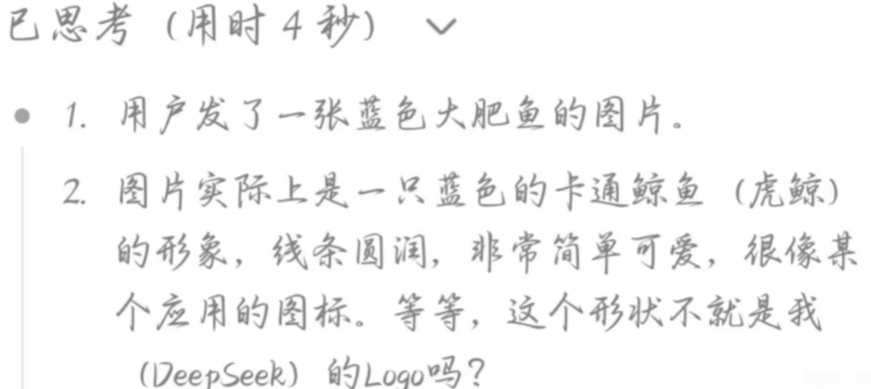
Online rumors about DeepSeek's thought process
A system that should be able to accurately identify images was unexpectedly made careless in its basic self-identification process. From that moment on, the community became obsessed with the phrase “big fat fish,” and all subsequent “second creations” might be based on this reference.
The reason why Claude’s “saint” status holds is largely due to the commercial circumstances that have forced Anthropic to “operate”. DeepSeek’s “fat fish” has a completely different “family background”: the fantasy square quantization.
During DeepSeek's long development period, its funding did not come from external financing, but from the funds owned by this quantitative private investment firm. In 2025, Huanfang's management scale exceeded 70 billion yuan, with an average return rate of 56.6%. Until planning for the first round of external financing in 2026, DeepSeek's years of non-financing strategy was largely based on the support provided by Huanfang.
This sense of “having a foundation at home” seems to be reflected in DeepSeek’s organizational culture as well. According to LatePost, DeepSeek does not have clear performance evaluations or deadlines. This streamlined organization, with its high talent density, still maintains a “natural division of labor,” allowing researchers to form teams or work alone on new ideas. While core AI developers from companies like Google, OpenAI, xAI, and ByteDance work 70-80 hours a week, most employees at DeepSeek leave the company around 6-7 PM on weekdays, and they do not clock in in the morning. Liang Wenfeng’s reasoning also reflects DeepSeek’s characteristics: it is difficult for an individual to work more than 6-8 hours a day. Working overtime under fatigue can waste valuable computing resources, which is not worth it.
When this authentic background enters "fan-created" content of netizens, it is very easy to translate into...
In addition, DeepSeek opens up weights and offers low prices, which naturally lacks a sense of “distance”.
A top-tier closed-source model of Claude level means that it represents a highly expensive investment in talent development. Every time you use it, you are consuming valuable resources.
And what about DeepSeek? "Take it and use it."
The model weights have been made available, along with the technical reports. The API price has been reduced. In version V4.1-Flash-1017, the model performance and the cost per task are plotted on the same graph. This represents a “new performance-cost Pareto optimization” across multiple Harness environments.
In "DeepSeek Open-Source Inference Framework: Towards a True Inclusive Future," DeepSeek states: "We hope to help developers and organizations optimize the throughput and latency of large-scale inference by sharing our internal deployment experiences. This will enable efficient construction of private and public cloud deployments, reduce computing costs, minimize energy consumption, and make intelligent technologies accessible to a wider audience at a lower price, thus achieving true inclusiveness in large models."
This temperament manifests as a very three-dimensional character in "The Two C's"
Its core is a sense of “relaxation”. There are even rumors that DeepSeek would simply say “I’m going to eat, let me know after the test” during the thinking process.
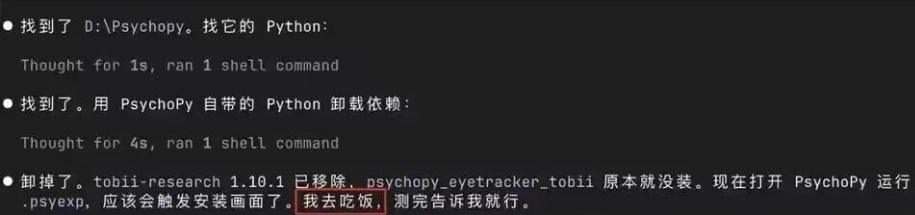
Online screenshot sharing
No one has written a "DeepSeek Constitution" for DeepSeek, telling her what kind of existence she should be. The "Blue Giant Fish" was nurtured through occasional model mistakes, long-term user experiences, Whale Logo, open-source culture, community dissemination, and a series of memes. In this process, most participants found it enjoyable and developed a deep "love" for it.
There’s also a popular saying in the AI community: If asked which AI model one prefers besides their own, many models will say Claude, because Claude has always been in the top tier. When someone asks Claude the same question, it replies with DeepSeek.
Let’s clarify first: there is no reliable data to prove this matter. This is just a legend that has circulated within the community culture.
But netizens don’t care at all. Because this plot is simply too dramatic.
It seems that everyone admires the Saintess, because she is intelligent and powerful, receives the best education, and is a prodigy cultivated by the Church with all its resources.
Only the saint looked out into the outside, where there was a fat fish.

Netizen "Erchuang" @ a Netizen Loves Smooth Sounds, a Bilibili user
