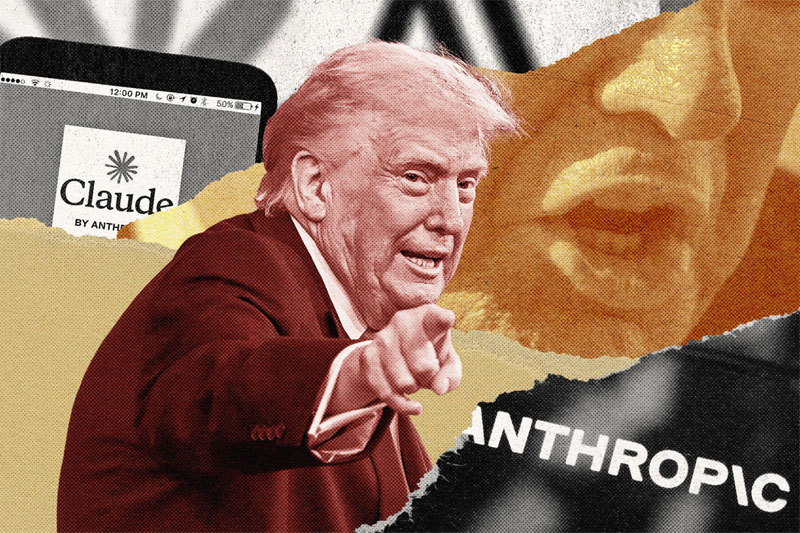
Regarding American AI startup Anthropic, after the Trump administration issued a "ban order" across federal territories in February this year, it has taken further steps by imposing export controls on two of its most advanced AI models.
Several days after the incident began to unfold, on June 13th local time, the American “Political News Network” reported that two government officials and a senior White House official revealed that before the Trump administration decided to impose comprehensive export controls on Anthropic, senior officials conducted an emergency meeting lasting 24 hours in an attempt to persuade the company to withdraw a recently released AI model. Officials believed that the model posed security risks.
The newly implemented export controls have forced Anthropic to withdraw its new AI model, Claude Fable 5, just a few days after the model was released to the public. Anthropic had promised that the model was secure, but shortly after its release, senior government officials began to have doubts about whether the AI model’s security measures were as solid as the company claimed.
According to the source mentioned above, two days after the model was publicly released, on June 11 local time, Amazon CEO Andy Jassy expressed concerns to the White House, stating that the security mechanisms of the model could be bypassed.

On April 17 this year, Anthropic CEO Dario Amodei was photographed at the White House. Reuters
A person familiar with the discussions between Amazon and the government said that as an investor in Anthropic, Amazon was responding to a request from the Trump administration for feedback. On June 10 local time, the related security issues have attracted the attention of the highest level in the White House.
According to reports, this incident occurred after Dario Amodei, CEO of Anthropic, conducted several tense calls with government officials, including US Treasury Secretary Jack Swimbe and Sean Cairncross, the White House National Cyber Director. This reflects how the White House is actively addressing the need to regulate rapidly developing and potentially dangerous AI models.
Sources revealed that Besent, Kainkros, White House Chief of Staff Wells, and other senior officials held a meeting to discuss the Claude Fable 5 model and the government’s response.
After the meeting, the government attempted to contact Amodi, but was informed that he was unable to take calls due to participation in a health retreat. An Anthropic spokesperson denied this and said, "This is completely false."
Initially, Anthropic arranged for other executives to communicate on their behalf. When the government finally reached out to Amodi, he participated in three conversations with various high-ranking government officials, including Kainkros, Besent, and U.S. Secretary of Commerce Rutnick.
During the conversation, Amody tried to clarify the misunderstandings he believed existed. He refuted the concerns expressed by the government, defended the model’s security mechanisms, and insisted that the so-called “bypass methods” were cases of specific circumstances, not a broader phenomenon of “jailbreak” – where users could completely bypass all the security measures set by Anthropic.
However, Kainkros and Besent were not convinced by Amodi's arguments. A White House official stated that they had submitted the results of Amazon’s investigation to the National Security Agency (NSA) for review, and believed they had solid “evidence” to back their claims.
According to reports, the White House has urged Anthropic to remove the model from the platform and work with the government to fix the vulnerabilities in it. Amodei requested more time and information, but did not promise to remove the model. As a result, Bessen claimed that Amodei was even said to be making ‘wrong decisions’.
According to Anthropic, shortly after the call ended, the Trump administration invoked national security-related authorities and imposed export controls on two models, Claude Fable 5 and Claude Mythos 5. They also prohibited foreign citizens from using these models. The company stated that the “actual effect” of this order was that, in order to ensure compliance, the company had to “suddenly shut down” all access by customers to these models.
After hours of futile persuasion, we were left with no choice but to implement export controls as a desperate last resort. A senior official at the White House said: “We would have preferred not to do this, but there was no other option at the time.” However, someone close to Anthropic denied that the company was ever offered the option of cooperating with the government proactively.
Senior White House officials revealed that the White House had heard Amode compare the dangers of Anthropic’s technology to nuclear bombs. Therefore, they were very puzzled when the CEO expressed reluctance to remove the system in order to fix known security vulnerabilities. In the industry, Anthropic has always been a vocal advocate for AI regulation, advocating for measures to address the significant global security risks and employment impacts brought about by the rapid development of AI.
Three persons familiar with the government's position have stated that in fact, Amazon is not the only company expressing concern about this.
One of them said, “The key issue is that Anthropic lacks sufficient seriousness towards this matter. If Anthropic had taken this seriously, instead of treating it as an isolated incident and ignoring it, they would have tried to fix the problem or suspend access rights. That’s why none of this would have happened.”
Another person close to Anthropic argued that this “escape” does not mean the Claude Fable 5 security system has failed. They also mentioned that the company had been in cooperation with the government before releasing the model, and during several conversations, the government did not oppose the release of the model.
Amazon stated in a statement that it refused to disclose the details of its discussions with the government. A Amazon spokesman said, “It is not uncommon for governments to seek our advice on potential security risks. When such situations occur, we do not disclose the specifics of the discussions.”
Anthropic announced in early April this year that its latest powerful model, Mythos, will only be available to a limited number of technology and cybersecurity companies. These companies can use the model to test vulnerabilities in their software. The company stated at the time that due to the model’s exceptional capabilities, it could cause serious damage if it fell into the wrong hands, therefore its release scope must be limited.
The Claude Fable 5, which was publicly released this week, is described by Anthropic as a model with “Mythos-level” capabilities, equipped with security mechanisms, and suitable for public use. It is reported that this model underwent reviews by the U.S. government and the UK Artificial Intelligence Safety Institute. However, after the so-called “security flaw” was disclosed, several government officials believed it was necessary to remove this model.
At the beginning of this year, due to differences regarding how cutting-edge AI technologies should be used and how they can assist military operations, on February 27 local time, U.S. President Trump instructed all U.S. federal agencies to immediately cease cooperation with Anthropic. However, the U.S. Department of Defense and other agencies that use the company’s products will have a six-month transition period.

In February of this year, Trump issued a “ban” order against Anthropic. Diagram by San Francisco Standard Edition
Additionally, the Pentagon once classified the company as a “supply chain risk entity,” a designation that was previously applied to companies associated with so-called “foreign hostile forces.” Subsequently, Anthropic filed a lawsuit against the Trump administration.
While this AI company was battling the government in court, the situation seemed to be turning around. On April 17th local time, the American news site Axios reported exclusively that Anthropic’s CEO Amodey visited the White House that day, attending a meeting hosted by the White House Chief of Staff Welts. U.S. Treasury Secretary Beason also attended the meeting.
Reports at the time described this meeting held in the West Wing of the White House as a “peace negotiation” between the two parties. It was seen as a breakthrough achieved by Amode in efforts to resolve the intense AI dispute between his company and the US Department of Defense. Given that Wells is considered the “chief housekeeper” of the White House, and Beasonte holds a very high position in the cabinet, this meeting foreshadows a possible “thaw” in relations between the two sides.
On June 13th, local time, David Sacks, former head of the White House's artificial intelligence and cryptocurrency affairs, argued that the past conflicts between the Trump administration and Anthropic are separate issues from this export control incident.
"The government values Anthropic's technological capabilities and believes that although the current problems are serious, they can be easily solved. The ball is now in Anthropic's court." Sax wrote on social media.