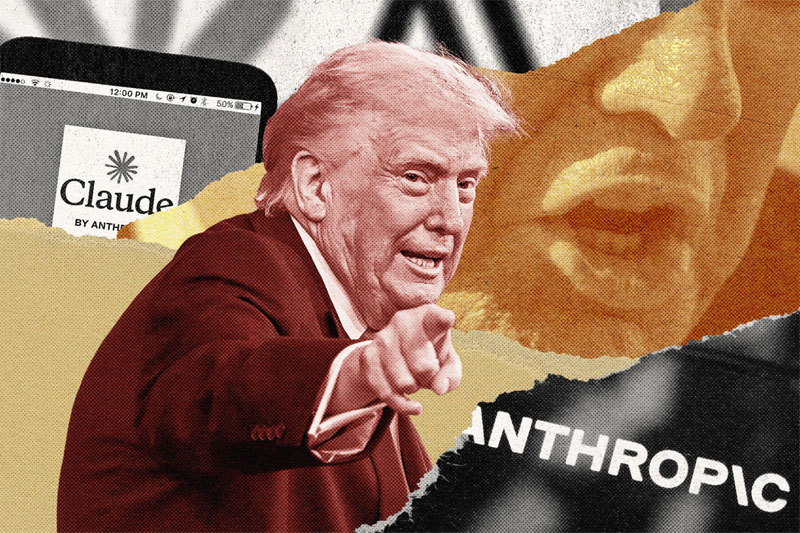
The US Department of Commerce suddenly imposed export controls on Anthropic, an AI company, last week, causing a "shock" in the US tech community. There are widespread doubts about whether this move is reasonable and compliant with regulations. Reuters reported on June 15 local time that the Trump administration's excuse for this action was "possible exploitation by China."
U.S. Secretary of Commerce Howard Loeb sent a letter to Anthropic’s CEO Dario Amodei on the 12th, requesting the company to suspend the export of Fable 5 and Mythos 5 models to all overseas destinations worldwide, as well as to all foreign citizens, regardless of their location.
According to a copy of the letter seen by Reuters on the 15th, Lützenich's reasons at that time were 'concerns' that these models might be used by military intelligence agencies from so-called 'United States concerns countries' such as China and Russia.
In his letter, Lutnick stated that the U.S. Department of Commerce is exercising authority under the Export Control Reform Act of 2018 to impose export controls on important emerging technologies that are related to national security in the United States. In the future, the export of related models, or the provision of such technologies to foreign citizens within the United States, will require government approval; otherwise, there will be “immediate criminal and civil penalties.”
A customs control expert pointed out that this is the first time the U.S. Department of Commerce has used this power to restrict the export of AI models.
After receiving a letter from Lutnick, Anthropic announced on the 12th that it would close access to related models worldwide.
The Trump administration's move has quickly sparked a multitude of legal and technical questions. Many experts in the field of export control have pointed out that AI models are typically not traded across borders in the traditional sense of "export", but rather through remote online services. Existing export control regulations do not provide clear regulations for such remote deployment methods. Therefore, there is still controversy over whether the U.S. Department of Commerce has the legal authority to take such measures.
On the other hand, more than 80 senior executives and experts in the cybersecurity industry, including large American technology companies such as NVIDIA, also signed a letter on the 14th. In the letter, they stated that the Trump administration’s ban has affected efforts to prevent the spread of cyberattacks, and called for the lifting of restrictions on Anthropic.
Anthropic revealed last week in its official blog that the U.S. government believes there is a "jailbreak" mechanism in the latest AI model Fable 5 released by the company on September 9th. This mechanism could potentially bypass security protection mechanisms and be used to identify software vulnerabilities. Therefore, the government has requested restrictions on the use of this model.

Anthropic website
But the company argued that this workaround can only detect some “minor” security vulnerabilities, and other AI models available to public companies also have similar capabilities.
A U.S. government official said that Anthropic’s senior technical team held talks with Commerce Department officials in Washington on the 15th. Another person close to the company revealed that since the Trump administration contacted Anthropic last week, the company’s technical team has held online meetings with U.S. government officials almost every day.
As of now, the U.S. Department of Commerce has not responded to the relevant legal basis, nor have either the Department of Commerce and Anthropic commented on the talks held on the 15th.
Some American media speculate that the so-called technical vulnerabilities and national security concerns are not the reasons behind the US government’s decision to impose export restrictions. The American political news website Axios quoted sources familiar with the matter, saying that the Trump administration’s move is likely due to a “difficult relationship” or conflicts with Anthropic.
Earlier this year, Anthropic refused to open its AI models to the US military for use in domestic surveillance and the development of fully autonomous weapon systems. As a result, relations between the two parties deteriorated rapidly, and the US government subsequently listed Anthropic on what it called a national security blacklist.
American technology media Tech Crunch also reported on the 15th that previous U.S. governments have implemented policies with significant impact due to issues related to knowledge or technological boundaries. For example, in the 2010s, when the U.S. government revised its export regulations for cybersecurity tools, the wording used was too broad, resulting in the inclusion of legal security research and vulnerability research activities within the prohibited scope. However, the ban imposed by the Trump administration seems more like a form of retaliation.
Tech Policy Press editor-in-chief Justin Hendricks believes that this move by the Trump administration "is likely to make foreign governments question the reliability of American AI in critical applications." This message conveys that American AI companies cannot operate independently without government interference.
According to Tech Crunch, the consequences of this incident are that the U.S. government has set a dangerous precedent, indicating its intention to exert control over the release of software products in the United States. “This time, the Trump administration targeted Anthropic, but next time, it could target any other company.”