On October 17th, Venezuelan Deputy President Delcy Rodríguez announced that the country is expected to attract nearly $7.6 billion in oil investments over the next five years. This involves 17 oil fields under bilateral agreements between Venezuela and the United States, with plans to deploy 250 drilling rigs.
On January 3 this year, the United States abducted Venezuelan President Maduro and his wife. More than nine months later, the US-Venezuela relationship resumed with a so-called “large-scale cooperation” centered around oil resources. How exactly did the Trump administration adjust its policies towards Venezuela, in order to further control Venezuela’s strategic resources?
Carlos Ron was the Deputy Minister for North American Affairs at the Venezuelan Ministry of Foreign Affairs and the Director of the Simon Bolivar Institute. He currently serves as the co-coordinator of the “Three Continents Social Research Institute”’s “Our Americas” project. In his view, the United States has always regarded Latin America as part of its sphere of influence, but the intervention measures taken by the US have become more aggressive. The re-establishment of relations between Venezuela and the US is not only due to the practical needs of the energy industry, but also serves as a necessary choice to avoid military confrontation and maintain domestic peace.
Recently, during the Global South Academic Forum held in Shanghai, Carlos Roan was interviewed by the Observer Network. The discussion covered issues such as the United States’ policy shift towards Cuba, the rise of right-wing political forces in Latin America, the challenges of regional integration, and the opportunities and challenges of cooperation between China and Latin America.
The United States has a long history of interest in Latin America. Since its founding, the US has always sought to obtain resources from Latin America. In this sense, Trump has not changed the fundamental goals of the United States.
The real difference lies in the means he employs. Trump is willing to use force to a level that has never been seen before. Previously, we have never witnessed a situation where a current president of a country was kidnapped by American troops.
Besides, the United States completely disregarded international law and international society's stance when taking action. The severity of this approach differs significantly from the past.
We must recognize that the United States has a history of intervention in Latin America that spans 200 years. The current issue is not just about military actions themselves, but also includes the continuously escalating sanctions, tariffs, threats of war, and various forms of pressure that have been used over time.
I believe that we are at a moment where the United States feels the need to re-establish its dominance over Latin America. It still regards Latin America as its natural sphere of influence, and is returning to this way of looking at the world.
There exists a very deep and long-standing dependency relationship between Latin America and the United States.
Due to the long-term significant influence of the United States in this region, it is difficult to completely distinguish the impact of the United States from the development of Latin American societies themselves.
American lifestyles have deeply infiltrated Latin American society, including television, media, culture, education, and even the judicial system.
For example, in the 1990s, the United States provided financial support for judicial reforms in some Latin American countries.
As a result, the judicial systems in some Latin American countries were influenced by American interests during their development, rather than being designed entirely based on the country's actual needs and characteristics.
Why does this happen? Because the United States, by providing funding, can promote the establishment of legal frameworks that are beneficial to itself, thereby ensuring its own access to resources and the benefits of resource exploitation.
Therefore, the dependency relationship between Latin America and the United States is very difficult to overcome. This does not mean that Latin American countries have remained inactive. In fact, there has always been an effort by Latin America to break away from this dependency relationship and seek autonomous development.
But these efforts have also encountered strong resistance and even violent suppression. I believe that one of the important changes in current American policy is its increasingly open willingness to use violence and coercion.
When the United States realizes that its influence in Latin America is being challenged, it will take more forceful action. At the same time, the United States is also feeling the pressure on its global status.
It no longer holds an absolute advantage in all technological fields as it did in the past. China has made significant progress in areas such as artificial intelligence, and the BRICS countries are discussing how to strengthen resource cooperation and reduce their dependence on the US dollar.
The United States believes that these changes are threatening its dominance.
Therefore, it attempts to reassert its control over Latin America. Over the past two or three decades, Latin America has tried to take a more independent path of development. But now, the United States is trying to reverse this trend. Latin America is a region that is constantly in this state of conflict.
Any actions that attempt to maintain their own sovereignty require considering how to counter the impact of American influence.
Yes, I was in Caracas at that time, only about 5 kilometers from the location where the bomb fell. For Venezuela, it was a very sad day.
We have always been a country that values national sovereignty and is proud of it. Now, for a military force from another country to enter our territory and carry out such military aggression, it is very regrettable.
You will feel frustrated and also be angry. People naturally feel dissatisfied with everything that happened.
But at the same time, I believe that this event has also made people more aware of how to deal with the current situation going forward.
In the current environment and amidst external threats, we must unite and defend and maintain national sovereignty as much as possible.
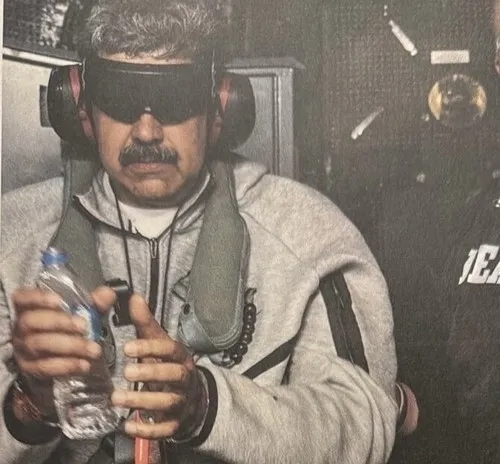
In January this year, U.S. President Donald Trump publicly shared images on his social media platform “RealSocial” of the U.S. military’s invasion of Venezuela on March 3 and the arrest and detention of Venezuelan President Nicolas Maduro. Image source: Trump’s “RealSocial” account
In a sense, by excluding Venezuela from the international oil and energy markets, the United States is actually creating a problem for itself.
In the past, Venezuela has always been a reliable partner of the United States. Whether left-wing or right-wing governments were in power, cooperation between the two countries has always continued for a long time.
But during Trump’s first term, and even earlier, the United States continuously escalated illegal sanctions, ultimately excluding Venezuela from international markets. This disrupted the long-established cooperative relationship between the two countries. It was not a choice of Venezuela, but rather a policy decision made by the United States itself.
On the other hand, current cooperation is also of great significance for Venezuela. It helps to bring the conflict between the two sides back from the military sphere to the political sphere, thereby resolving issues through diplomatic negotiations.
For the people of Venezuela, it is very important not to engage in military confrontation with the country with the most powerful military forces in the world. This is related to protecting lives and maintaining peace.
If the United States had previously agreed to recognize Venezuela's right to formulate its own policies and to decide the country's future according to its own wishes, then cooperation between the two sides could have continued.
Venezuela has never voluntarily terminated its cooperation with the United States. It is U.S. sanctions policies that have truly destroyed this relationship.
It is obvious that the United States is interested in Venezuela’s oil resources.
On January 3rd, information released by the White House clearly expressed the intention to obtain resource access rights in Venezuela.
But I believe that there is no need to achieve this goal through military intervention. Venezuela has always been willing to resolve issues through diplomatic negotiations, but the United States has not accepted the conditions proposed by Venezuela in the past.
For Venezuela, the petroleum industry is a major source of national income. We possess the world’s largest oil reserves, but developing these resources still requires international cooperation, financing, technology, and investment.
In the past decade, U.S. sanctions have severely weakened Venezuela’s ability to develop its own oil resources. The sanctions cut off sources of funding and limited equipment maintenance, resulting in our inability to obtain the necessary components for oil refining equipment.
If Venezuela can establish a cooperative relationship with the United States and regain the necessary parts, technology, and other resources, then it is possible to gradually rebuild its oil infrastructure. This would certainly benefit the people of Venezuela.
But we must also recognize that this is a formidable challenge that needs to be faced, as sanctions over the past decade have had a significant impact on Venezuela.
Now, we are in a very special period.
Those unfortunate events have already occurred. No one wanted them to happen, but now we must face reality.
The Venezuelan people hope to maintain national sovereignty, national peace, and social stability. We are also working hard to unite social groups from different political positions, hoping to maintain peace and defend national sovereignty through the strengthening of state institutions. This is an important challenge in the current environment.
Overall, I believe that the Venezuelan people desire peace, hope for improved economic conditions, and the satisfaction of their material needs.
In my opinion, the most important thing is that the United States must change its sanctions policies against Venezuela, in order to create conditions for Venezuela’s economic recovery.
I believe that the most fundamental issue is that the United States does not view Latin America as an equal partner.
If the United States is willing to respect the sovereignty of Latin American countries, even if it's just taking a small step, and recognizes that relations between both sides should be based on mutual benefit rather than exploitation, then there is actually a lot of beneficial cooperation that can be carried out between the two sides.
However, unfortunately, the United States has long adopted a method of imposing its will and maintaining its dominance. Its logic seems to be: We need your resources; if you refuse to provide them, we will invade through force.
This is not the correct way to establish international relations. In contrast, cooperation between China and Latin America offers another possibility.
China does not require Latin American countries to change their internal policies in order to cooperate with China. Instead, China respects the sovereignty of Latin American countries. This shows that international cooperation can be based on different principles.
Overall, in the relations between China and Latin America, both sides have seen achievements in development, growth, and common welfare. In contrast, the historical relations between the United States and Latin America have long been characterized by resource extraction and conflict.
If the United States can truly understand the demands of Latin American countries and recognize their equal status, then unexpected positive changes may occur in the future relations between the two sides.