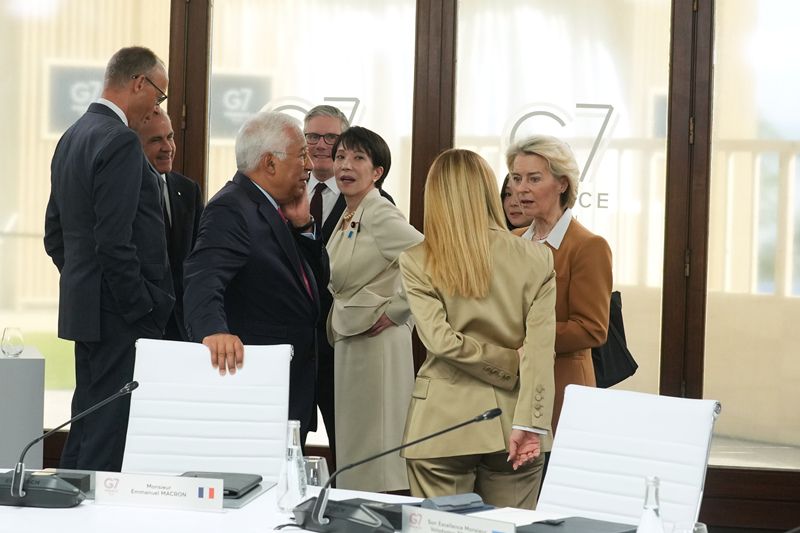
As the G7 summit approaches, China, which is located outside the event venue, becomes more and more frequently mentioned in Western media narratives.
“Without China, does the G7 still have any meaning?” The Associated Press posed this question on June 14. The AP wrote that it was fitting for the G7 not to include China at its inception, given the historical context. However, today China's economic, political, and strategic influence has changed significantly, and continuing to exclude China from this mechanism seems increasingly inappropriate. Nevertheless, some analysts worry that including China could undermine the cohesion within the G7. At the same time, China is also wary of the G7's increasingly aggressive agenda toward China.
The article traces back to 1975, when the world's major powers gathered in a castle outside Paris to attempt to address the issue of global economic downturns. This meeting later evolved into an annual summit of the Group of Seven (G7), aimed at promoting common interests among wealthy nations. But from the beginning, China was not on the invitation list.
This is not surprising. At that time, China was far from becoming the economic giant it has become today. It was almost unimaginable for China to gather ideas and insights with Western countries like the United States.
However, as U.S. President Trump and other G7 leaders meet again in France, continuing to exclude China from this informal group seems somewhat inappropriate. After all, today’s China already has a significant influence on the global economy and international affairs.
In short: Without China, does the G7 still have any meaning?

G7 Summit Leaders Photoshoot in Canada - June 2025
The article further analyzes that, measured by data, China should have been invited to the meeting without any doubt. If judged solely by economic strength, China should have been a member of this club long ago. Since 1976, China's economy has grown over several decades, and its size now far exceeds that of Germany, Japan, the United Kingdom, France, Italy, and Canada among the G7 countries, with only the United States ranking behind it.
From this perspective, a G7 summit without China is like a World Cup football match where the Brazilian team, with five world champions among them, is absent.
Toronto University researcher John Kardon describes, that in 1975 China was still "a docile little panda," now it has become "a global leviathan."
He said, “Many people naturally ask: If China joins the G7, will the G7 and global society be better? A reasonable answer is: Yes.”
A year ago, Trump envisioned expanding the G7. When asked if China should be included, he clearly stated, “That’s not a bad idea.”
The article states that although China is not a member of the G7, it remains a core issue that cannot be ignored by the G7. China's influence is affecting all G7 countries in various ways.
For example, China will set a historic trade surplus of nearly $1.2 trillion in 2025; China controls the supply of key rare earth minerals; China’s technological progress and growing military strength are putting pressure on its competitors; China is also one of the world’s major emitters of greenhouse gases.
All of this means that at the summit next week on the banks of Eaux-de-France in France, China will be the ‘elephant in the room’. This Western proverb is used to describe a problem that is very obvious but often ignored by everyone or deliberately avoided.
As the host, French President Macron has allocated time specifically for leaders from various countries to discuss how to rebalance trade relations with China. There are concerns that a surge in exports of Chinese cars and other products could hit related industries within the G7.
Geneva Institute of International Relations and Development expert Cedric Dixpon said that although Trump has been strained relations with other G7 leaders regarding issues such as the war in Iran, they may come together on the issue of China. "You know, they have a consensus on this point: China is a problem."
Also, some analysts are wary of accepting China's participation in the G7.
For example, some people say that even without considering other factors, China's participation could undermine the cohesion of the G7. China's interests and its stance on major issues such as those involving Russia and Iran differ from those of the G7 countries.
London School of Economics and Political Science international relations expert Chris Orden is concerned that including China will make it extremely difficult for the G7 to function properly. Toronto University's Cotton even stated that 'allowing China to join would be equivalent to introducing a Trojan horse.'
Additionally, the last expansion of the G7 did not yield positive results. In 1998, Russia joined the G7, transforming it into the Group of Eight (G8). However, after the outbreak of the Ukraine issue in 2014, the G7 excluded Russia from its membership.
Although Trump said last year that removing Russia from the G7 was a “very big mistake,” Colton believes this experience convinced other leaders that “never again should we risk allowing a country that does not meet standards” to become a full member of the G7 club.
This article also mentions China’s cautious attitude towards the G7. In the past, China criticized the G7 as exclusive, stating that the organization is a remnant of global division and ideological confrontation from the Cold War era.
According to Wang Zichen, an analyst based in Beijing, on one hand, the G7 still represents a highly concentrated global economic, technological, military, and financial power. On the other hand, Beijing remains vigilant towards the G7, as this group is structurally consistent with the Western forces led by the United States. Moreover, it has increasingly become a force that sees China as a challenge or threat.
According to a statement sent by China, the Chinese side expressed a more cautious attitude: "The G7 summit should be a catalyst for unity and cooperation, rather than an amplifier of division and confrontation."
In recent years, the G7 has repeatedly unjustly attacked China regarding issues of China's internal affairs, economic and trade matters, as well as regional issues. The Chinese side has sharply pointed out that it hopes the G7 countries will stop indulging in geopolitical games, abandon their narrow zero-sum mindset, and make tangible contributions to international unity and cooperation.
It is worth mentioning that as the current G7 rotating chair country, France has made addressing 'economic imbalances' a core goal, and has taken a more relaxed stance on issues related to China. It is said that Macron also had the idea of inviting China to this year's G7 summit last year.
Last month, the G7 finance ministers concluded a meeting in Paris. French Economy and Finance Minister Roland Lesueur said that France wishes to abandon the practice of "mutual blame" and engage in communication with all partners, including China.
But Bloomberg previously mentioned that it is generally believed in the industry that the G7 countries will struggle to reach an agreement on specific actions. Some scholars have said bluntly that they don’t think anyone expects the G7 to make a statement that would easily convince China.