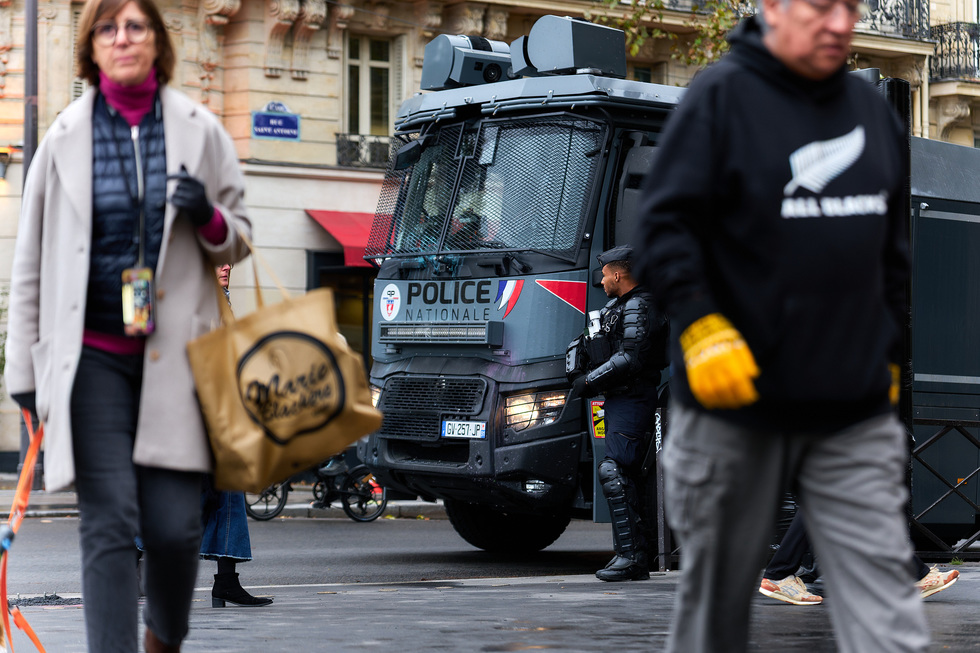
On October 24th local time, before a new round of protests, major French cities set up strict security lines, deploying police forces, helicopters, and armored vehicles to prevent the recurrence of the violent looting incidents that occurred during the nationwide demonstrations last weekend.
According to AFP, hundreds of demonstrations are planned in many parts of France. Shops and restaurants in the center of Paris have all been blocked with protective boards. The Louvre and the Musée d'Orsay have closed, and a curfew has been imposed in some areas of Paris.
French Interior Minister Laurent Nuñez said that approximately 70,000 security personnel will be deployed on Saturday. French Prime Minister Sebastian Courion warned on the evening of the 23rd local time that the risk of violence was "still high."
This protest initially started by high school students in response to poor teaching conditions. After lasting for several weeks, it spread across the country. The widespread dissatisfaction with rising living costs further boosted the intensity of the protests. A week ago, more than 500,000 people took to the streets, and during the demonstration, the most severe urban violence incidents in France in recent years occurred.
The protests took place at a critical moment in France: there are still six months until the presidential election of President Macron. Recent polls show that the far-right candidate Marine Le Pen is leading, and recent unrest have further solidified her advantage.
Macron met with more than 20 high school students on the 23rd local time, saying he hoped to hear their demands and concerns. However, after the meeting, the student representatives continued to call for continued protests until the government presented a concrete plan to meet their demands.
Tensions are escalating. Le Pen will hold a party of the National Alliance in the city of Orleans this weekend. Thousands of supporters are expected to attend, and about 20,000 to 30,000 opponents of Le Pen will also be there. The authorities in Orleans are worried that clashes might occur between the two groups. Local shops have also installed barriers, and residents are in a state of anxiety.
Local citizen Stefan Jantil told AFP: “The atmosphere was strange on Saturday morning, with many stores closed and roadblocks set up. We truly hope that security measures will prevent such violence from happening again as last week.”
Macron's government attempts to distinguish between the legitimate demands of protesters and the acts of looting, arson, and vandalism that occurred during the demonstrations last Saturday. They attribute the violent disturbances to "far-left" groups. French officials report that 217 people have been sentenced for these incidents, half of whom are first-time offenders.
AFP reported that the violent events have damaged France's image. This election could become a turning point in French modern history. Additionally, the country's large debt load also raises concerns among investors. Polls suggest that Le Pen is likely to win both the first and second rounds of the presidential elections.