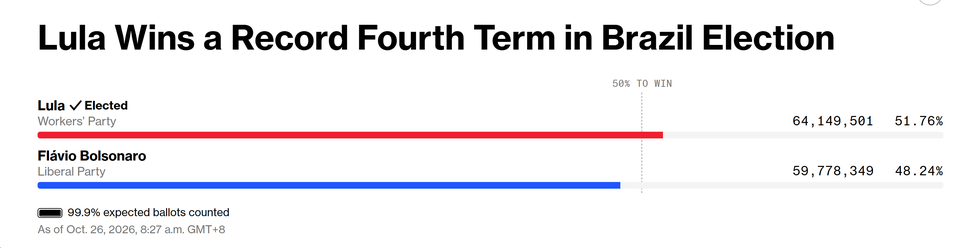
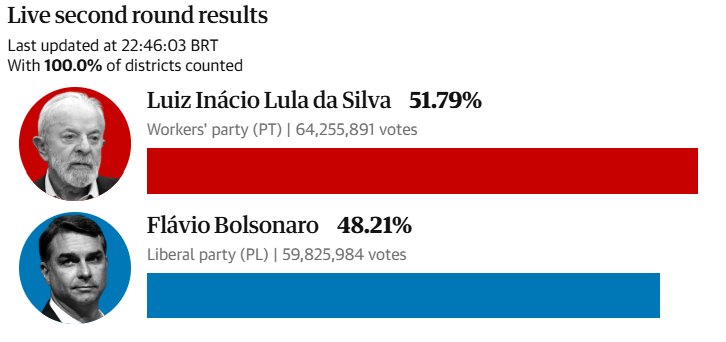
On the evening of the 25th local time, the results of the second round of the Brazilian presidential election were announced. The Labor Party candidate and current president, Luiz Inacio Lula da Silva, defeated the Liberal Party candidate, Flavio Bolsonaro, son of former president Jair Bolsonaro, and won re-election.
Lula set two significant records: first, he became the first politician in Brazilian history to win a direct presidential election four times; second, he became the first candidate since Brazil restored direct presidential elections in 1989 who fell behind in the first round but managed to reverse the situation in the second round.
According to CNN, in the three weeks between two rounds of voting, Lula received over 10 million more votes, while his opponent only gained 3.6 million votes.
On October 4th, during the first round of voting, Vladislav Borison obtained approximately 47% valid votes, leading Lura by about 2 percentage points. In the second round of voting, Lura's vote share was 51.79%, while Vladislav Borison had 48.21%.
Reports say that this counteraction allows Lula to continue playing the role of a left-wing leader in the region, where right-wing forces are expanding rapidly and more and more countries are following the US government's lead.
Like his father, Jayl Bosonaro, four years ago, Flavio Bosonaro refused to accept the election results and announced that he would seek to cancel the election through legal means. He questioned the decision by Federal Supreme Court judge Cristiano Zanin to extend the voting time by two hours, saying, “Given the circumstances in which these events occurred, it is impossible to accept the election results.”
CNN said that Bosonaro’s statement did not dilute the celebration among people for Lula’s historical achievements. However, Bosonaro’s defeat did not weaken the power of the right-wing forces in Congress and state governments. The right-wing forces are still likely to hinder Lula’s governance efforts during his new term.
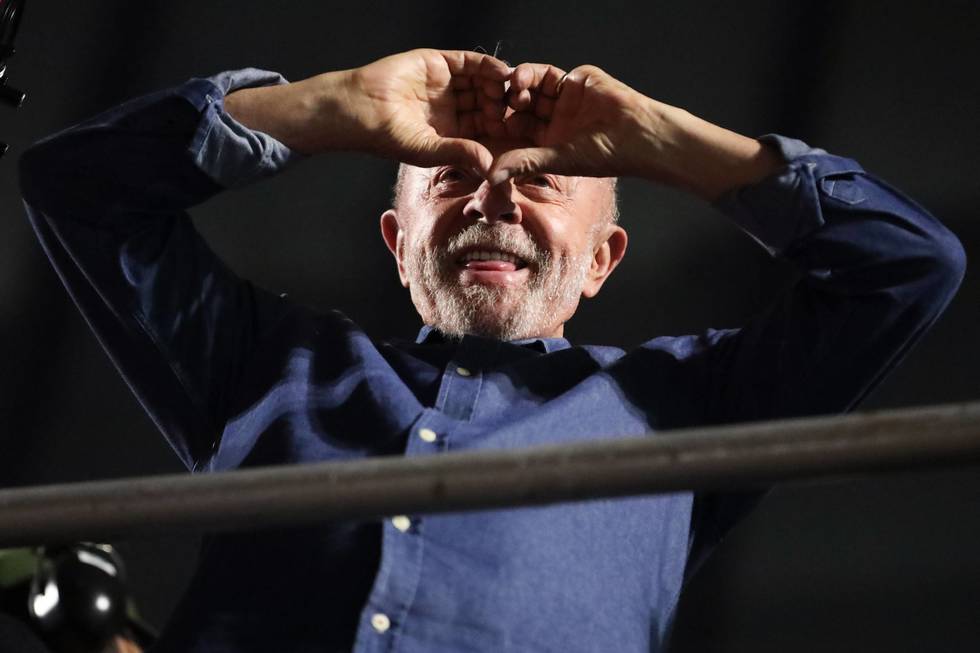
October 25th, Brazilian President Lula celebrated his re-election with supporters in downtown São Paulo. Visual China
First, look at the geographical distribution of the elections.
In Minas Gerais state, which boasts the second-largest electorate nationwide, Lula trailed by nearly 590,000 votes in the first round of voting. He then secured a lead of approximately 99,000 votes in the final count. The resulting gap between the two candidates reversed a margin of roughly 690,000 votes.
Since 1989, the state has supported the ultimately winning candidate, and this time too, it has aligned with the national election results.
Despite still leading in São Paulo and Rio de Janeiro states, Lujá won the capitals of these two largest cities in Brazil, flipping a first-round voting deficit in Rio de Janeiro.
Furthermore, Lu La won the support of all nine states in Northeast China and voter turnout increased as well. The withdrawal rate fell from 21.08% in the first round to approximately 19.2% in the second round, which allowed an additional about 3 million Brazilians to enter voting booths.
These new votes cannot be attributed entirely to Lula, but this change highlights the importance of mobilizing voters who previously did not vote.
This election campaign is also taking place on the phones of Brazilians.
After ranking second in the first round of voting, Lula strengthened digital mobilization efforts to expand his influence and turn support into actual votes. The challenges he faces are not only convincing voters who have not yet decided whom to vote for, but also getting those who already show favor toward him to actually go to the polls.
This offensive was also accompanied by a series of measures and policy proposals introduced during the final stage of the campaign, aimed at addressing the specific concerns of voters.
Lula signed a law that expands the maximum revenue limits for individual micro-entrepreneurs; proposed new measures to help consumers renegotiate their debts; and advocated for the elimination of online gambling. The expansion of online gambling has exacerbated the debt problems of Brazilian families.
On issues related to public safety, Lula is not opposed to accepting right-wing proposals: he supports lowering the age of criminal responsibility for particularly serious crimes.
This statement is aimed at responding to voters' demands for more severe measures against crime, and public security is also one of the main topics in this election.
This victory allowed Lula to continue in office. It also means that he must fulfill the promises made to win elections and respond to the public expectations that have arisen as a result.
The primary challenge comes from the legislative body.
The right-wing political party will occupy 303 seats out of the 513 available seats in the lower house. The left-wing holds 124 seats, and the center-left group has 86 seats. In the upper house, the right-wing is expected to occupy nearly two-thirds of the seats.
This does not mean that all right-wing members of parliament will automatically become opposition parties. However, Lula must seek support from forces outside the basic camp in order to promote his policies and at the same time maintain the government’s focus on governance.
The political map of each prefecture shows that the conservative camp remains strong in strength.
Additionally, Lula needs to transform economic progress into changes that the Brazilian people can truly feel in their daily lives. Public dissatisfaction with the cost of living will continue to exist.
Debt, fiscal deficits, and high interest rates limit the room for expanding spending, and also indicate that the debate over how to raise funds for electoral promises will intensify. Lula must find sources of funding for these promises without compromising social welfare programs.
Lula faces challenges that extend far beyond Brazil's borders.
CNN reported that amidst a wave of victories for regional right-wing candidates and White House supporters, this progressive leader achieved a reversal, winning the most important victory.
Lula's government utilized Brazil's economic strength to meet the demands placed on it by Washington in terms of trade and politics.
Michael Palmer, a political science adjunct professor at the University of Virginia and research fellow at the Center for International Policy (CIP), told CNN that "Lau's victory shows that extremist right-wing forces, particularly Bolsonaroism, have an upper limit on their support, as many voters believe this political force is too radical."
He pointed out that this result also indicates that gaining support from the White House and a series of economic measures implemented by Trump are ‘not factors that determine the election outcome’.
In a Latin America where new faces emerge constantly, Lula remains a politician with broad international influence and one of the main players on the international stage.
This record-breaking leader will celebrate his 81st birthday on the 27th of this month. After once again creating history, he has two months remaining until the end of his fourth term as president. During this time, he can determine what direction the South American superpower will take in the next four years. CNN says.