(Text by Gua Guanghao of Observer Network)
On August 15, 1945, Japan announced its unconditional surrender. The 9-year-old Koji Fukuda did not hear the Emperor’s ‘Proclamation of End-of-War’ because he was playing a war game with his friends at that time.
After returning home, when he heard the adults say that “the war is over, and Japan has lost,” this “warrior boy” became furious. “How can we stop the war? It’s absolutely unreasonable of His Majesty the Emperor! We were all ready with our bamboo spears, and we firmly believed in our ability to win. We were still fighting hard!”
More than 80 years later, the former “military youth” has become a former Japanese prime minister and a political figure who has long promoted friendly exchanges between China and Japan. In the last year of his life, he was interviewed by the media several times, reflecting on his war experiences, and warned the Japanese political scene: The duty of politicians is to do everything possible to prevent the country from being forced into a situation where “war is inevitable”.
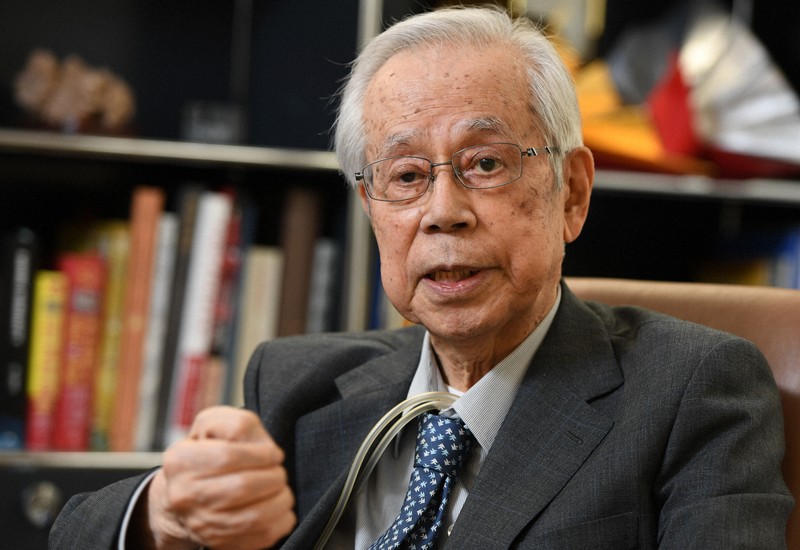
In December 2025, Fukuda was interviewed.
According to Japanese media reports on October 26, former Japanese Prime Minister Fukuda Yasuo passed away in a hospital in Tokyo on the 22nd due to heart failure at the age of 90.
As the first father-son pair to serve as Prime Minister in Japanese constitutional history, Fukuda Yasuhiro and his father Fukuda Yoshio both played important roles in the development of Sino-Japanese relations. Looking back at Fukuda Yasuhiro's life, from Nanjing under Japanese occupation to the Japanese political scene after the war, from promoting strategic mutual benefits between China and Japan to reflecting on the war in his later years, his personal experiences were always closely linked to the complex historical entanglements between the two countries.
Fukuda Yasuhiro was born in Tokyo in July 1936. His father, Fukuda Yasuhiro, was originally an official in the Japanese Ministry of Finance. During World War II, he was sent to Japan to assist the Wang Jingwei regime as a financial advisor.
Due to his father's work, Fukuda Yasuhiro lived in Nanjing, China under Japanese occupation, during his childhood.
Years later, Fuki recalled that his family lived in a two-story Western-style building, which served both as his father’s office and as their home.
In his childhood memories, Nanjing was a peaceful city. The Chinese people were very kind to them, and sometimes they would even go to the city to watch movies. They even felt that life there was more peaceful than in Japan.
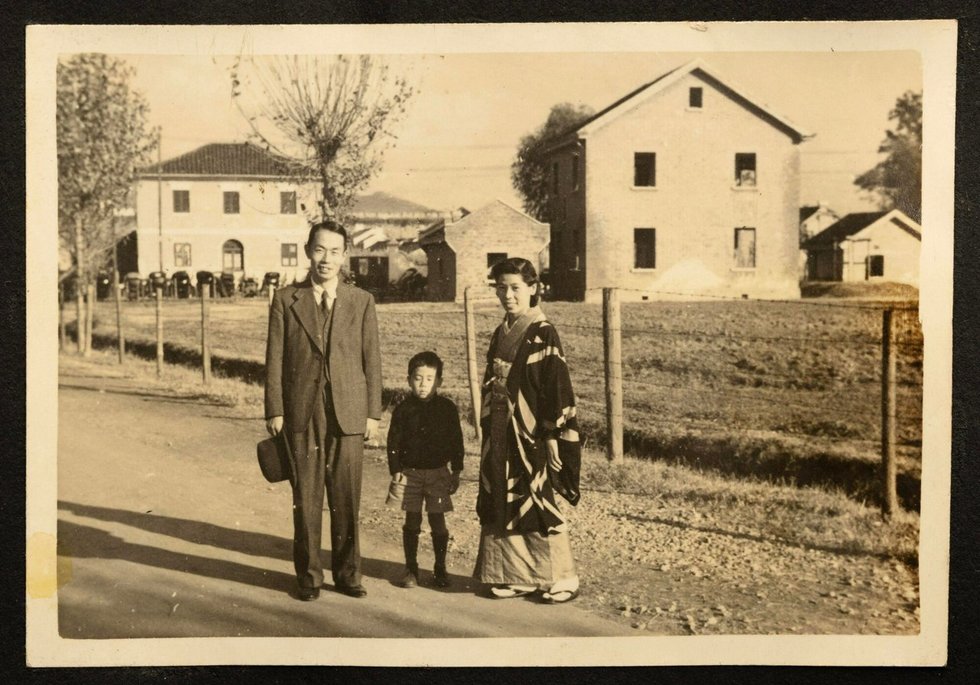
In 1942, Koizumi Yasuhiro and his parents were in Nanjing.
However, this tranquility was just a partial view seen by the child in one of the Japanese occupied families. As the situation for the Japanese forces deteriorated, the Fukuda family rushed back to Japan, and later relocated to their father’s hometown in Gunma Prefecture.
At the end of the war, Fukuda's life was surrounded by militarism. He recalled that every morning, when he arrived at school, air raid warnings would sound. After the children returned home, they would gather together to imitate soldiers fighting, and each of them would be given a corporal rank. They also collected bark from mulberry trees to make fiber for the army. Some even prepared bamboo guns, intending to confront any American soldiers who might land in parachuting.
In his later years, Fukuda admitted that he had wanted to become a soldier since he was very young. In fact, he had no real understanding of what war really meant. He also recalled witnessing school teachers harshly reprimanding students who did not meet the criteria of militarism. However, after Japan's defeat, the educational content in schools quickly shifted from militarism to democracy. The drastic change in values struck the young Fukuda deeply.
Truly deepened with age, along with increasing memory of another war is his understanding of it.
Fukuda could never forget the scene of seeing off the soldiers who were going on a military mission in Gunma Prefecture back then. Approximately 50 people from the village gathered together, singing military songs to see off the soldiers. He remembered especially the look in those soldiers’ eyes as if they were looking into the distance.
At that time, the young Fukuda did not understand the meaning of these words. It was only many years later that he began to think about it—these soldiers might have known from the beginning that they would not return alive, yet they still had to obey orders. Perhaps some of them left behind their lovers waiting for them to get married.
Fukuda said that whenever he recalls the expressions of those people, he feels a sense of emotion that is hard to put into words.
In his view, war means the loss of freedom, and it is accompanied by a dehumanizing force of coercion. He no longer wishes to experience such things, nor can he allow others to experience them again.
Fukuoka Kentaro's understanding of war and Asian diplomacy was closely intertwined with his father's political career, Fukuda Jiro.
During the war, Fukuda Joshi participated in raising military budgets. After the war, he turned to politics and served as Japanese Prime Minister from 1976 to 1978.
In 1977, Fukuda Joeo visited Southeast Asian countries and proposed an Asian foreign policy later known as “Fukudaism”. He promised that Japan would not become a military power and advocated establishing a “heart-to-heart” trust relationship with Southeast Asian countries.
In 1978, Japan and China officially concluded the "Peace and Friendship Treaty", and Fukuda Joeo became a promoter of this significant diplomatic process.
In his later years, Fukuda Yasuhiro recalled that his father once used a bridge to describe the development of relations between China and Japan: In 1972, the normalization of diplomatic relations led to the establishment of a “suspension bridge”; by the 1978 Treaty of Peace and Friendship, this suspension bridge was transformed into an “iron bridge” capable of transporting goods.
However, even if national relations have been legally guaranteed, true mutual understanding still requires long-term communication to accumulate. This is the diplomatic philosophy that Fukuda Koichi has repeatedly emphasized after this.
In 1959, after graduating from Waseda University, Fukuda Yasuhiro worked in a petroleum company for a long time. He did not resign until 1976 and entered politics. Thereafter, he served as the prime minister's secretary, personally participating in and witnessing Fukuda Yasuhiro’s foreign policy in Asia.
In 1990, he was elected as a member of the House of Representatives for the first time. Starting from 2000, he served as the Chief Secretary for Political Affairs in the Koizumi Yasuo and Koizumi Junichiro cabinets.
In September 2007, Fukuda Yasuhiro succeeded Anbi Junshiro, who resigned from the position, and became Japan's 91st Prime Minister. He became the first politician in Japan's constitutional history to serve as Prime Minister both before and after his father.
After taking office, he actively promoted the improvement of Sino-Japanese relations.
In December 2007, Fukuda Yasuhiro officially visited China; in May 2008, the two countries signed the fourth political document between China and Japan—the Joint Statement on Comprehensively Promoting Strategic Reciprocal Relations between China and Japan.
Although Fukuda Yasuo resigned as Prime Minister in September 2008 due to political deadlock in Japan, his tenure as Prime Minister lasted only one year. However, he did not stop promoting exchanges between China and Japan.
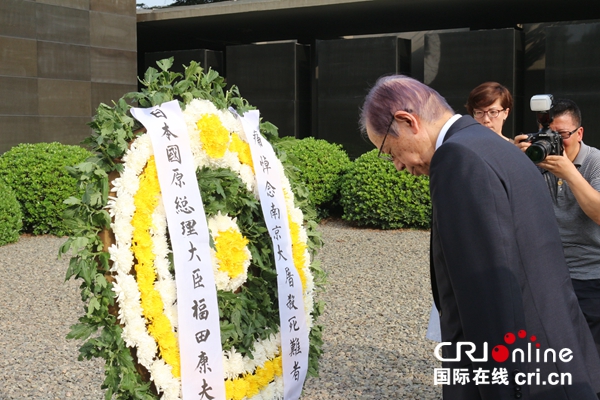
In June 2018, 81-year-old Fukuda Yasuhiro visited Nanjing once again.
This time, he was no longer a child living in the Japanese occupied area following his father, but as a former Japanese prime minister, he visited the Memorial Hall of the Victims in Nanjing during the Japanese invasion of China.
It is noteworthy that visiting the Nanjing Massacre Memorial Hall was not a passive diplomatic activity undertaken by Mr. Fukuda but an itinerary he himself proposed.