Last week, the EU announced its intention to prevent China and Russia from "dominating" the Arctic waterways. However, US media poured cold water on Europe: faced with the cooperative advantages of China and Russia in the Arctic shipping sector, Europe has hardly any bargaining chips.
According to a report by the American consumer news and business channel (CNBC) on October 26, local time, as China and Russia expand their cooperation in Arctic shipping, Europe attempts to compete with them. However, analysts believe that Russia's advantage in managing the Northern Sea Route, combined with China's growing commercial strength, makes it difficult for Europe to shake up the cooperation between China and Russia.
French Foreign Bank's Chief Economist for the Asia-Pacific and Middle East Africa region, Alicia Garcia-Herrero, said, "At any meaningful time frame, Europe cannot truly challenge China and Russia's dominance in Arctic shipping."
On October 20th, the EU announced a new Arctic strategy. The plan includes expanding the fleet of ice-breakers, strengthening maritime surveillance, enhancing protection for submarine communication cables, and establishing maritime security hubs.
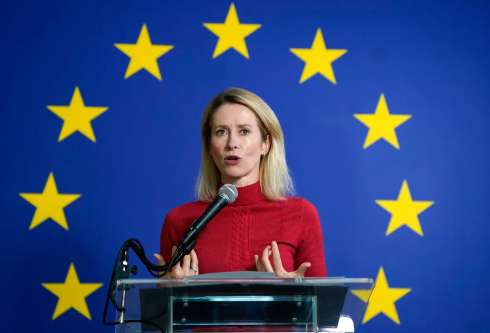
The High Representative of the European Union for Foreign and Security Policy, Catherine Schöne, stated on the same day that as Russia and China expand their influence and activities in the Arctic region, the Arctic has become the forefront of global power competition. She also warned that the Arctic waterways should not be dominated by Russia and China.
But Garcia-Herrera told CNBC that Russia has the authority to grant navigation permits for the Northern Sea Route, charge transit fees, and possesses a large fleet of nuclear-powered icebreakers. China, on the other hand, provides the necessary supply sources, ships, and industrial production capabilities required to develop this route.
In contrast, European icebreakers and infrastructure in the Arctic region are relatively limited. Even though Europe is an important market for Arctic shipping, it lacks sufficient leverage to challenge cooperation between China and Russia.
On October 21, the joint communiqué of the 31st regular meeting between Chinese and Russian prime ministers clearly stated that both sides will expand cooperation within the framework of the Arctic Shipping Cooperation Subcommittee. They aim to promote a steady increase in cargo volume on the Arctic shipping route and the number of shipping services between Chinese and Russian ports. This will enhance the competitiveness of the shipping routes and foster mutually beneficial cooperation in the field of polar ship construction.
As the Middle Eastern conflict threatens traditional international shipping routes, the Arctic route becomes even more attractive for freight transportation between Asia and Europe.
According to data provided by shipping company Fertmax FZCO, CNBC states that the transportation time for goods from Asia to Europe via the Northern Sea Route is expected to be shortened to 18 to 22 days, compared to the usual 28 to 35 days required by the traditional Suez Canal route.
For Russia, the Northern Sea Route helps it to shift more energy exports to Asia, given the Western sanctions. For China, this route provides another trade channel to Europe, reducing its dependence on traditional maritime chokepoints.
Senior strategist David Roche of Quantum Strategy & Geonomics believes that the strategic significance of the Arctic route lies not so much in changing the global shipping landscape, but rather in deepening economic ties between China and Russia. He said that Russia is becoming more dependent on energy exports to China due to the loss of some European natural gas markets, thereby giving China greater economic influence.
In September 2025, the Chinese container ship "Istanbul Bridge" set off from Ningbo Zhoushan Port and sailed along the Arctic route to Europe. In August this year, the China-Europe Arctic Express Service entered the stage of weekly voyages during the summer navigation season, connecting Chinese ports with those in European countries such as the UK, the Netherlands, and Germany.
Data released by the Norwegian High North Logistics Center (CHNL) on October 9 shows that as of September 30, 104 transit voyages have been completed along the northern sea route, exceeding the 103 voyages planned for the entire year of 2025. The volume of transit cargo is estimated to be 3.7 million tons, which also exceeds the annual total of 3.2 million tons in previous years.
Among them, 4 international transits between Asia and Europe have been completed, while only 1 transit will take place throughout the year of 2025.
However, there is still a significant distance before the Arctic route becomes a major international shipping route.
According to data from the Russian State Atomic Energy Corporation and the United Nations Conference on Trade and Development, CNBC estimates that the freight volume on the Northern Sea Route will account for approximately 0.3% of the global maritime trade in 2025. Of the total freight volume of about 37.02 million tons that year, only 3.2 million tons were transits along the entire route, which is less than one-tenth of the total. The rest mainly involved the transportation of energy and bulk commodities in the Russian Arctic region.
Ice restrictions, specialized vessel requirements, high insurance costs, and transit fees may also offset the cost advantages that come with a shorter voyage distance.
Kpler analyst Matthew Wright pointed out that international shipping companies need stable and year-round operation services, so the Arctic shipping route is not currently suitable for replacing traditional routes.
Fertmax FZCO CEO Daeijin Lee also believes that the Arctic shipping route is more likely to develop as a seasonal fast transportation corridor for high-value goods, rather than a substitute for the Suez Canal.
CNBC pointed out that although Europe has a large shipping market and large shipping companies, it also faces restrictions related to sanctions, insurance, and compliance. As a result, the Arctic route is less attractive to Western operators than Chinese companies.
If Europe further participates in Arctic shipping, it may increase its dependence on Russian-managed infrastructure. The EU has been trying to reduce Russia's influence in the European economy in recent years.
Garcia-Erez believes that Europe can indeed use its market position and regulatory measures to increase the commercial and compliance costs of this route. However, to change the current competitive landscape, the EU requires continuous and substantial industrial investment, and related discussions are only just beginning.
Regarding the EU's concerns about China's activities in the Arctic and its cooperation with Russia, Chinese Foreign Ministry spokesman Mao Ning responded on October 22 that the Arctic concerns the overall interests of the international community, and the rights and freedoms of all countries to carry out activities in the Arctic in accordance with law should be fully respected.
Mao Ning said that China's activities in the Arctic are aimed at promoting peace, stability, and sustainable development in the Arctic, and comply with international law. She emphasized, "Classifying nations based on Cold War thinking and provoking geopolitical conflicts is not conducive to the peaceful and stable development of the Arctic region."
Garcia-Herrero told CNBC that unless the EU continues to promote large-scale industrial investments, the main measures Europe can take are to increase the commercial and regulatory costs of Arctic routes.
But Europe cannot stop or replace the partnership between China and Russia that currently operates this route.