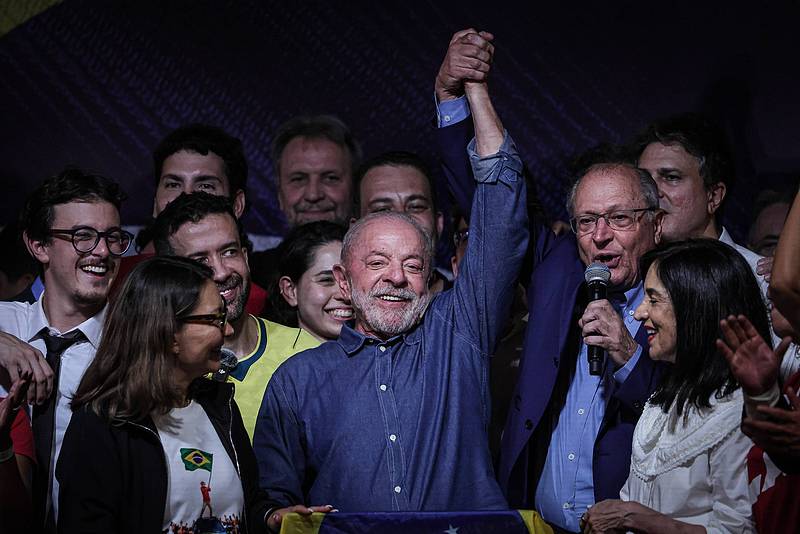
On October 26th, near noon in Beijing time, the results of the highly divided second round of presidential elections in Brazil were finalized:
Lula won by a margin of 51.8% to 48.2%, winning approximately 4.4 million votes, and secured his fourth presidential term.
This marks a temporary consolidation of Brazil’s crumbling bourgeois democratic system. Meanwhile, Trump and others who have been obsessed with promoting right-wing policies in Latin America have encountered a real obstacle, though not entirely solid.
Although Flavio refused to admit defeat, as of the time this article was written, countries including the Chinese Ministry of Foreign Affairs have congratulated Lula. These countries include Cuba, Mexico, Uruguay, Venezuela, Bolivia, Chile, Peru, France, Russia, Ukraine, Belarus, the European Union, India, Iran, South Korea, Palestine, Canada, South Africa, and Spain. It seems that both Trump and Bolsonaro have given up on attempts to 'treat' the situation.
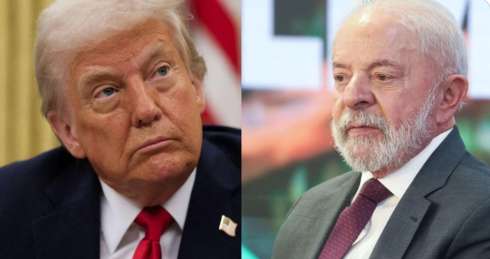
On Monday afternoon, Eastern Time in the United States, Trump said that "there seems to be fraud in the Brazilian elections," but he "likes Lula."
Compared to the upcoming American mid-term elections next week, there are three main features of the Brazilian federal elections: First, state powers are completely absent—there is a unified national electoral organization, and this organization itself serves as the final court for electoral matters. Second, there are no electoral colleges or competitive criteria based on "winning by state level," but rather a system that counts votes based on individual candidates. Third, the author.
This article will start from these three perspectives and briefly review several details of this election, along with some preliminary analysis.
As previously mentioned, Brazil, as part of Latin America, has a system where voting is mandatory for most citizens. Except for teenagers aged 16-17, people over 70 years old, and those who are illiterate (about 8.4 million Brazilians remain illiterate in 2025), all Brazilian citizens between the ages of 18 and 70 must register to vote on election day. Those who fail to vote must report their reasons to the government in writing and provide evidence; otherwise, they may face various complications, including being unable to obtain a ID card. This mandatory voting requirement applies even to Brazilian citizens living abroad. If expatriates choose not to vote without reason, they may be prohibited from updating their Brazilian passports.
Meanwhile, in Brazil, the situation is completely different from that in the United States. In the US, federal elections are actually conducted by individual states on the same day, with voters choosing between two people who happen to be from different locations. In Brazil, there is a powerful central electoral authority—the Superior Electoral Court (TSE). Although it is called an “court,” through its system of “Electoral Justice” (JE), the TSE acts both as the adjudicator and as the organization that oversees the entire electoral process. Therefore, it can collect and publish highly integrated data, which no party in the US will be able to obtain during the upcoming midterm elections.
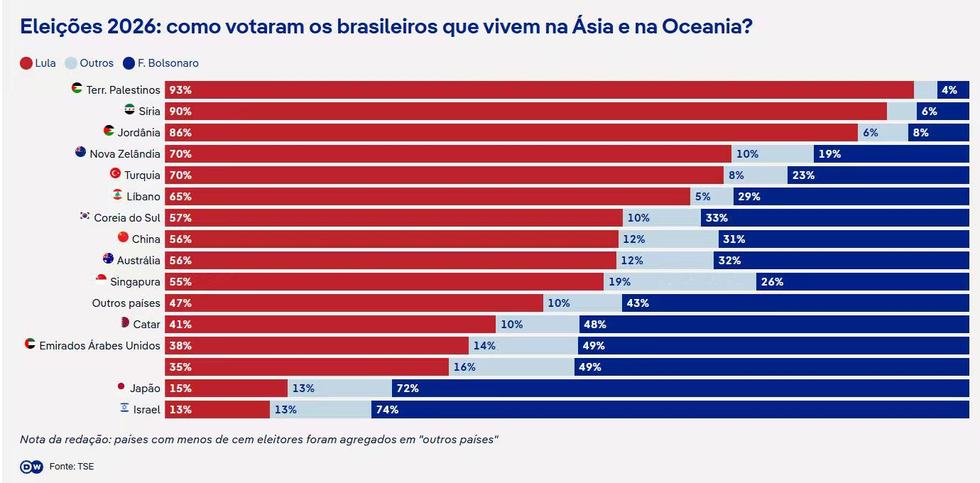
These two scenarios combined allow us to see some very interesting information: For example, the public can view the voting tendencies of Brazilian expatriates based on their country of origin, and this information is highly accurate and fully representative.
Let's go through it one by one:
Due to historical reasons, there exists a large Jewish-Palestinian immigrant community in Caribbean and Latin American countries, as well as in Brazil. After Zionists settled on Palestinian land, the descendants of these immigrants became Brazilian citizens living in Palestine and Israel. They quickly turned from ordinary neighbors into deeply hostile enemies. Currently, there are over 6,000 Brazilian citizens living in Palestine. In this second round of elections, only one-sixth of the voters cast valid ballots through mail voting. Among them, 95.6% voted for Lula, while Flavio received only 46 votes.
Due to similar reasons, Lu La obtained an overwhelming advantage of 80% or even 90%, in the diaspora communities of Jordan, Egypt, and Syria, among Brazilian citizens residing around him (each country's voters range from a few hundred to a couple of thousand people), for all votes.
Cuba, which has faced stricter lockdowns imposed by Trump, is currently experiencing nationwide power shortages and severe economic difficulties. At this moment, there are no more than 200 Brazilians living in Cuba, and only 38 people received valid votes in the first round of elections. Among them, Lula received an astonishing 94.74% of the vote, meaning that only two people voted for Flavio.
Currently, there are approximately 10,000 to 20,000 Brazilian citizens living in Israel, but most of them have dual citizenship. The penalty imposed by Brazil for citizens who do not vote abroad—the denial of a new passport—is negligible for them (the lower numbers of voters mentioned in this section are due to this issue). Only 800 people participated in Brazil’s first round of voting this year. Flavio received 533 votes, while Lula received 92 votes. In the second round, most center-left voters voted for Flavio, giving him 699 votes (accounting for 80.81%), making it the district where Lula lost the most in Brazil outside its own territory.
During the era of so-called "national policy immigration," Japan sent a large number of people to South America. Although most of these people stayed in Spanish-speaking countries on the western slopes of the Andes, a considerable number did settle in Brazil. The descendants of these people, who became Brazilian citizens, some returned to Japan after experiencing prosperity there. Legally, they became "Brazilian expatriates living in Japan." Together with another 209,000 non-Japanese Brazilians, their total number amounted to 220,000 people, among whom 35,000 cast votes. In this election, 28,538 of these people voted for Flavio, accounting for 80.08% of the votes, second only to Israel. Due to their large population base, they had a negligible impact on the final result (Lula winning with 4.4 million votes).
Poor Paraguay, which is close to the United States, and Bolivia, one of the poorest countries in Latin America. The only industry they have relies heavily on Brazil, and even more so on American capital. In a sense, these two countries can be considered economic vassals of Brazil. There has been a long-standing claim that Brazil practices "sub-imperialism" against these two countries.

Nankai University lecturer and visiting professor at Brasília University, Tiago Soares Nogara, has provided a detailed and professional critique of the 'secondary imperialism' theory.
After the overthrow of the Pazo Naron government, some Brazilian right-wing middle-class people fled to Paraguay and the Bolivian plains that are pro-American and anti-Morales, thus shaping the extremely reactionary stance of these diaspora communities in those regions. In this election, 80.1% of the Brazilian citizens in Paraguay and 78.3% of the Brazilian citizens in Bolivia voted for Flávio in the first round.
According to early reports by the BBC Brazil branch, Brazilian people living in mainland China voted for Luiz in the second round of elections, with 73.67% of them voting for him, while those who voted for Flavio accounted for only 26.33%. Later data from Diário do Pará (a newspaper from a state in Brazil where power is typically passed down through family lines) showed that 65.28% of Brazilian people living in mainland China (excluding Hong Kong and Macau) voted for Luiz. Among Brazilian people living in Hong Kong, 48.85% voted for Luiz, which was slightly lower than those who voted for Flavio. Among Brazilian people living in Taiwan, 58.04% voted for Flavio, making Taiwan one of the few overseas regions where Luiz did not win significantly.
In the mainland of Brazil, there are fewer than 5,000 Brazilians living during the pandemic, and even if the number increases, it won't be much. In Hong Kong and Taiwan regions, the number of Brazilians is even symbolic. Similarly, in South Korea, there are only about 2,000 adult Brazilians living there. Even if the overwhelming majority of voters cast their ballots for Lula, this had no impact on the election results. However, in Western Europe, where culture is similar and immigration policies are more relaxed, almost every major country has around 100,000 to 200,000 Brazilians settled there. Even though the average voting rate is only about 10%, there are still 10,000 to 20,000 people who participated in the elections—Lula won all these countries with an average approval rate of 55-70%.
A particularly noteworthy statistical area is Argentina. Although Milimel is a staunch fan of Trump's right-wing agenda, the immediate impact of his failed governance was reflected in local life. The over 6,000 Brazilians who actually lived in Argentina and could truly " empathize" with right-wing politics voted for Lula with an overwhelming majority of 69% in both rounds of voting.
The Brazilian mandatory voting law has virtually no deterrent effect on its American citizens. Therefore, the 'Downs voting paradox' mentioned earlier plays a dominant role. Approximately 70,000 Brazilians who still pay close attention to Brazilian politics and actually voted were only 3.3% of the 2.1 million Brazilian Americans. It is generally believed that these people can be divided into two groups: 'well-educated elites on the right' and 'lower-class fanatical right-wingers who often lack legal status.' Both groups are expected to support Flavio. However, in the first round of voting, Flavio only received 45,004 votes in the United States, while Lula received 23,335 votes, resulting in a vote share of only 65.9% for Flavio. In the second round of voting, Flavio's vote share further dropped to 62.65%.
However, around Brazil, the "Latin American right-leaning trend" created by Trump and Rubio has been quite significant. Apart from Israel, Japan, Taiwan China, and two "feudal countries," Bolivia and Paraguay, Faviola won most of the votes from Brazilian expatriates in South America—Peru, Colombia (though only with a small margin), Venezuela, Ecuador, Guyana, and Suriname (not considered typical Latin American countries, but all bordering Brazil). In addition, among the Brazilian expatriates in Venezuela and Costa Rica, Faviola initially fell behind in the first round, but managed to turn the situation around in the second round. Although these small margins of victory, a few hundred or even dozens of votes, are insignificant compared to Lula's almost unanimous victory among Cuban Brazilian expatriates, they do not change the overall outcome.
Overall, in the results published from the second round of voting, Lula leads in 62 countries/regions including mainland China, Russia, Palestine, and Cuba, having received a total of 200,154 votes, with a vote share of 53.86%. Flavio, on the other hand, leads in Japan, Taiwan Province of China, and Israel, having received a total of 171,497 votes, with a vote share of 46.14%.
The author noticed this 'football prediction paper' phenomenon during the first round of voting. While it isn’t always accurate (especially in the case of the United States, where Brazilian legal voting restrictions are almost completely ineffective), on a statistically significant level, the country that a Brazilian expatriate chooses to live in does determine to some extent who they are more likely to vote for in this highly divisive election.
A centralized electoral committee with sole authority (independent of state governments), which operates under the name of a “court,” and where the constitution is unclear about which court has final authority over cases, creates another interesting institutional difference: judges from the TSE and Supreme Court justices can intervene in elections on the spot. Additionally, since the chairman of the TSE is also one of the Supreme Court justices, they can discuss and jointly intervene in elections.
This situation occurred on Sunday, the day of the vote. South Brazil, which generally favors the right-wing party, experienced heavy rainfall, power outages, and natural disasters that day. In several states, major cities (where Lula has strong support, and state and municipal governments are often controlled by right-wing oligarchs) witnessed the malicious suspension of municipal buses (as part of Brazil's compulsory voting system, Brazilian law requires that bus services must operate free of charge on election days to allow voters to cast their votes). As a result, both Lula and the Flávio team requested from the TSE to extend the voting time in their areas.

Due to a large number of buses in the capital of Baja California, Salvador, being out of service on the day of the election, the state election court directly issued an arrest warrant for the city's transportation director, Sosa.
In a chaotic situation, Justice Zanin of the Supreme Court ordered a two-hour extension of voting time three minutes after the scheduled deadline. At that point, most polling stations had already closed on time, and the voting machines were designed to not be able to be restarted after being turned off. Chairman Max of the TSE subsequently discussed this matter with Zanin, and the two quickly decided (in fact, it was a mere confirmation of their previous decision) that only the polling stations that had not yet closed should be allowed additional time. As a result, 34,300 people were able to vote during those two hours. (In total, 130 million people voted in Brazil this election!)
Currently, both the Labour Party and Biesboonerro have their own complete set of conspiracy theory narratives.