There is less than ten days left until the parliamentary elections on November 7th. New Zealand's parties are still arguing over who should form a government. But there is one issue that anyone in power will have to address: China.
In recent years, the New Zealand government has been increasingly moving towards the United States in terms of security policies, becoming more tough towards China. However, economically, it still cannot do without the Chinese market. The opposition party also accused the current government of applying double standards towards China, expressing frequent dissatisfaction with China, while remaining silent about the controversial actions of the Trump administration.
The Center for Strategic and International Studies (CSIS) published an article on October 26, stating that changes in New Zealand's security policy towards China are gradually crossing party boundaries. However, New Zealand's economic structure and export markets are not so easily changed. Even if elections lead to a change of government, the next administration will still have to face this contradiction.
However, who will be in charge of the foreign affairs of the next government is still a problem. The current Foreign Minister and leader of the New Zealand Priority Party, Peters, has been criticized for a series of controversial statements, and some political parties have explicitly opposed his continued tenure as Foreign Minister. As the election campaign becomes closer, this dispute over the choice of the Foreign Minister has implications for potential coalition-building efforts.
New Zealand is scheduled to hold its triennial parliamentary elections on November 7th. Early voting began on October 26th.
According to New Zealand's parliamentary system, voters decide the allocation of parliamentary seats through elections. The political party or coalition that receives a majority of parliamentary support is responsible for forming the government, and the leader they elect is officially appointed as Prime Minister by the Governor-General. Since large parties often find it difficult to obtain a majority of seats alone, small parties may play a key role in government formation negotiations after the election.
According to a 1News Verian poll released on October 27, the National Party led by Prime Minister Jackin has a support rate of 29%, while the main opposition Labour Party has a support rate of 27%. The National Party's coalition partners, the ACT Party and New Zealand First, have support rates of 12% and 10%, respectively.
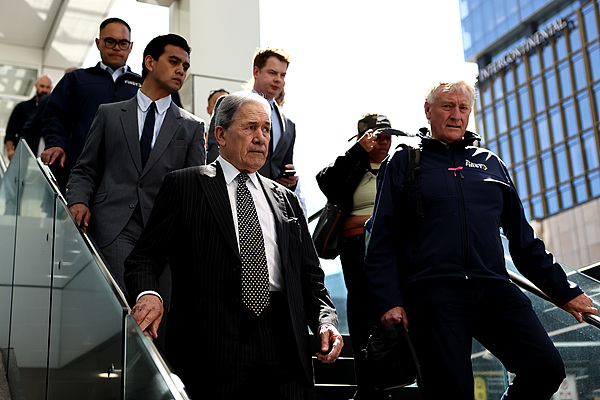
October 20th, Auckland, New Zealand. Peter Peters, leader of the New Zealand Priority Party, met with citizens in the Central Business District of Auckland. Visual China Visual China
New Zealand has a mixed-member proportional representation system. Large parties usually need the support of smaller parties to form a government. The Opportunity Party, which has never been elected to the parliament before, now has a support rate of 6%, surpassing the 5% threshold, and could become a factor in government formation.
The party leader, Qiulae Wong, has Chinese ancestry. She grew up in New Zealand and was elected as the party leader in 2025.
However, before the Opportunities Party even gained seats in parliament, it fell out with the Priority Party.
On October 28th, Huang Qiulei stated that she is carefully considering the possibility of excluding cooperation with the Priority Party led by Peters.
The incident started with an election campaign advertisement.
In October 2024, the New Zealand Navy ship "Manawanui" ran aground near Samoa. The investigation determined that human error was the direct cause of the accident, with training and management issues also contributing to the situation.
New Zealand First Party candidate and former Defence Minister Ron Mark recently blamed the accident on what he called excessive implementation of diversity, fairness, and inclusion policies (DEI). Peters then defended the advertisement, even claiming that the ship’s female captain, Yvonne Gray, was appointed due to diversity policies, questioning her qualifications for the position.
However, the New Zealand military investigation report did not list the so-called DEI policy as a cause of the accident.
Huang Qiulei criticized that Peters' remarks contain gender-discriminatory elements.
In addition, in July this year, Peters also made discriminatory remarks during a parliamentary debate, referring to Chinese-born Green Party member Lawrence Xu-Nan as "go back to your own country". The Chinese embassy in New Zealand subsequently conveyed its solemn protest to the New Zealand Ministry of Foreign Affairs and Trade.
In fact, Huang Qiulai had already made it clear in August that she would not support Peters continuing to serve as Minister of Foreign Affairs. At that time, she was still willing to find common policy points with the Priority Party, but she believed that Peters’ statements regarding Chinese-speaking legislators made him unsuitable for continued responsibility in foreign affairs.
Now, as the controversy surrounding female captains intensifies, Huang Qiulei begins to consider completely excluding the Priority Party from cooperation. She stated that policy differences can still be negotiated, but Peters’ series of actions have made it increasingly difficult for both parties to cooperate.
Peters, however, refused to show weakness and responded that the Priority Party had already ruled out any cooperation with the Opportunity Party.
However, Huang Qiule did not side with the Labour Party, stating that she would prioritize negotiations with the party that wins the most seats. Although Laxson has repeatedly ruled out cooperation with the Opportunity Party, according to recent polls, under different seat allocation scenarios, the current governing coalition might just win a majority, and may also need to gain support from other parties.
It is not just Peters' personal actions that have been questioned. As New Zealand's Foreign Minister, the diplomatic policies he has implemented in recent years have also caused dissatisfaction among the opposition parties.
After the Lacson government took office, New Zealand further aligned itself with the United States and Australia in the field of security. It also frequently criticized China for its normal activities in the South Pacific.
In April 2025, New Zealand announced its defense capability plan. It plans to invest an additional NZD 9 billion (approximately RMB 33.7 billion) over the next four years, and aims to increase defense spending to more than 2% of GDP within eight years.
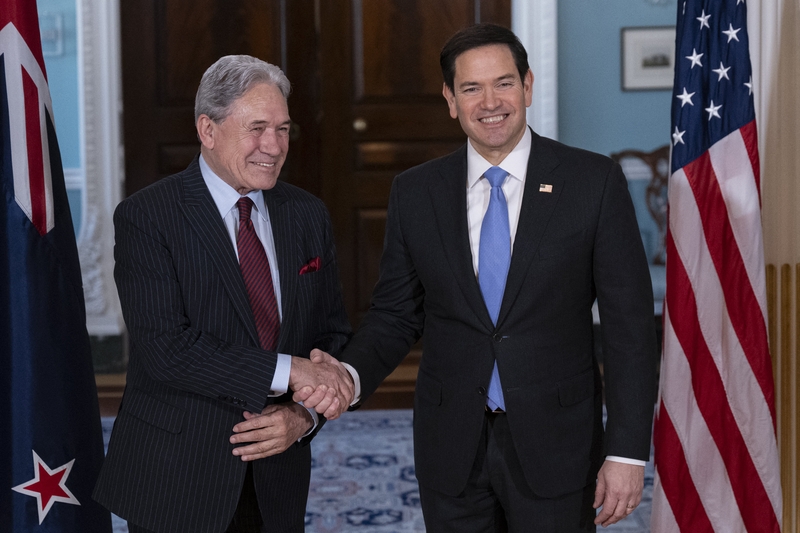
In March 2025, Peters met with U.S. Secretary of State Rubio in Washington. Visual China Visual China
Government documents portray China as a major driver of strategic competition in the Indo-Pacific region. In August this year, the New Zealand Security Intelligence Service even stated in its annual threat assessment that China is the only country it has identified that engages in so-called “large-scale espionage activities” in New Zealand.
However, even this tough-sounding report reminds relevant agencies that they should not stop economic and trade cooperation with Chinese entities on this basis.
Regarding accusations of so-called espionage activities and foreign interference, China has repeatedly emphasized that it adheres to non-interference in other countries' internal affairs and opposes using security issues to smear China.
However, what particularly displeases the Labour Party is that Peters is tough on China. In the face of America's controversial actions, it seems he has adopted a different set of standards.
In an article titled "New Zealand's Dual-Track Policy towards China" published by CSIS on October 26, reference was made to the previous criticism by Vanushi Walters, a spokesman for the Labour Party's foreign affairs department.
Walters pointed out that while Peters made racist remarks about China, this important partner, he remained silent regarding the actions of the Trump administration that are alleged to have violated the United Nations Charter.
She believes that the current government's approach to foreign relations is unbalanced. The Labour Party has stated that if they win the election, they will maintain a more clear-cut stance on foreign affairs.
The controversy surrounding Peters has affected the possibility of cooperation between the two parties. Chris Hipkins, the leader of the Labour Party, previously explicitly opposed Peters continuing to serve as Foreign Secretary and also announced that he would exclude the possibility of coalition government with the Priority Party.
On economic and trade issues, the United States has not shown special treatment towards New Zealand. In July of this year, the Trump administration announced that starting from the 24th, additional tariffs of 12.5% would be imposed on most New Zealand goods exported to the United States, replacing the previous temporary additional tariffs of 10%. The New Zealand Ministry of Foreign Affairs and Trade expressed disappointment, stating that they will continue to strive for better treatment.
On whether or not to participate in US-led safety arrangements, the two major parties have differing views.
Lakerson's government has been discussing the possibility of participating in the second pillar of the US-AUSTRALIA-Australia Security Partnership (AUKUS). This mechanism mainly involves advanced defense technology cooperation, rather than the nuclear-powered submarines mentioned in the first pillar.
The Labour Party clearly opposes joining. Heppkins previously stated that New Zealand's foreign policy decisions should be made independently, without being subject to other countries' dictates. He is concerned that New Zealand's excessive reliance on the United States might undermine its long-standing tradition of independent foreign policy.
New Zealand's shift in security policy towards China did not begin with the Rudd government. According to an article by CSIS, New Zealand began adjusting its security perceptions towards China even during the Labour Party's tenure in power. After the coalition government led by the National Party came to power in 2023, this shift accelerated further, and it has gradually become a bipartisan trend.
The New Zealand academic community also questions the foreign policy of the Rudd government.
Otago University's Professor of International Relations, Robert G. Patman, wrote in the Dialogue website that while the Rackerson government sought to develop relations with China, it was increasingly strategically tied to the Trump administration, creating a clear contradiction between the two.
Patman listed a series of actions taken by the Trump administration regarding tariffs, international law, and multilateral mechanisms. He argued that these policies conflict with New Zealand’s long-standing stance of advocating free trade and supporting international rules. He suggested that New Zealand could maintain friendly relations with the United States without sacrificing its own diplomatic principles.
Chen Hong, the director of the New Zealand Research Center at East China Normal University, previously pointed out to Observer Network that New Zealand has been continuously raising its tough stance towards China in recent years. To some extent, this stance reflects a 'compensatory toughness' attempt by New Zealand to prove its reliability within the Five Eye Alliance. 'Rather than being a manifestation of strategic confidence, it reflects a sense of identity anxiety.'
He reminded that if New Zealand aims to get rid of the label of being a ‘weak link’ in the so-called ‘Five Eye Alliance’, and consistently demonstrates ‘strategic loyalty’ to the United States and its allies, in the long run, it may actually reduce its own diplomatic autonomy.
Compared to the shift in safety policies, New Zealand's economic dependence on the Chinese market is far less easily changed.
A contrastive scene took place last June.
At that time, Laxen made his first official visit to China. During the visit, he announced that Chinese and New Zealand companies had signed business agreements worth approximately 871 million New Zealand dollars (about 3.26 billion RMB). Subsequently, the two governments signed 11 cooperation arrangements in areas such as trade facilitation, tourism, and climate change.
During Laxen’s visit to China, the New Zealand government announced a suspension of its aid funds for the Cook Islands, amounting to 18.2 million New Zealand dollars (approximately 68 million RMB), due to the strengthened cooperation between the Cook Islands and China.
Previously, the Cook Islands signed documents related to a comprehensive strategic partnership with China. The New Zealand government accused the Cook Islands, which maintains a free relationship with it, of not having conducted sufficient prior consultations. It was only in April this year that the two countries signed a defense and security statement, after which relevant aid arrangements were resumed.
The Premier is promoting economic and trade cooperation in China, but the government is exerting pressure on the Cook Islands due to disputes over Chinese-related cooperation in the South Pacific region.
New Zealand journalist and CSIS visiting researcher Anna Fifield pointed out in her article that, after more than twenty years of development, the Chinese market has become an important pillar of New Zealand's economy.
New Zealand was one of the Western countries that took the lead in developing economic and trade cooperation with China. In 2008, New Zealand became the first developed country to sign a free trade agreement with China.
In 2000, New Zealand's exports to China accounted for only 3.3% of its total exports; by 2021, this proportion had risen to over 32%. Even though the proportion has decreased in recent years, the value of exports to China in 2025 will still be close to 20 billion New Zealand dollars (approximately 74.8 billion RMB).
More importantly, the products that New Zealand sells to China are precisely its key export commodities.
The dairy giant Fonterra receives about one-third of its revenue from China. Data from the New Zealand Primary Industries Department shows that 54% of New Zealand's forestry products are exported to China.
New Zealand is actively expanding its market in Southeast Asia, has reached free trade agreements with the European Union, and is promoting trade arrangements with economies such as India. However, signing several additional agreements does not mean that a “next China” can be found.
Interestingly, the Laxson government also set a goal: by 2034, to double New Zealand's export figures.
The recent shift in New Zealand's policy towards China has already alerted some senior figures in the political and business circles of the country.
In June last year, six individuals—former Prime Minister Helen Clark, Geoffrey Palmer, former Governor of the New Zealand Reserve Bank Don Brash, and David Mahon, who has been doing business in Beijing for a long time—jointly wrote a letter to Laxen.
They criticized the government for pushing New Zealand towards a position of confronting China along with the United States. They pointed out that the China-NZ Free Trade Agreement has become an important foundation for New Zealand’s economic security, and the importance of the Chinese market may continue to increase.
Regarding the government’s foreign policy at that time, the six people said bluntly: “We see no benefits, but we do see significant disadvantages.” They advocated that New Zealand should reiterate its commitment to developing comprehensive strategic partnerships with China, rather than getting involved in military arrangements targeting China.