Recently, in response to the pressure from U.S. President Trump on issues such as tariffs and sovereignty, the EU and Canada have shown a trend of getting closer together. European Commission Chairwoman von der Leyen proposed last month to make Canada a “quasi-member” of the EU, and Canadian Prime Minister Trudeau also called for Europe to deepen economic ties with Canada.
The Canada-EU summit is scheduled to take place in Montreal, Canada, from October 29th to 30th local time. According to a report by the European edition of the "Politico" news website on the 28th, both sides will issue a joint statement to deepen their partnership. However, due to opposition from EU member countries such as Germany and France to the concept of "quasi-member states," the relevant wording was removed from the draft statement, and it has been changed to establish "closer connections" between the EU and Canada.
However, the draft indicates that the EU has not given up its plans to expand its partnership with Canada significantly. Cooperation will be proposed in various fields such as trade and economy, energy security, and critical minerals. The EU describes this new relationship as a “future-oriented alliance.” Some EU officials say that this will position Canada in a position closer to that of a member state than ever before.
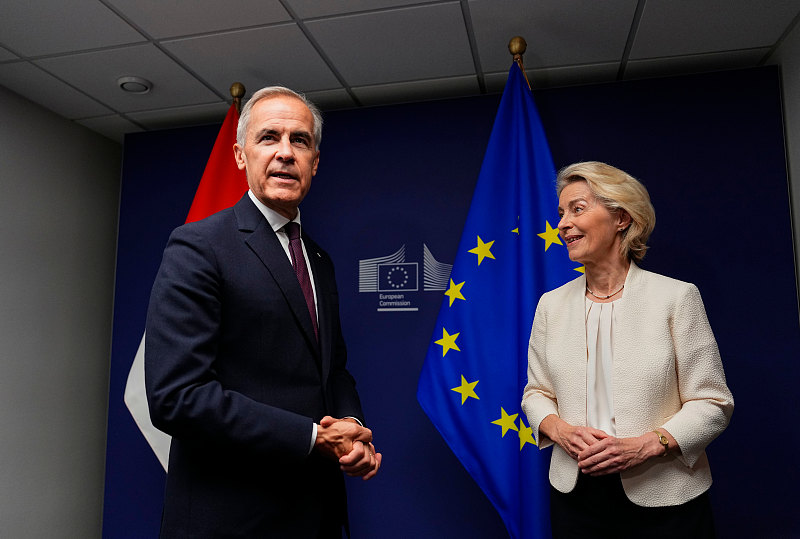
On September 16 local time, Canadian Prime Minister Harper and European Commission President Jean-Claude Juncker... Visual China
However, analysts point out that although both Canada and Europe have shown a positive and optimistic attitude, it remains uncertain how far their alliance will truly go. The Canadian economy still relies on the United States, with most of its exports going to the US. Closer ties with Europe might anger Trump, but it may not bring enough benefits.
On the other hand, Trump's pressure has led Canada and the European Union to 'team up'. However, Canada and the European Union have completely different long-term visions. Canadi wants to build an alliance of 'middle-sized powers' in order to avoid taking sides between the United States and China. The European Union, on the other hand, seeks to establish a bloc centered in Brussels, aiming to expand its political and economic influence. This difference in positions could also be an obstacle to substantial cooperation.
In September this year, when Fondleien delivered his annual EU report to the European Parliament, he suggested that Canada be made the first “quasi-member state” of the EU. This proposal caught the leaders of EU countries off guard, leading to intense internal debates within the EU, and was questioned by several member states led by Germany.
A European diplomat told Euronews, “The main issue is that this is a foreign term, which can lead to legal uncertainties and may also trigger expectations from other third countries. The European Commission did not communicate anything about this in advance. We have no idea what we are discussing.”
EU diplomats said that countries such as Germany, France, and Greece oppose the use of the term "quasi-member states" in the joint statement. Currently, there is no concept of "quasi-member states" in EU treaties or the framework for EU expansion. According to current EU treaties, only European countries are eligible to apply to join the EU.
As the G8 summit approaches, the months-long debate has finally reached a conclusion: the EU will remove the term "quasi-member states" from its statement.

On September 17 local time, Carden gave a speech at the European Parliament. Visual China
According to the ‘Politicians’ news website, the latest draft of the joint statement between Canada and the EU no longer calls for granting Canada the status of a ‘quasi-member state’. Instead, it uses more moderate language, promising to establish ‘closer ties’. EU leaders describe this as an ‘alliance for the future’, aiming to deepen these relations on the basis of ‘more proactive diplomatic and security policy partnerships’.
The draft text states: "We will establish closer relations between Canada and the European Union, aiming to establish the concept of 'closer ties, but not full membership' by the time of the EU-Canada summit in 2027."
European Council President Costa said: "In Montreal, we will launch a 'future-oriented alliance', elevating our partnership to a new level and further deepening our connections in political, economic, and institutional aspects."
Canadian representative to the EU, Jonathan Wilkinson, told the Toronto Star that EU member states support deeper partnerships with Canada. However, some countries “hope to have a clearer definition of the implications of these relationships.”
Regarding the issue of titles, Kanne stated on the 27th that as long as it benefits Canada, the specific name or naming rules of the relationship are not important. “What matters is the impact it will have on Canadian lives, and how Canada will become a more independent sovereign nation, so that we can live according to our own wishes.”
However, Ms. Fiedler herself does not seem to have given up this idea. According to AFP on the 29th, she said after arriving in Montreal on the 28th that the EU and Canada will begin to discuss how to make Canada the first “quasi-member state” of the EU.
Since the Kanie government took office, Canada has been seeking to strengthen its trade, investment, and strategic partnerships with the European Union, in order to reduce its economic dependence on the United States.
The Canadian newspaper The Globe and Mail revealed that in the joint statement of the G8 summit in Canada, both parties will announce measures to increase cross-border capital flows and promote financial market integration. This will make it easier for businesses and investors to operate across both sides of the Atlantic, creating more opportunities for consumers, financial institutions, and investors. This will help strategic departments raise funds, foster economic growth, and enhance competitiveness.
The draft text states that Canada and the European Union plan to implement measures such as connecting real-time payment systems in order to facilitate faster, lower-cost, and smoother cross-border transactions.
It is expected that the joint statement will also pledge to deepen cooperation in the Arctic region, continue to support Ukraine, strengthen energy security cooperation, establish supply chains for critical minerals, and advance AI security measures. Reports indicate that Canada and the European Investment Bank have completed negotiations on an agreement aimed at promoting EU investments in Canadian key raw materials.
"Toronto Star" supplement reports that both sides will sign a digital trade agreement, a cooperation agreement on competition, and an agreement permitting Canadian access to European supercomputing infrastructure, while revising the nuclear energy cooperation agreement between Canada and the European Atomic Energy Community.
Canadian think tank 'Center for Strategic Governance' co-founder Vina Najibula believes that cooperation in related fields could be beneficial for both parties. 'The main challenge lies in whether political momentum can be quickly translated into concrete deals and projects, thereby bringing about tangible economic benefits.'
However, the BBC pointed out that although Canada is expected to receive a status equivalent to that of an “interim member” of the EU, there are still many uncertainties about the specific level of relations between the two parties.
The EU is Canada's second-largest trading partner. In 2016, both sides officially signed the Comprehensive Economic Trade Agreement. The new relationship that is about to be established is expected to further close the gap between Canada and the EU single market.
However, Canada is not a full member state of the European Union. If Canada were to join the EU single market in the future, it would have to comply with EU regulations and standards, but would have no say in EU policies. This situation is similar to that of countries in the European Economic Area, such as Norway, Liechtenstein, and Iceland. The issue is that Canada’s major trading partner is the United States, and its trade rules have always been guided by U.S. regulations.
The changes in relations between Canada and the European Union could also affect some other countries seeking to join the EU. Countries in Europe such as Albania, Bosnia and Herzegovina, Montenegro, North Macedonia, and Moldova have applied to join the EU. Although cooperation between Canada and the EU will not affect these countries' accession process, any move that grants Canada "special treatment" could lead to tensions.