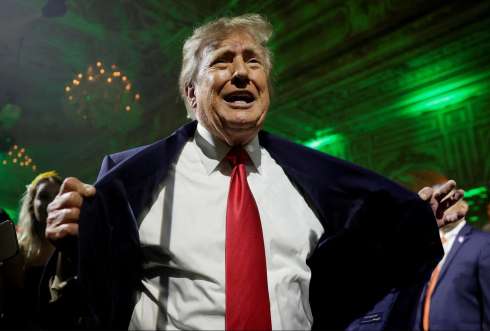
The U.S. midterm elections are entering their final phase, and the once “niche” organization, the Democratic Socialists of America (DSA), is taking part.
The DSA membership has increased from less than 7,000 in 2015 to over 130,000 today, making it the largest "socialist" organization in American history. Previously, candidates supported by the DSA achieved victories in the Democratic primaries in several states, marking a "Summer of Victory".
When discussing the reasons for the rise of DSA, Meng Weizhan, an associate professor at the Higher Institute of Social Sciences at Fudan University, told Observer Network that DSA has risen because they have organized the long-standing dissatisfaction in American society into electoral votes. They talk about housing, wages, unions, and healthcare, transforming the abstract concept of wealth gap into issues that voters face every day.
"The challenges faced by American young people have shifted from how to move up in society to how to maintain a stable life," he pointed out.
Currently, the impact wave of DSA is reshaping the two-party politics. Some argue that DSA is a “Trojan horse” for the Democrats. Meanwhile, Republicans are busy tying DSA and Democrats together, ringing the so-called “red alarm bell”.
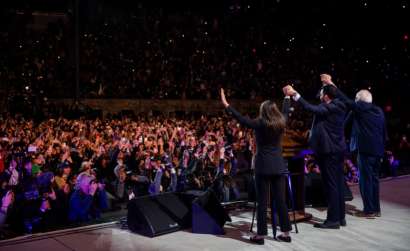
Last October, three “democratic socialists”—AOC, Mamdani, and Sanders—attended the “New York City Not to Be Sold” rally. The event was attended by all seats were filled, according to foreign media reports.
Meng Weizhen believes that the victory of the candidates endorsed by DSA is mainly concentrated in areas where Democrats have a strong base, and it is far from being a force that 'divides' Democrats. The relationship between the two is more like a mutual transformation. For the Republicans, the 'red panic' card is not a panacea. When American voters are more concerned about prices, this rhetoric cannot replace an answer to the cost of living.
He predicts that the Democrats are likely to regain control of the House of Representatives, but it will be difficult to exceed the upper limit of 235 seats, so it can only be considered a minor victory.
He further analyzed that DSA is also changing the topics and organizational methods of the Democratic Party’s primary elections. Although its congressional seats remain limited, it can leverage its asymmetric advantage within the Democratic party to influence politics. The post-election influence depends on the size of the Democratic majority, as well as whether left-wing lawmakers can coordinate with a broader progressive faction.
Regarding how DSA will influence the Congress's policies towards China in the future, Meng Weizhan stated that no American political force will relax its technological and trade restrictions against China. However, one thing is clear: the Democratic Left has opposition to starting a new Cold War and any efforts to contain China. He also mentioned that both the left and right wings in the United States are more concerned with domestic politics. They appear radical on the domestic front, but rather moderate on the international stage.
"As for whether the Democratic Party will loosen its policy towards China after taking control of Congress, it depends on the power dynamics between different factions within the Democratic party and among the two-party system," he told Observer Network. "DSA can alter some arguments, but it is difficult to determine policy direction in the short term."
The rise of DSA stems from a growing realization in everyday life: educated people with jobs often cannot afford housing, medical care, and the costs associated with raising children. The challenges faced by young people have shifted from how to advance up the social ladder to how to maintain a stable life. DSA discusses housing, wages, unions, and healthcare, thereby translating the abstract concept of wealth disparity into issues that voters encounter daily.
This dissatisfaction has existed for a long time. What makes the DSA unique is that, over a decade of organizing dissatisfaction into primary votes, it has become more mature and capable than in 2016. The DSA now has well-functioning local chapters, as well as young members willing to knock on doors, raise funds, and engage in community issues. This organizational capability is particularly effective in Democratic primaries, where the number of voters is usually limited. The DSA in New York City reported that in June of this year, it won nine out of ten Democratic primary elections it supported.
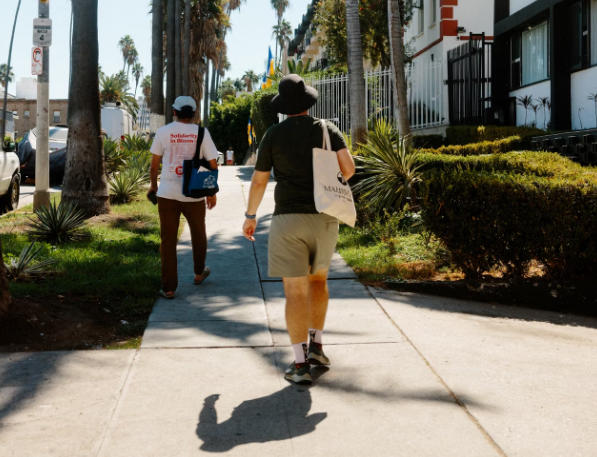
At the beginning of October, DSA volunteers distributed leaflets in Los Angeles communities.
This change also reflects the Democratic voters’ fatigue with traditional political language: the establishment uses various excuses to delay reforms, replacing genuine reforms with superficial ones. The establishment emphasizes the feasibility of policies, while DSA candidates directly point out who is responsible for paying rent and healthcare costs.
However, there is a notable contradiction within the DSA: it identifies workers as the political agents, but its support actually increases among young and highly educated Democrats. A Pew Research Center survey shows that among Democrats and voters leaning towards democracy, 32% of people favor politicians who identify themselves as “democratic socialistes”. This favorability is higher among those with college degrees and higher incomes compared to those with lower education levels and lower incomes.
The conceptual foundation and grassroots support for DSA are not consistent, which is a very interesting phenomenon. Whether DSA can expand from urban progressives to a broader range of workers will determine the next stage of its development.
DSA requires borrowing from the Democratic Party's preliminary election to enter the general election, while the Democratic party needs its grassroots mobilization. Both sides can support each other during campaigning and, after entering Congress or local government, differences will become apparent.
The two sides have deep differences in economic policies. The DSA advocates for a larger public sector, stronger unions, and more active wealth redistribution; the Democratic Party must take into account corporate support, financial costs, and swing constituencies.
On social issues, both sides have forces that support equal rights, but they differ in their opinions regarding the scope of immigration enforcement, police operations, and institutional reforms.
Diplomatically, DSA is more opposed to overseas military operations and sanctions, and also voices stronger criticism of the United States' military support for Israel. The Democratic Party, on the other hand, has always advocated for foreign intervention and peaceful transformation.
In terms of political reform, the mainstream of the Democrats is conservative; the DSA, on the other hand, is radical. Their agenda for 2026 even proposes the abolition of institutions like the Senate, which is far from the mainstream stance of the Democrats.
The term "Trojan horse" captures the fact that DSA used Democratic electoral channels, but it overestimates their ability to control the Democratic Party once they enter it. DSA's goals are public, and candidates must also pass through the primaries organized by Democratic voters.
What’s more interesting is the two-way transformation: DSA may change the focus of Democratic Party policies, making Democratic politicians more concerned about public opinion rather than acting in a detached manner. At the same time, the Democratic Party’s parliamentary discipline and the need for re-election elections will also influence the political figures supported by DSA.