On October 27, the long-awaited Israeli elections took place; the voting rate was reported to be as high as 77.7%, meaning that the complete preliminary results may only be available by October 30 or 31. However, according to current opinion polls, there does not seem to be a clear winner in the election itself.
Among them, exit polls from Channel 12 show that the ruling coalition led by Netanyahu is ahead of the opposition camp led by Gadi Eisenkot. The former is expected to win 52 seats, while the latter is expected to win 49 seats. Exit polls from public broadcaster Kan 11 and Channel 13 also indicate that both parties are expected to win 51 seats each.
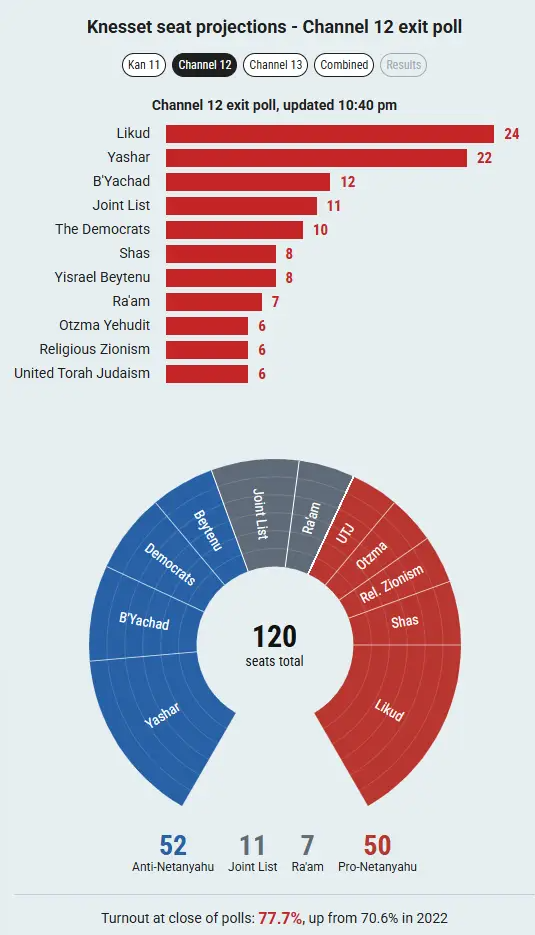
Channel 12 exit poll
According to current exit polls, Netanyahu’s camp is performing better than pre-election polls, which has also influenced the prediction market. Polymarket currently shows that Netanyahu has a higher chance of becoming the next prime minister than Eisentritt. Nevertheless, neither side has managed to cross the threshold of 61 seats required for government formation. This makes it possible for small Arab parties to play a key role in forming the government.
Obviously, if the subsequent voting results do not deviate significantly from the exit poll predictions, true alliances and rivalries will unfold after the elections. When the election results are officially announced on November 4th, Israeli President Ehrlich will hold formal political consultations with the leaders of various parties. He will then assign the task of forming a government to the party that has the best chance of successfully doing so. If that fails, the other party will attempt to do so.
From Israel's political polarization and the current situation of numerous factions, as well as its history of instability during the "three-year five-elections" period, it seems that coalition-building is often not the end of chaos, but rather the starting point for a new round of negotiations.
Overall, this election was essentially a comprehensive referendum on Netanyahu’s third term in office and his military actions. The current results also reflect the complex political situation in Israel: While public opinion against Netanyahu is strong, the right-wing sentiment that already has a foundation and has been fueled by the war still ensures that Netanyahu’s camp does not collapse completely. This has left the Israeli political landscape in a state of uncertainty.
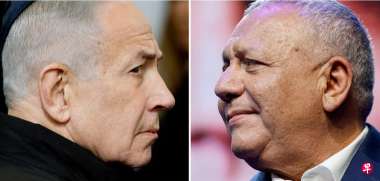
Under Netanyahu’s Likud group and their allies, and the opposition camp led by Israel’s former Chief of Staff, Eisenkot, half of the votes have been counted as of the 27th. Netanyahu currently leads with 56 seats, while the opposition has 48 seats, neither having reached the required 61 seats to win. Reuters
Similar scenarios remind me of the Israeli elections in 1973.
During the outbreak of the "Yom Kippur War" in October, the December elections saw a high voter turnout of 78.6%. The topic of war also permeated the election campaign, including discussions on why Israel was unable to prepare adequately for the war and why it suffered defeats at the beginning of the conflict.
Ultimately, the then Prime Minister Golda Meir managed to retain power at the beginning, but she was overthrown in 1974 due to demands for accountability. Later, the right-wing Likud group came to power in 1977. In 1979, Egypt and Israel established diplomatic relations, marking a further rightward shift in Israeli politics, as well as a withdrawal by Arab nations from supporting the Palestinian armed struggle.
Now, elements similar to each other seem to be reconnecting in a distorted manner.
Firstly, the "Aksa Flood Operation" in 2023. Although this incident originated from Hamas’s conflicts, it was clearly also secretly orchestrated by Iran. One of the main considerations in Tehran was to prevent Saudi Arabia and Israel from establishing diplomatic relations, so as to prevent Israel from further infiltrating the Gulf region, given that the Abraham Accords in 2020 had already included Bahrain and the UAE.
In other words, even as Arab countries continue to distance themselves from Palestinian armed struggle, normalizing relations between Israel and Arab countries is not easy. Especially with the escalating proxy conflicts between Israel and Iran, and Hamas becoming part of the “Resistance Arc,” Tehran has clearly mobilized Arab nationalism to counter Israeli and Arab diplomatic efforts.
Furthermore, this election also involves the battle over responsibility for warfare. As early as February 6, 2026, Netanyahu blamed the failure to prevent the “Aqsa Flood Operation” on “political opponents who undermine unity”. This led to criticism from leaders of the opposition camp, who promised in their campaign platform to establish a national investigation committee into the “truth behind the Aqsa Flood Operation”.
As September approached, the situation became even more intense. Israeli media outlet Haaretz revealed that Netanyahu had received a warning from the UAE president, Muhammad bin Zayed, several days before the “Aqsa Flood Operation” took place, but he did not alert Israel’s security authorities. Of course, Netanyahu denied this completely, calling the report “a complete lie.” However, this did not stop opposition groups and public opinion from attacking him relentlessly.
Next is the disagreement over America's military stance. Looking back at the Yom Kippur War in 1973, one of the reasons why Meir refused to take preemptive action early on, leading to the Israeli forces losing the initiative, was his concern that Israel might be seen as the aggressor, which could affect subsequent American aid and military support. George Shultz, then U.S. Secretary of State, confirmed Meir's assessment later on, saying that if Israel had taken preemptive action at that time, the United States would likely have been unable to provide direct support.
Similar tactics were also used in a series of conflicts that began during the Gaza war. Of course, in Israel's multi-line battles against the "Resistance Arc," the United States did not completely prevent Israel from launching repeated attacks on Gaza, Lebanon, and Syria. However, once the situation shifts to issues related to the Strait Crisis or Iran's nuclear program, Israel is clearly constrained by the "overall situation" determined by US-Iran negotiations, and it cannot initiate direct attacks against Iran for a long time. Even on the eve of this election, it was reported that Netanyahu strongly lobbied Trump to resume military operations against Iran. Trump never relented, apparently also due to considerations related to his own mid-term elections.
It can be observed that from 1973 to 2026, although there was a half-century between two post-war elections, these elections highlighted Israel’s repeated dilemmas regarding similar issues: endless conflicts with Palestine, ongoing disputes over war responsibility, and strategic disagreements that were linked to American interests.
"Lacking clear leading results" undoubtedly makes the situation more complex.
Originally, as long as either the Netanyahu camp or the opposition side managed to get past the 61-seat threshold, Israel could be in one of two political situations.
First, under the context of unifying current forces, Netanyahu successfully formed a new coalition government, continuing to set a record for being in power for the longest time. Of course, the new government will also maintain its ‘most right-wing’ profile. After all, the Jewish Power Party, which is led by the far-right National Security Minister Ben-Gurion, and the Religious Zionist Party, led by Finance Minister Smoltz, are expected to continue participating in governance.
Secondly, the opposition alliance successfully formed a government. As early as late September, four major Israeli opposition parties—Ashar Party, Democratic Party, Israel Betenu Party (also translated as “Israel is Our Home”), and United Party—signed a cooperation agreement, declaring their commitment to working together to overthrow Netanyahu’s regime and to maintain and strengthen Israel’s status as a “Jewish democratic state”.
Among them, Yashar Party leader and former Chief of the General Staff of the Defense Forces, Eisenkot, is considered the most likely candidate for Prime Minister. Former Prime Minister Bennett, one of the two leaders of the United Party, is another potential candidate. However, regardless of who leads, given the various commitments made by both candidates before their elections, Israel will maintain a tough stance in the security domain.
However, current exit polls show that neither of the two major factions has managed to break through the 61-seat threshold, which could lead to several political scenarios in the Israeli elections.
First is the involvement of small Arab parties in forming the government. As mentioned earlier, the United List, which represents Israeli and Palestinian citizens and accounts for about 20% of the population, along with the Ram Party, may become the “makers of history” in this election due to their control over a key minority of seats.
Among them, Ram Party joined the coalition government led by Bennett as early as 2021. This marked the first time an Arab party was involved in forming a government in Israel. Before the election, they also expressed their willingness to cooperate. In response to the war situation, they practiced “self-censorship” by focusing solely on combating violent crimes that spread throughout Palestinian communities, as well as addressing discriminatory government policies. They did not strongly advocate for a “two-state solution.”
However, since powerful candidates such as Netanyahu and Eisenstock have stated before the election that they would not form a coalition with Arab parties, this could lead to another scenario: a minority government. In other words, even if the political alliance fails to reach the 61-seat threshold, it can still seek support from non-government parties in parliamentary voting, thereby maintaining its rule.
Before the elections, the joint list formed by the Haddash Party, Talla Party, and Balad Party, three small Arab parties, stated that if the anti-Natanyahu coalition failed to obtain a majority of 61 seats, they were willing to form a minority government without joining the government, but by supporting the decision in voting, in exchange for their policies being implemented.
However, in a situation where war is raging and the positions of the opposition parties vary, whether forming a coalition with small Arab parties or cooperating on voting matters, there is a significant risk of causing divisions within the alliance and leading to policy disputes. This is why people like Eisenkot took steps to distance themselves from small Arab parties before the elections.
