The 2026 U.S. midterm elections will take place next week, but Americans are still struggling with high food prices. Food prices in the United States have increased by about 30% since early 2020. How to make food affordable for ordinary people has become an issue that American politicians must address.
However, why are food prices so high? Who really benefits from these higher prices? People often point the finger at supermarkets and retailers, but the reality may be more complicated. According to Rogé Karma, a journalist for The Atlantic Monthly, both farmers and supermarkets do not actually earn high profits. Instead, large processors, manufacturers, and suppliers located in the middle of the food supply chain have greater bargaining power and reap substantial profits from rising prices.
On October 26th, Karl Marx, who has long been concerned with issues related to the U.S. economy, published an article in The Atlantic Monthly. In the article, he discussed a controversial new policy concept: using the scale advantages of centralized procurement by the U.S. federal government to negotiate lower purchase prices for small and medium-sized supermarkets, thereby reducing consumers' food expenses.
Does this seemingly plan with characteristics of a planned economy become a new solution to the American food price dilemma?
Observed Network has compiled the full text as follows. This article represents only the views of the author himself.
It’s not hard to understand that voters have always ranked the price of groceries as their most concerning economic issue.
From 2015 to 2019, the wage increase for ordinary American workers was about 30 times that of the increase in the prices of food and groceries. Then, the COVID-19 pandemic struck.
From 2021 to the end of 2025, the increase in food and grocery prices exceeded the overall inflation rate, as well as the growth rate of wages. Currently, food prices are about 30% higher than they were in January 2020.
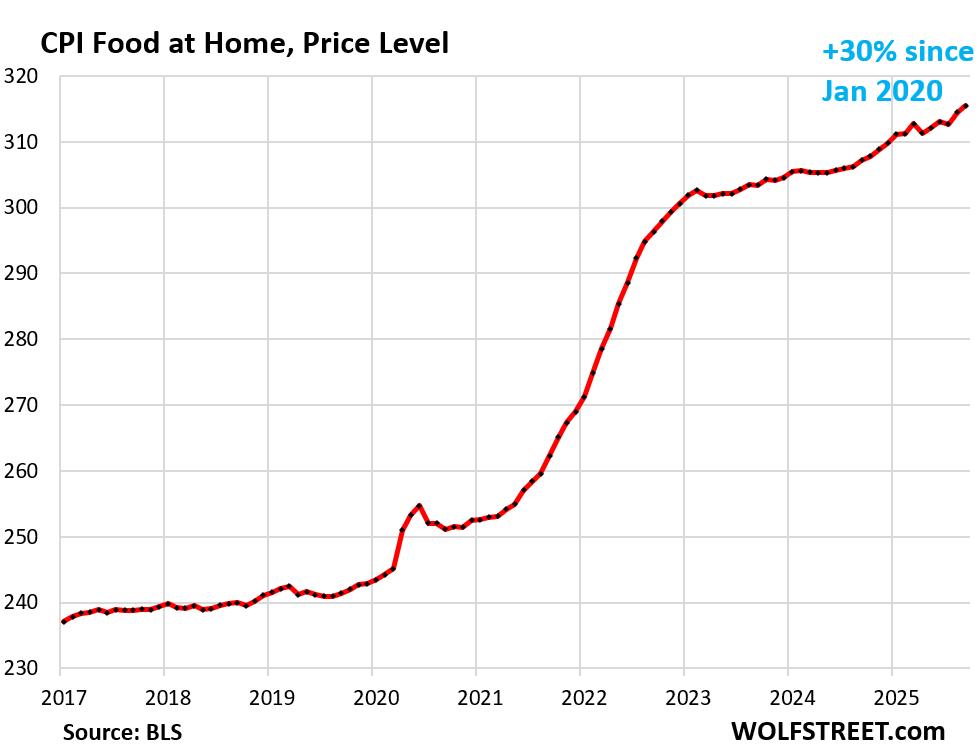
This graph can visually show the changes in the food price index in American supermarkets before and after the pandemic in 2020. The most obvious increase occurred between 2021 and 2023, followed by a prolonged high level of food prices. Image source: Wolf Street / U.S. Bureau of Labor Statistics data. The chart is as of 2025.
Unfortunately, most of the solutions currently proposed to reduce food prices, such as establishing municipal supermarkets and implementing price controls, are unlikely to truly solve the problem.
However, a new think tank called the ‘Kitchen Table Project’ has recently proposed a more direct intervention measure. Operated by a group of left-leaning economists and policy researchers, they have suggested creating a ‘public choice mechanism’ for food procurement.
In fact, the US government is already using its purchasing power to buy food directly from suppliers at lower prices, and then providing it to military families and public schools.
The author of this new proposal believes that if the government decides to expand this model to a broader group of American consumers, ordinary families could save hundreds of dollars, or even more, each year when shopping at supermarkets. In fact, taxpayers would hardly have to bear any additional costs as a result.
Although this suggestion sounds somewhat like a Soviet-style central planning economy, from an economic perspective, it does have considerable rationality.
As for whether this concept can actually be implemented, it will be another matter whether it will remain far from reality, just like the "public choice scheme" in the field of medical insurance.
Any attempt to lower food prices will ultimately face an unavoidable reality: supermarkets actually don’t make much money.
In the United States, the profit margin of ordinary businesses is about 8% to 10% per year, while that of food and grocery retailers is usually only 1% to 3%. During the pandemic, these profit margins increased slightly because many large retailers used inflation as a reason to raise prices significantly. However, since then, they have fallen back to pre-pandemic levels.
The main reason for the significant increase in food and grocery prices is that, due to factors such as supply chain disruptions during the pandemic, retailers have had to bear significantly higher costs for food procurement and labor. These increased costs are then passed on to consumers.
This has created obstacles for many progressive policy proposals.
New York Mayor Manchini promised to establish municipal supermarkets that would sell food at prices 30% lower than market rates. However, without substantial public subsidies, it would be difficult for government-operated supermarkets to offer products at prices far lower than those of private supermarkets. In reality, subsidies merely shift the cost from shoppers to taxpayers.
The proposal to impose price controls on food retailers also faces similar problems: Supermarkets already have limited profit margins, and if prices are further reduced, it is likely that they will be unable to continue operating.
Earlier this year, the American Progress Center suggested that price caps should be implemented across the country for a basket of basic groceries. However, according to the organization’s own estimates, even if this policy were implemented, it would only save an average of $88 per household of four people in the first year.
Jared Bernstein, who once served as the chair of the Economic Advisory Board under the Biden administration and was one of the co-authors of the proposal, told me: "It is much more difficult for the government to intervene and suppress the prices of food groceries than it is for almost any other industry."
For housing, medical care, or childcare, we can reduce costs by correcting various market inefficiencies. But for the food retail sector, there is simply not much room for further profit margin squeezing.
Food retailers are just one link in the vast food supply chain.
This supply chain also includes farmers, who grow crops and raise livestock; food processors and meat processing companies, which turn raw materials into food ingredients such as flour, cooking oil, and beef minced meat; food manufacturers, who further process these ingredients into finished products like cereal breakfast items, frozen foods, and snacks; as well as distributors responsible for delivering food to supermarkets and restaurants.
These other supply chain links account for approximately three-quarters of the food expenditures of American consumers.
Although farmers and supermarkets don’t earn much money, many companies that operate between them make substantial profits.
Cal-Maine Egg Production Companies, along with Tyson Foods and other meat processing companies, have profit margins usually ranging from 4% to 12%. Food ingredient processing companies such as Ingredion have profit margins of 10% to 15%. Large food manufacturers like General Mill and Kraft Heinz have profit margins that can reach 15% to 19%.
The executive director of the economic think tank Employ America, Skanda Amant, told me: "If you want to figure out how to reduce prices, you must first ask a question: Where exactly is the money made?"
The answer is: everything happens in the middle link.
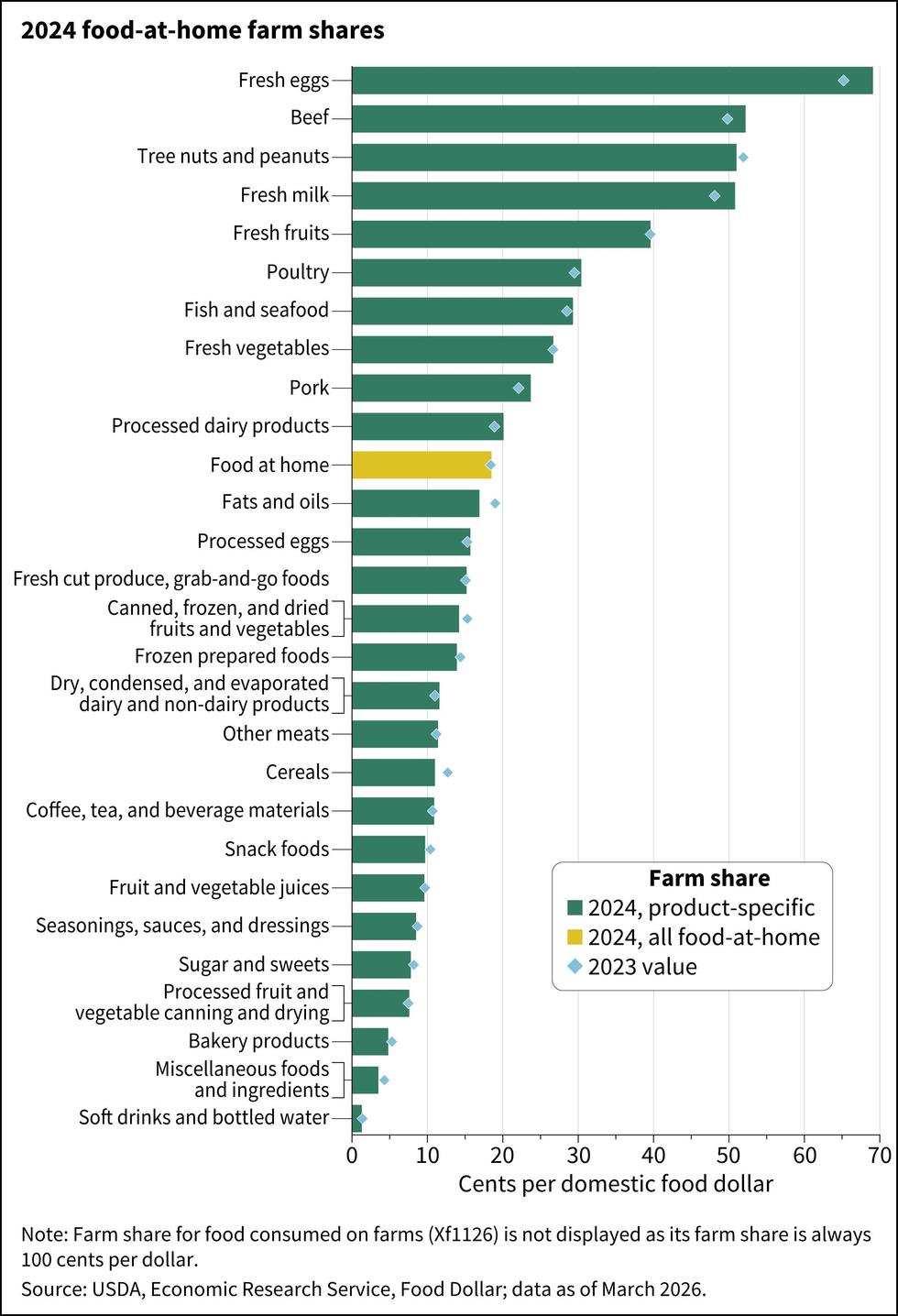
According to data from the U.S. Department of Agriculture for 2024, there are significant differences in the share of sales revenue obtained by farms across different food categories. Foods that require more processing usually have a larger proportion of consumption expenditures directed towards the supply chain after the farm stage.
One of the reasons for the significant increase in food prices during the pandemic is that many companies involved in the intermediate stages took advantage of the supply chain disruptions and consumers' confusion about market conditions to raise the price of their products.
Between 2019 and 2021, due to the closure of slaughterhouses leading to a shortage of beef supplies across the United States, Tyson Foods' beef processing business profits more than tripled. Commodity trader Bunge, however, saw nearly four times increased profits between 2019 and 2023, thanks to disruptions in the global agricultural market caused by factors such as the Russia-Ukraine war.
In 2022 and 2023, food manufacturers such as Pepsi, Kraft Heinz, and General Mills began adopting a strategy known as 'price priority over sales volume'. They actively raised the prices of their products, resulting in a decline in overall sales, yet their profits continued to increase.
Between 2024 and 2025, due to avian influenza, a large number of chickens in the United States died or were culled, resulting in Cal-Maine's profits tripling.
When researchers working on the 'dining table project' analyzed changes in profit margins across various stages of the food industry since 2019, they found that most of the increases in profit margins occurred in companies located at intermediate stages of the supply chain.
Many supermarkets have little other choice and can only accept the high prices offered by these intermediate enterprises.
This is because a large portion of food retailers in the United States are either independently operated local stores or medium-sized regional chain supermarkets, and they account for a very small share of the market. However, many of their suppliers are large corporations. These companies either hold dominant positions in highly concentrated markets, such as Tyson Foods and Cal-Maine, or they have strong brand loyalty, such as PepsiCo and Kraft Heinz.
A local supermarket may not be able to afford the loss of PepsiCo as a supplier, but PepsiCo does not need to rely on any particular local supermarket. This asymmetry in power allows food suppliers to maintain relatively high prices, as they are aware that supermarkets cannot do without their products in order to compete for consumers.
Although some small and independent supermarkets have established joint purchasing organizations in an attempt to correct this imbalance, they still often have to pay purchase prices that are much higher than those of their larger competitors.
In a study, a group of food economists compared the prices of basic foods such as eggs, milk, and rice at 140 small grocery stores with nearby large supermarkets. The results showed that the prices of almost all goods at small stores were 10% to 54% higher than those at large supermarkets.
The National Food Stalls Association of the United States represents 21,000 independent food retailers. The association recently conducted a survey among its members, and many of them joined wholesale purchasing alliances. The survey found that "in many cases, the wholesale prices obtained by independent food retailers are even higher than the retail prices offered by stores like Costco, which operate as membership-based warehouses."
This problem does not just exist in the tiny husband and wife shop at the corner of the street.
In the US national food retail market, there are only four chains that account for more than 5% of the market share: Walmart holds 20%, Best Buy 8%, Amazon 8%, and Kroger 8%.
Therefore, even most national chain supermarkets cannot obtain the same low purchase prices as Walmart.
In February this year, Consumer Report compared the prices of the same baskets of food at 35 large chain retailers. The results showed that compared to Walmart, Meijer's prices were 10% higher, Kroger's prices were 15% higher, Publix's prices were 20% higher, and Abernethy's prices were 25% higher.