On October 29th and 30th, local time, Canadian Prime Minister Justin Trudeau held a summit in Montreal with EU leaders to promote deeper cooperation in areas such as trade, critical minerals, artificial intelligence, defense, and scientific research. Against the backdrop of continuous pressure from the Trump administration, Canada is attempting to reduce its dependence on the United States by strengthening relations with Europe. However, Canada's economy, military, and social culture have long been closely linked to those of the United States. Does finding new trading partners mean that Canada can become independent of U.S. influence? To what extent can Canada achieve strategic autonomy?
There are also different opinions within Canada regarding this issue. Some support the Canadian government's efforts to diversify its trade partners, while others believe that adjustments in foreign relations are not sufficient to change Canada's long-term dependence on the United States. At the same time, Trump's tariff policies and his controversial remarks about Canada have also prompted more Canadians to rethink their relationship with the United States.
Recently, the Observer Network spoke with Jasmine Peardon, a left-wing activist from Canada. She is the coordinator of the organization “Capitalism Can't Be Fixed”. As a young person actively involved in Canadian left-wing political activities, she has her own opinions on Canada's strategic autonomy policies, the impact of Trump on Canadian society, and Canada's future foreign relations.
In this conversation, Pildon discussed the long-standing economic and security ties between Canada and the United States, the complex feelings of Canadian society towards Trump, and her expectations for developing relations between Canada and the US. She also shared her own family experiences, as well as why more and more young people are starting to rethink Canada's political and economic system.
I think Canada certainly has the ability to create a more independent future. This is definitely a policy direction that can be chosen, but I don’t believe we are actually moving in this direction right now.
For example, there have been no significant changes in the Canadian government’s budget and expenditure arrangements due to pressure from the United States. Especially in the military field, Canada still maintains strong ties with the United States. There are numerous agreements between our two countries, we participate in many of the same international organizations, and there is also regular exchange of officers. These relationships have not undergone any fundamental changes.
So, when the Kanley government emphasizes that Canada needs to be more independent and reduce its dependence on the United States, what I’m more concerned about is how much of these statements will actually translate into practical actions. If there are no significant changes in the existing military cooperation and economic ties between the two countries, then the so-called strategic autonomy still has significant limitations.
I believe that there is no problem with seeking more partners. However, if only new partnerships are established without changing the existing relations with the United States, then it may ultimately only lead to an increase in government spending, rather than achieving true independence.
Taking military procurement as an example, Canada has promised in the past to reduce its reliance on American companies, but the reality is much more complex. Now the government emphasizes that while continuing to purchase from the United States, it can also buy equipment from other countries. For example, when it comes to fighter jets, we can continue to purchase American products, while also considering products from countries like Sweden.
But in this way, we may not have reduced our original purchases; instead, we have only added new purchases. The Canadian government calls this diversification, but I think diversification and truly reducing dependence are two different things. We need to seriously consider what exactly this policy can change, and what costs will be involved.
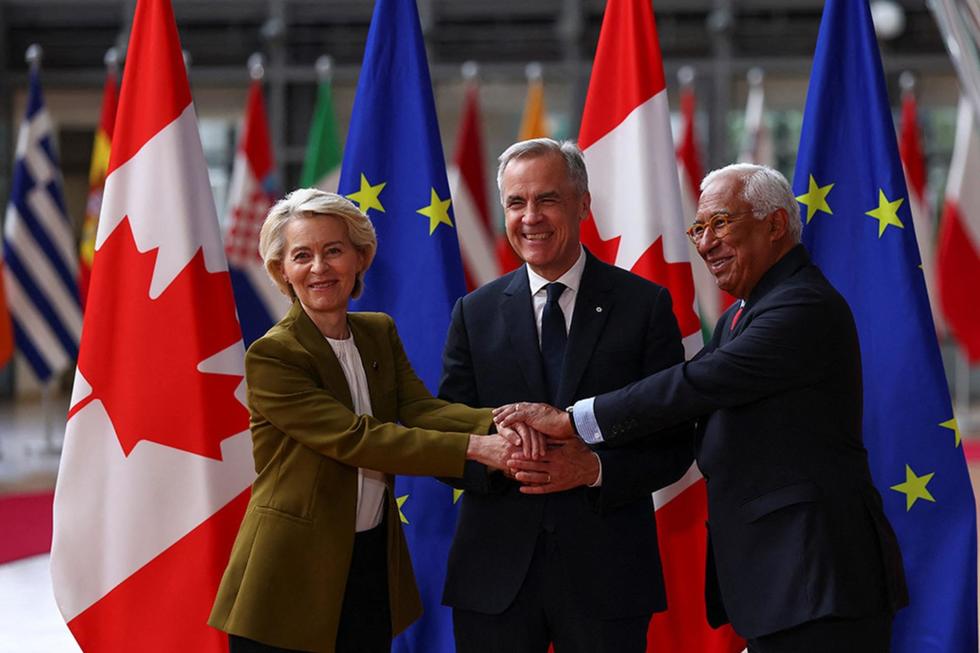
On October 29, 2026, local time, in Montreal, Canada, Canadian Prime Minister Kanie attended the Canada-EU Summit along with European Council President Costa, European Commission Chair Von der Leyen, and others. Discussions took place on topics such as economy, trade, security, and strategic cooperation between the two sides. The European Commission Audio-Visual Services Center was also present at the event.
I believe that improving relations with China is something the Kanney government has done quite actively. The relationship between Canada and China has gone through a difficult period before, but it has improved now, and I think this is a good thing. For example, the Kanney government has made some arrangements with China regarding the import of electric vehicles.
But I believe that Canada should be more proactive in developing relations with China. If the United States continues to exert pressure on us, and Canada relies so heavily on the United States, then this is precisely an opportunity for Canada to reconsider its trading partners and develop more international cooperation.
China is certainly a very important choice, as is other economies within the BRICS group. I hope to see Canada establishing broader trade and cooperation relationships with these countries, but at present, no significant changes in the direction I was hoping for have taken place.
In addition to the relationships between governments, I also place great importance on civil exchanges. Canadians need to learn more about China and establish connections between people. I myself am willing to participate in such exchanges.
Canada will certainly be affected by this competition, and based on past experience, Canada tends to choose to support the United States.
I think the technology sector is a good example of this issue. Canada once tried to impose taxes on some large digital platforms, which caused dissatisfaction among American tech companies. Later, the Kany government withdrew those tax arrangements. This was indeed a controversial issue between Canada and the United States.
In my opinion, if Canada is unwilling to regulate these foreign companies that have a significant influence in its economy, it is essentially helping these companies continue to expand their market power.
This is also why I believe that independence cannot remain limited to diplomatic levels. We must consider whether Canada can independently formulate economic policies, effectively regulate foreign companies, and truly allocate resources according to the needs of its own society. If these issues are not addressed, it will still be very difficult for Canada to achieve strategic autonomy.
: Canadians generally have a strong dislike for Trump.
However, I think there is another very interesting issue here, which is the national identity of Canadians. It has been difficult for us to completely escape the cultural influence of the United States, because we speak the same language, watch the same media programs, and often pay attention to American politics.
Sometimes, Canadians even define themselves by emphasizing that they are not Americans. We say that we are not Americans, that we are different from them. But in fact, in many cultural habits and daily life aspects, we are very similar to Americans.
So, when Trump made those statements about Canada, many Canadians felt extremely angry. They thought that the United States is a country that has a very close relationship with us; how could they treat Canada in such a way?
We indeed see some changes. In the past, many Canadians would drive to the United States for shopping and tourism, but now such activities have decreased. Some stores and communities along the American border also feel the impact of the decline in Canadian tourists.

March 22, 2025, Toronto, Canada. People held a demonstration to protest against U.S. President Trump’s tariff policies and his statement that Canada would become the 51st state of the United States. Demonstrators at the event carried banners reading “Canada is not a commodity to be sold.” Photo from foreign media.
: Yes, that’s exactly what I wanted to say.
Many Canadians believe that the main problem now lies with Trump. They think that as soon as Trump leaves the White House and a new government takes office, Canada and the United States will resume normal relations.
But I don’t think so. Canada’s dependence on the United States didn’t arise after Trump came to power, but has been deepening over decades. Whether it was the Conservative or Liberal governments, they have all, to varying degrees, strengthened economic and political ties with the United States.
The reason we lack sufficient options in the face of American pressure today is precisely the result of these policies over a long period of time. Trump has only made this dependency relationship even more apparent.
I think one of the problems facing Canadian society now is that people are very willing to criticize Trump, but not so willing to criticize Canada’s long-term dependence on the United States. Many still believe that as soon as Trump leaves office, we can return to the previous state.
But if we continue to maintain this structure, Canada will still face the same problems when similar political figures emerge in the United States in the future.
To be honest, when Trump talked about Canada, I didn’t really feel scared. I think many Canadians have similar reactions. We are too accustomed to thinking that there is a special relationship between Canada and the United States, and it’s hard to imagine that the United States would actually take extreme actions against Canada.
But once, I did feel afraid of Trump's statements. That was when he mentioned the possibility of taking extreme military action against Iran.
At that time, I was really worried about whether the United States would use nuclear weapons against Iran. I know this sounds extreme, but it was one of the few times I was genuinely concerned that Trump might actually carry out his threats.
This also makes me think that we cannot simply dismiss all of his statements as political showmanship. Especially when it comes to issues related to war, these statements could have very serious consequences.
I believe that many people feel that life is becoming increasingly difficult.
Canada has a universal healthcare system, but medical services have long faced issues with insufficient funding. As a result, some people are turning to private medical services, and some provincial governments are also expanding the role of private healthcare sectors.
At the same time, housing is becoming increasingly unaffordable, and public services are under pressure as well. People feel that some of the social security benefits they once enjoyed are diminishing, while new development opportunities have not truly emerged.
Of course, people with different political opinions will interpret these issues differently. Many conservatives believe that the problem lies in the government spending too much money, having too high taxes, or in the inefficient nature of the government itself.
I’m not saying that there are no problems with governments. It’s true that governments may invest a large amount of money in large corporations, or make spending decisions that don’t benefit ordinary people.
But I believe that solving these problems should not be simply about continuing to cut public services. We need to discuss where the Canadian government should invest its resources, and how we can truly improve the lives of ordinary people.