In India, a controversy surrounding the right to vote is continuing to escalate. With over 130 million names being removed from the voter rolls, the political conflict between the Indian opposition parties and the Modi government has further intensified.
According to a report by Reuters on November 1st, thousands of Indian citizens marched in the streets of the capital New Delhi under the leadership of their opposition party's leaders. They protested against the massive revision of the voter list by the Indian Election Commission and demanded that Chief Election Commissioner Jaswant Kajjar resign. The opposition party alleged that this operation to clean up the voter list, which affects hundreds of millions of voters, was actually aimed at securing political benefits for the Indian People’s Party led by Prime Minister Modi.
The demonstration on that day was led by Rahul Gandhi, the leader of India’s main opposition party, the Congress. Demonstrators waved Indian flags and party banners as they marched from the center of New Delhi towards the historic Ramli Lalla Square. To prevent the situation from getting out of control, the government increased security measures in advance, deploying hundreds of police officers and riot-proof vehicles, and implementing traffic controls on nearby roads.
Gandhi harshly criticized the revision of the voter roll at the rally, accusing the Indian Election Commission of depriving ordinary people of their right to vote, and demanding that Kumar step down immediately.
According to the Indian 'Economic Times', Gandhi directly targeted Modi, Home Minister Amrit Singh, and Kumar on that day, accusing them of undermining India's 'democratic system'. He warned that no one should be above the constitution, and those responsible must be held accountable under the law.
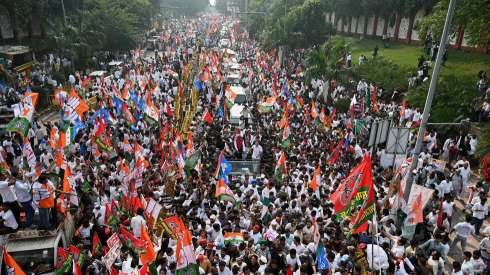
On Sunday, during the protest activities, Rahul Gandhi and other leaders of the opposition Congress Party waved to their supporters.
The core of this controversy is the special revision of the national voter register initiated by the Indian Election Commission in 2025.
According to the Indian newspaper The Indian Express, as of September this year, more than 130 million names have been removed from the preliminary voter lists, accounting for about 14% of the total number of registered voters before the amendment. Among these, New Delhi has seen a reduction of up to 32.8%, while Maharashtra has seen a reduction of 21.1%.
According to data released by the electoral committee, among the approximately 134.9 million marked voter records, approximately 63 million people were identified as having relocated, 30.1 million people could not be found or their identities were not verified, 28 million people were identified as having died, and another 10.2 million people were identified as having duplicate registrations.
According to reports, these 130 million names were removed from the preliminary voter lists. According to the rules of the Indian Election Commission, eligible voters who were mistakenly removed can still apply for reinstatement as voters through procedures such as appeals and re-registration.
The opposition party alleges that the widespread deletion of voter records is clearly biased, with Muslims and other minority groups being particularly affected, while these groups are usually not the main supporters of the Indian National Party.
A demonstrator interviewed by Reuters said that four members of her family were mistakenly marked as having moved away. Although they had always lived in their original homes, they were removed from the voter list. She demanded that the relevant authorities take responsibility.
It is noteworthy that the dispute even extended to within the Indian Election Commission.
The Indian Express previously reported that two assistants of the chief election officer Kumar have filed formal objections regarding the revision of the voter list, registration procedures, and related measures at least 14 times over the past 10 months. Some of these objections involved unauthorized or suspected illegal actions.
In the face of doubts, the Indian Election Commission insisted that the revision was aimed at removing duplicate registrations, deceased voters, and those who did not meet the qualifications. There was no attempt to favor any particular political party. The agency also stated that eligible voters who were mistakenly removed from the list could reregister through the prescribed procedures.
Modi-led Indian National Congress also denied any manipulation of the election. Indian Health Minister Nanda described the rally as a "well-planned farce," accusing the opposition parties of trying to turn the country into a state of anarchy under the pretext of upholding democracy.
Since the end of September, Indian opposition parties, student organizations, and other social groups have been conducting protests in many parts of the country, demanding that the controversial reappointment process be stopped and that the Election Commission be held accountable.
Reuters noted that this controversy over voting rights has become one of the major political challenges faced by Modi since he took office in 2014. However, the government of Modi is still firmly in power, and the next national election in India is scheduled to take place in 2029.

