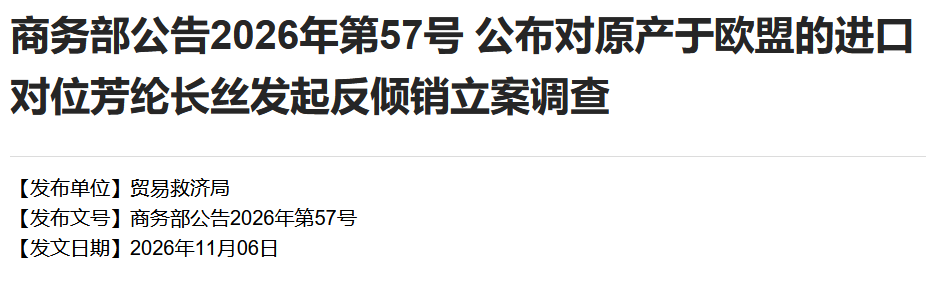
According to the news on the Ministry of Commerce website on November 6th, the Ministry of Commerce announced Announcement No. 57 of 2026, initiating an anti-dumping investigation into imported parehronaline yarn originating from the European Union.
The Ministry of Commerce of the People's Republic of China (hereinafter referred to as the Ministry of Commerce) received an anti-dumping investigation request on October 12, 2026, from Sinochem High-Performance Fiber Materials Co., Ltd. and Toray Carbon Fiber Materials Group Co., Ltd. (hereinafter referred to as the applicants). The applicants requested an anti-dumping investigation to be conducted regarding imports of pitch-resistant aramid fibers originating from the European Union.
The Ministry of Commerce, in accordance with the relevant provisions of the Anti-Dumping Regulations of the People's Republic of China, reviewed the applicant's qualifications, information regarding the products under investigation, information regarding similar products in China, the impact of the products under investigation on the domestic industry, and information regarding the country and region where the investigation is conducted.
Based on the evidence provided by the applicant and the preliminary review by the Ministry of Commerce, the applicant's production of aramid filaments complies with the provisions of Articles 11 and 13 of the Anti-Dumping Regulations of the People’s Republic of China regarding applications for anti-dumping investigations targeting domestic industries. Additionally, the application includes the content and relevant evidence required for initiating an anti-dumping investigation as stipulated in Articles 14 and 15 of the Anti-Dumping Regulations of the People’s Republic of China.
Based on the above review results, and in accordance with Article 16 of the Anti-Dumping Regulations of the People’s Republic of China, the Ministry of Commerce has decided to initiate an anti-dumping investigation into imported aramid filament originating from the European Union starting from November 6, 2026.
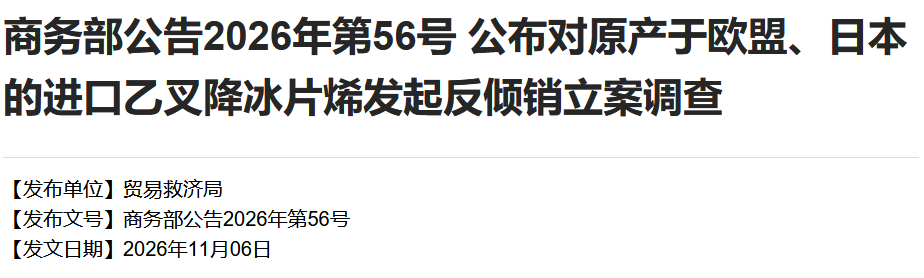
On the same day, the Ministry of Commerce announced No. 56 of 2026, announcing the initiation of an anti-dumping investigation against imports of 1,4-biphenylenecyclohexane in the European Union and Japan.
The Ministry of Commerce received an anti-dumping investigation request on October 9, 2026, from Hemera Materials Technology Co., Ltd. (hereinafter referred to as the applicant), representing the Chinese y-bis(1,4-cyclohexenediene) industry. The applicant requests an anti-dumping investigation to be conducted on imports of y-bis(1,4-cyclohexenediene) originating from the European Union and Japan.
The Ministry of Commerce, in accordance with the relevant provisions of the Anti-Dumping Regulations of the People's Republic of China, reviewed the applicant’s qualifications, the relevant circumstances of the products subject to investigation, the situation of similar products in China, the impact of the products subject to investigation on the domestic industry, and the relevant circumstances of the country or region where the application is made.
According to the evidence provided by the applicant and the preliminary review conducted by the Ministry of Commerce, the production of ethylidene-cyclohexenone by the applicant complies with the provisions of Articles 11 and 13 of the Anti-Dumping Regulations of the People's Republic of China, which require domestic industries to submit anti-dumping investigation applications. Additionally, the application includes all the information required for initiating an anti-dumping investigation as stipulated in Articles 14 and 15 of the Anti-Dumping Regulations of the People's Republic of China, along with relevant evidence.
Based on the above review results, and in accordance with Article 16 of the Anti-Dumping Regulations of the People’s Republic of China, the Ministry of Commerce has decided to initiate an anti-dumping investigation into imports of 1,4-bisdienylcyclohexene originating from the European Union and Japan, effective November 6, 2026.
On November 6, a spokesperson for the Ministry of Commerce answered reporters' questions regarding two anti-dumping investigations involving imported aramid filaments and ethylene-vinylidenephene from the EU.
Reporter asked: We have noticed that the Ministry of Commerce today initiated two anti-dumping investigations against imported aramid filaments and e-behenyl cyclene related to the EU. Could you please provide some information on this?
Answer: All relevant investigations should be initiated by domestic industries. The preliminary evidence provided by the applicant shows that the quantity of aramid fiber products imported from Europe from 2023 to the first half of 2026 was high, with the cumulative price decline exceeding 50%. The quantity of bis(2-fluoroethyloxacyclopentane-1-sulfonate) imported from regions such as the European Union increased by 27.35% from 2023 to 2025, and increased by 56% in the first half of 2026, with prices showing an overall downward trend. The applicant claims that the related dumped imported products have caused damage to the production and operation of domestic industries in China.
According to Chinese laws and WTO rules, the relevant applications meet the conditions for initiating an anti-dumping investigation. The Chinese side will conduct the investigation in accordance with laws and regulations, fully protect the rights of all interested parties, and make an objective and fair decision.
It should be emphasized that since 2026, the EU has initiated 16 trade remedy investigations involving China. The number of such cases has nearly doubled compared to the same period in previous years. Among these cases, 9 involved chemical products, accounting for nearly 60% of the total. Especially since mid-October, the EU has continuously launched anti-dumping investigations against Chinese products such as furfural and polyvinylidene fluoride.
Compared with the number of trade remedy cases filed by the EU against China, China has always been cautious and restrained in the field of trade remedies. China wishes to reiterate that the EU must face up to the economic and trade issues it faces. Protectionism does not enhance competitiveness; addressing mutual concerns through dialogue and negotiation is the right approach.

