Due to its high melting point and high hardness, tungsten is an indispensable rare metal for manufacturing cutting tools, automobiles, and various industrial products such as semiconductor equipment. In recent years, the surge in artificial intelligence has driven a significant increase in demand in the semiconductor industry, resulting in a continuous tightening of the supply-demand balance in the tungsten market.
At the beginning of last year, China imposed export restrictions on various tungsten-related materials, including key metals such as bismuth and molybdenum.
"China's export restrictions are putting pressure on AI supply chains," according to Nikkei Asia, which published an article on November 5th with this title. While microdrills may not seem like major players in the AI chip supply chain, they are essential nonetheless. Microdrills resemble tiny needles and are primarily made of tungsten carbide. They are used to drill small holes in printed circuit boards (PCBs) and chip substrates, allowing for electrical connection between multiple layers of circuitry.
Several sources familiar with the matter revealed that since China imposed export restrictions, the price of drill bits has increased several times over, affecting smelting and processing enterprises in regions such as Japan, the United States, Europe, and Taiwan, China.
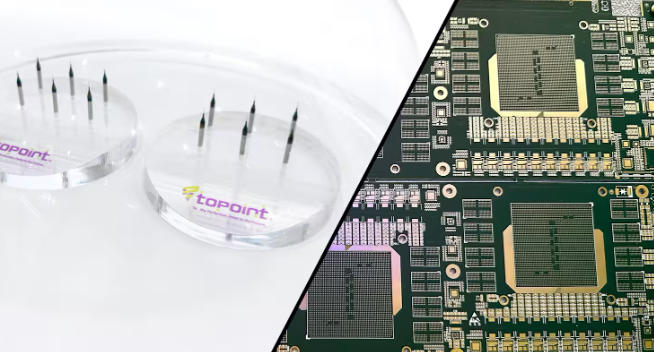
Tungsten carbide drills for punching holes in PCBs and chip substrates
Reports indicate that chip substrates and PCBs are becoming increasingly complex. They have more layers, harder materials, and higher precision requirements. As a result, drilling becomes more difficult, leading to a rising demand for drills. Due to the surge in AI computing power, the supply of PCBs and substrates is in short supply.
“China's side has choked off key suppliers of raw materials for Japan and other countries, leading to a shortage of high-end tungsten carbide materials,” said a PCB industry manager in an interview with the Nikkei Asian Review. “We also see that some PCB manufacturers are running low on their existing supplies from Japan, Europe, and other regions. Prices have risen significantly this year, forcing them to turn to Chinese drill bit factories or tungsten carbide suppliers."
According to reports, the main suppliers of high-end tungsten materials include Sumitomo Electric Industries from Japan, Kyocera and Mitsubishi Materials from Japan, Kerna Metals from the United States, and Sandvik from Sweden. These companies have strong manufacturing capabilities, but they still cannot avoid China's position in the global tungsten supply chain. The production of refined tungsten materials and tungsten powder is also included in their operations.
Several industry executives said that, in comparison, Chinese companies have access to cheaper tungsten resources, which has led to an expansion of their market share.
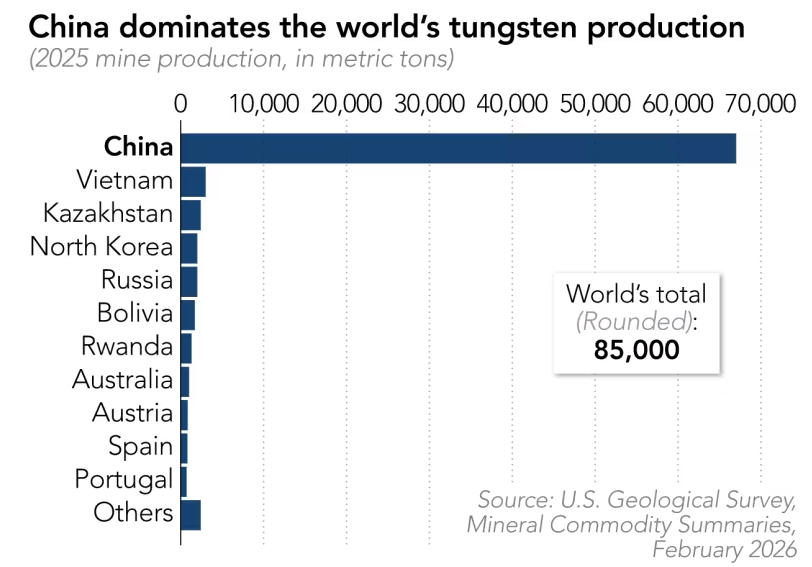
Japanese Media Mapping
According to data from the United States Geological Survey, China ranks first in tungsten resources globally, with an annual production of about 79% of the world’s total. The sizes of other producing regions are much smaller, including Vietnam, Kazakhstan, North Korea, Australia, and Austria.
China imposed export restrictions on various tungsten-related materials at the beginning of last year, including key metals such as bismuth and molybdenum. Data from Shanghai Metals Network shows that ammonium paratungstate (APT) is an intermediate product of tungsten and also serves as a benchmark for tungsten prices. The price of APT has risen from about 213,000 yuan per ton in February 2025 to over 530,000 yuan per ton this week.
Domestic APT every ton roughly 500,000 to 600,000 yuan, overseas can reach triple, 150,000 to 180,000 yuan per ton," a Chinese drill manufacturer senior executive said. This manufacturer supplies the PCB and chip baseboard suppliers for AI chip companies.
Another company manager told Nikkei Asia that their company has to use Chinese materials and rely more on China's supply chain.
“In the short term, until we find cost-competitive alternatives to tungsten and develop more substitutes, we may have to rely more on Chinese tungsten carbide suppliers,” admitted the manager. “China’s export controls actually make the industry more inclined to cooperate with Chinese suppliers, including those who manufacture tungsten carbide materials and micro drills.”