From Spain and Portugal to the Netherlands and Germany, a housing crisis that has persisted for many years is intensifying in Europe. High housing prices and rents, the continuous expansion of short-term rental accommodation, and the reality that young people struggle to own independent homes are all contributing to growing public dissatisfaction.
Nowadays, the housing problem is no longer limited to low-income groups. More and more middle-class individuals with stable jobs and incomes are also finding themselves excluded from the housing market. At the same time, high costs of energy and other living expenses further burden the economic burden on ordinary families. As a result, the housing problem has gradually become an important source of social protests and political dissatisfaction in Europe.
Why, in Europe where economies are relatively developed and social welfare systems are well-established, is it becoming increasingly difficult for ordinary people to obtain a stable place to live? Why does the government continue to emphasize increasing the supply of housing, yet housing prices and rents still rise? How will the housing crisis change the lives of European young people, and what will be the political landscape of Europe in the future?
Manuel B. Aalbers, a professor at the University of Leuven in Belgium, has long focused on issues related to housing financialization, the real estate market, and urban social inequality. In his view, the European housing crisis did not arise suddenly in recent years, but was the result of structural problems that have accumulated over the past decade or more. The deepening involvement of financial capital in the housing market, insufficient social housing construction, and long-term policy choices by governments have all exacerbated the housing difficulties of ordinary people. He believes that if existing policies do not undergo substantial changes, the European housing crisis may worsen, and housing issues could become important topics affecting future elections and democratic politics.

Manuel B. Aalbers, professor at the University of Leuven in Belgium and scholar specializing in the study of housing finance.
Recently, Observer Network had a conversation with Professor Albers, discussing the deep causes of the European housing crisis, the social pressures caused by rising living costs, and possible solutions that governments around the world might implement. This article represents solely the views of the interviewee.
: I think it’s difficult to answer this question from the perspective of the entire Europe, because there are significant differences between countries in Europe.
For example, in France, some of the protests were initially related to changes in the school education system. Students expressed dissatisfaction with educational reforms, and over time, these protests expanded to broader issues such as living costs. Housing is, of course, a very important part of living costs. Even without a so-called housing crisis, housing remains one of the largest expenses for people.
The situation in Spain is different. Recently, there was an old woman named Maricarmen who had lived in her home for several decades and had never missed a rent payment. However, the house she lived in was acquired by an investment fund. The new owners wanted to find tenants who could pay higher rents, so they tried to evict her. Eventually, an agreement was reached between the two parties, allowing her to return to her original home. But she died before she had a chance to move back there. This incident caused a great deal of attention and it shows that the housing problems in Spain have different roots from those in France.
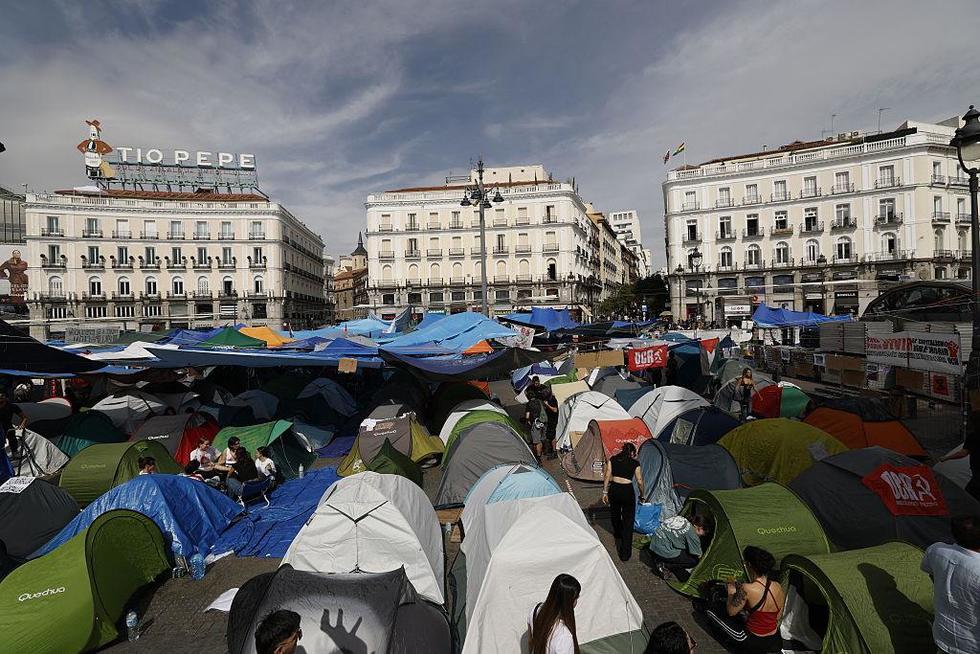
On September 28, 2026, local time, in Madrid, Spain, housing rights protesters set up camp in the Puerta del Sol square. Previously, a 87-year-old woman was forcibly evicted, sparking protests from the public over rising rent prices, housing shortages, and inadequate tenant protections. Reuters
Therefore, there is actually no unified housing system in Europe. The European Union is currently developing the "European Affordable Housing Plan," but legally, housing policy is not a domain directly under the EU's authority. The EU can propose policy measures and provide support to member states, but it cannot force any member state to adopt a specific housing policy, as each European country has its own housing system.
However, we do see that rent and housing prices are rising across Europe. But I believe this is a global phenomenon, not just a problem in Europe. Housing prices have also been rising in China for a long time, as have rents. Many of the phenomena we see in Europe today can be found elsewhere in the world.
An important characteristic of Europe is that the scale of social housing varies greatly from country to country. For example, France, the Netherlands, and Austria all have relatively large social housing sectors. However, in Romania, Bulgaria, and Spain, the amount of social housing is very limited. This means that the ways in which governments from different countries have intervened in the housing market have also varied significantly.
But whether it’s countries with more social housing or those with less social housing, we are seeing an increase in rents and housing prices. I believe this is related to a broader global trend: housing is becoming an increasingly important investment target.
Of course, housing investment isn’t a phenomenon that emerged only today. In the past, rental housing in Europe was often owned by local businesses or private landlords. For example, a person running a store might purchase an apartment for rent, using the rent as a financial security for retirement.
Nowadays, in addition to these traditional landlords, an increasing number of investment funds are raising capital through the global financial markets and then entering the housing market. These funds are not necessarily foreign ones. For example, in Spain, they might be Spanish funds; in France, they could be French funds; in Germany, they might be German domestic funds. The key lies not in where these funds come from, but in their ability to raise capital globally, including a significant amount of capital from European pension funds.
In Germany, millions of residential properties are owned by such investment institutions. In most other European countries, the scale is much smaller. However, even if these institutions occupy only a small portion of the market, they can still have an impact on the housing market. This is because they typically acquire existing residential properties and then increase rent prices.
Other landlords may see that these institutions can charge higher rents. They might think, since they can do so, why can’t we also increase our rents? As a result, the rent levels in the entire market could be affected.
I believe Belgium is not actually one of the countries with the most serious housing problems in Europe. Rent prices have indeed increased, with the rise being slightly higher than inflation, but it’s far less severe than in other places. The same is true for housing prices; they have increased, but not to the extreme levels seen in some countries. However, this doesn’t mean there isn’t a problem. In Brussels, there are many low-income residents, many of whom are immigrants from relatively poor countries. They have limited income and find it difficult to find affordable housing. Nowadays, this problem is also affecting more and more middle-class people.
This is also a situation we see in other parts of the world. Belgium also has these problems, but to a relatively lesser extent.
I just returned from Lisbon, Portugal. Over the past decade, housing prices in Lisbon have increased significantly, as has rent prices. However, by European standards, Portugal is still a country with relatively low income levels for its residents. Therefore, when comparing the situations of the two countries, the housing problem in Belgium is indeed not as serious as that in Portugal.

In Lisbon, Portugal, a sign reading “AL” (Alojamento Local, Local Accommodation) hangs on the exterior wall of a building. This is the registration sign used by local accommodation providers in Portugal for short-term tourist accommodations. The expansion of short-term rental services has been a topic of ongoing debate regarding the impact on the local long-term rental market. Portuguese weekly newspaper Expresso.
However, there have been some noteworthy changes in Belgium. For example, the proportion of households with their own homes has stabilized, while among low-income groups, this proportion is actually declining.
We can see similar situations in many European countries. The percentage of households with their own homes either remains stable or decreases slightly. At the same time, more and more people have difficulty obtaining housing. Young people may have to live with their parents for a longer period of time before they become able to move out and rent or eventually purchase their own homes.
I believe that due to the significant differences in housing systems among European countries, it is difficult to identify a common reason that applies across all of Europe.
Of course, there are some common phenomena in European countries, but these same phenomena also exist in many countries outside Europe, namely rising rents and housing prices.
In some places, there is indeed a lack of sufficient housing construction. There is a serious shortage of housing in some cities. However, we have also found that even in areas where housing is not scarce, housing prices and rents can still rise.
According to traditional mainstream economic views, if you build more housing, housing prices should decline, as market supply increases. However, the situation we see today does not necessarily fit this simple explanation.
Even in areas where housing supply is already relatively sufficient, prices may continue to rise. This is because the demand for housing comes not only from local residents who need to live there, but also from a large amount of capital that has entered the housing market.
Housing has become an investment asset that is traded on the international market. Funds from all over the world can flow into the real estate market. Therefore, we cannot explain changes in housing prices solely based on the housing needs of local residents in a particular city and the local supply of housing.
Moreover, this phenomenon exists not only in the rental housing market but also in the own-home market.
For example, people often say that I need to apply for a larger mortgage loan, otherwise I won’t be able to afford a house. But we can also ask why housing prices have risen so high. One reason is precisely because people can get access to larger amounts of housing loans.
It should be noted that the vast majority of housing in the market are existing properties, not newly built homes. If only you have access to a larger loan amount, it might be possible for you to buy a larger house. However, in a city with over one million people, if everyone can obtain larger loan amounts, then people will use these loans to bid for housing. The result might not be that everyone moves into larger houses, but rather that housing prices are collectively pushed up.
This phenomenon of driving up housing prices by expanding mortgage loans occurs not only in Europe, but also in many countries outside of Europe.
I believe one reason is that these countries are relatively wealthy. People have more money, and thus can invest more money in the housing market. But if everyone does this, it will lead to further increases in housing prices.
Meanwhile, if the government does not increase investment in affordable housing accordingly, low-income groups and the younger generation will find it increasingly difficult to obtain housing.
If we look back at some welfare states in Europe around 50 years ago, we will find that governments invested substantial amounts of money in affordable housing. For example, in Nordic countries, the UK, and the Netherlands, more than half of new housing constructions were social housing during certain periods. At that time, governments played a crucial role in providing housing security.
But we are already far removed from that era today. In the UK, a significant portion of social housing has been privatized. The situation in the Netherlands is different; they still maintain a substantial social housing sector and continue to build social housing, but the pace of construction can no longer meet the growing demand.
I believe that there used to be a rather naive notion in the past, where governments thought that as more people owned their own homes, society no longer needed so much affordable social housing. The government only needed to reserve a small amount of social housing for those with the lowest incomes, while allowing most people to solve their housing problems by purchasing their own homes.
This model did work for a certain generation. They got the opportunity to buy homes and become homeowners, which is of course a good thing.
But for the generations that followed, the situation was completely different. Housing prices rose to a level that became increasingly unaffordable for them. As a result, not everyone became homeowners, but rather more and more people were excluded from the market of own homes. They had to look for social housing again. However, at this point, the stock of social housing in many countries had already been reduced, or there was no significant increase over time, which simply couldn’t meet the growing demand.
Therefore, I believe that the housing problems faced by some wealthy countries in Europe today are closely related to the government's judgments and choices regarding housing policies over the past few decades.
: I believe that there is an important generational difference here.
In many European countries, the older generation of middle-class families purchased homes decades ago, and their living conditions are relatively stable today. There are also some elderly people who still live in rental housing, but they have been living there for a long time. In comparison, it has always been difficult for low-income groups to obtain decent and affordable housing. In this sense, the housing crisis has existed for a long time for them.
What truly changed was that an increasing number of young middle-class individuals began facing similar problems.
It is very difficult for them to obtain sufficient mortgage loans to buy housing that meets their needs, and it is also difficult to find rental properties with reasonable rents and good living conditions.
In the past, many young people would rent houses for a few years. At that time, rent wasn’t very high, so during the rental period, they could still save some money in order to prepare for buying a house in the future. Once they had some savings, they could apply for a mortgage and then buy a house that would roughly meet their expectations.
But now, on the one hand, housing prices have become extremely high, and on the other hand, rent costs are also very high. Many young people, after paying their monthly rent, simply do not have enough money saved, making it increasingly difficult to achieve their goal of buying a house in the future.
This makes them very frustrated. The problem is not just that they are forced to rent houses for a long time, but also that even when they have rented houses, the annual increase in rent may exceed their income growth.
Meanwhile, the sense of security in renting homes in some countries is also declining.
For example, I just visited Portugal. They are discussing some reforms that could make it easier for landlords to evict tenants. Prior to this, rents in Portugal have been rising significantly over a period of time.
Of course, the situation varies from country to country. In Nordic countries, Germany, and the Netherlands, it is usually relatively difficult for landlords to evict tenants. However, in some Southern European countries, it is easier for landlords to do so.
This means that renters’ sense of security will be greatly affected. You simply cannot be certain whether you can live in the same place for a long time.
Just like that Spanish woman mentioned earlier. She has lived in the same house for decades, but one day, when the property was transferred to a new owner who wanted to charge a higher rent, she could face being evicted.
So, the housing crisis means not only that people cannot afford to rent a house, but also that they may lose a very basic sense of security in life. You may have lived in a certain place all along, but suddenly you are forced to leave your home.