From the ongoing conflict between Russia and Ukraine to the Middle Eastern wars that erupted at the beginning of this year, these brutal conflicts have made people increasingly realize that energy is of paramount importance.
According to a report by the Hong Kong-based South China Morning Post on June 21, the ongoing energy crisis is driving an increase in overseas orders for energy storage products from Chinese companies. These orders involve the construction of energy storage capacities of over 25 GWh in the United States and European countries.
In just the first two weeks of June, CATL secured orders for a total of 5.4 GWh of energy storage products. Another leading company in China's battery industry, CALB Group, announced its entry into the Japanese market. System integrators HyperStrong and Envision AESC, part of Chinese wind power giant Envision Technology Group, have begun to make a significant impact in the US market.
Matty Zhao, co-head of China stock strategies at the global research department of a U.S. bank, stated that the global demand for energy storage facilities is driven by multiple factors: on one hand, the Middle Eastern conflict has caused disruptions in the oil and gas supply chain; on the other hand, developed markets are urgently in need of upgrading their aging power grids.
She pointed out that, regardless of whether a agreement to end the conflict has been reached between the United States and Iran in the near future, “government officials around the world realize the need to establish a structured energy security system.” This will encourage governments in the United States and Europe to invest more funds in the field of energy storage over the next few years.

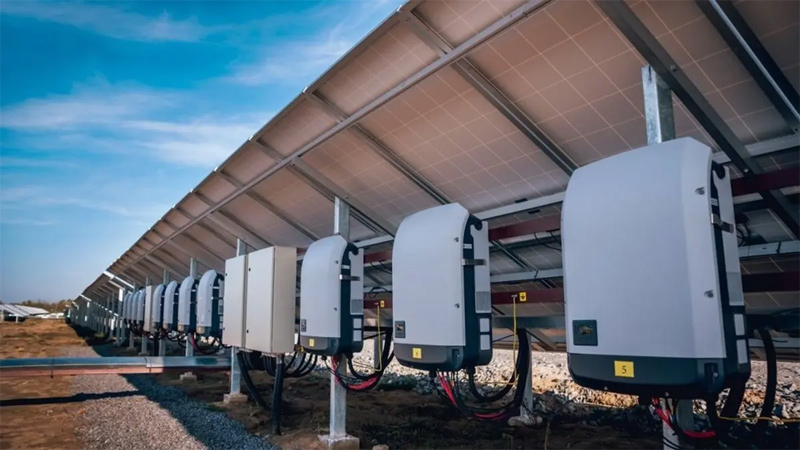
May 28, 2026, aerial view of the 50 megawatt solar-thermal power plant in Delingha, Qinghai. IC Photo
In the process of transitioning to renewable energy sources such as solar and wind power, energy storage systems act like "giant power banks" for the electrical grid, providing stability to the grid and preventing widespread power outages. An energy storage capacity of 1 gigawatt-hours is sufficient to meet the annual electricity needs of approximately 100 ordinary American households.
As the world's largest manufacturer of energy storage batteries, CATL will collaborate with Finnish company Merus Power to deploy 3 gigawatt-hours of energy storage systems in Northern Europe. Additionally, CATL has reached an agreement with Edify Energy to supply 2.4 gigawatt-hours of energy storage systems for projects in Smoky Creek and Guthrie’s Gap in Australia.
On June 10th, Zhejiang Haina announced that it had signed a system procurement agreement of 220 megawatt-hours with Japan's Kitahama GRF, focusing on the development of energy storage solutions for the power grid and backup power supplies for data centers.
In the US market, HyperBlock has signed a contract worth 2 GWh with a developer based in New York. The contract provides them with the flagship product, the HyperBlock III 5 MWh liquid-cooled energy storage system, which will be used for power arbitrage and grid support services in Texas.
Meanwhile, China-based battery and energy storage system integrator Envision Power announced in mid-June that it has reached a three-year strategic agreement with system integrator Prevalon Energy. Prevalon Energy is a joint venture of Mitsubishi Power Americas.
Wanshan Power is expected to supply over 10 gigawatts-hours of advanced energy storage components and modules, to support utility projects, with a focus on connecting renewable energy sources and AI data centers (AIDCs) into the power infrastructure network.
Meanwhile, Chinese manufacturers are also continuously expanding their presence in the Middle Eastern market.
In mid-May, Shenzhen-based energy giant Sungrow Power Supply announced that it has received an order for 7.5 GWh of energy storage in the UAE. Previously, the company finalized a project in Saudi Arabia with a capacity of 7.8 GWh last December, which is considered the largest energy storage project in the world.
According to data from consulting firm InfoLink, in the shipments ranking of the first quarter of this year, Chinese energy storage system manufacturers occupied seven of the top ten positions.
Despite the changes in the policy environment, analyst Marty Zhao from a U.S. bank expects that, thanks to strong overseas demand, cost advantages, and efficient supply chains, the export of Chinese battery energy storage systems will remain resilient. Chinese suppliers are expected to maintain their competitive edge in the medium to short term.
American banks predict that the global installation of battery energy storage systems will reach 425 GWh in 2026, and 533 GWh in 2027, with year-on-year increases of 39% and 25%, respectively.
A report released by HSBC Global Investment Research in June indicated that the rapid growth in demand for artificial intelligence-related energy is reshaping the prospects of energy storage systems. As a result, artificial intelligence data centers are gradually becoming a key growth area for demand in the medium term.