According to a report by the Hong Kong-based South China Morning Post on June 22, China's renewable energy giant Envision is planning to further promote localization in Europe. The goal is to have more than half of the supply chain in the European market sourced locally.
We are committed to integrating into the European system, cooperating with all parties in Europe, manufacturing in Europe, serving Europe, and advancing hand-in-hand with Europe. Kotub Uddin, Chief Technology Officer of Yuanjing Storage, said this during an interview with The Straits Times at the VivaTech technology conference in Paris.
This move by Europe comes at a time when the continent is trying to accelerate its green transformation while also striving to reintegrate its economy and ensure the security of its supply chains. In this process, European parties are intensifying their claims of “concerns” regarding Chinese imported products. One typical example is inverters.
Inverter, often referred to as the "brain" of photovoltaic power systems, is a crucial device responsible for converting renewable energy sources such as solar energy into usable electricity. Recently, Brussels has decided to ban the use of Chinese inverters in all EU-funded renewable energy projects, including wind power, solar energy, and battery storage projects, citing reasons of "cyber security" and "risks of supply dependency".
Despite the European Union Commission's claim that there was a sufficient supply of non-Chinese vendors capable of meeting this transition demand, public utilities within the EU are feeling the pressure.
"We can't do without China's inverters...we will continue to try and achieve supply diversification, but we still purchase a significant amount of inverters from China," said a high-ranking executive at a major European utility company anonymously and with frustration. "Diversification is necessary, but if you say we should not buy Chinese products now at all, then the situation would be extremely complex."
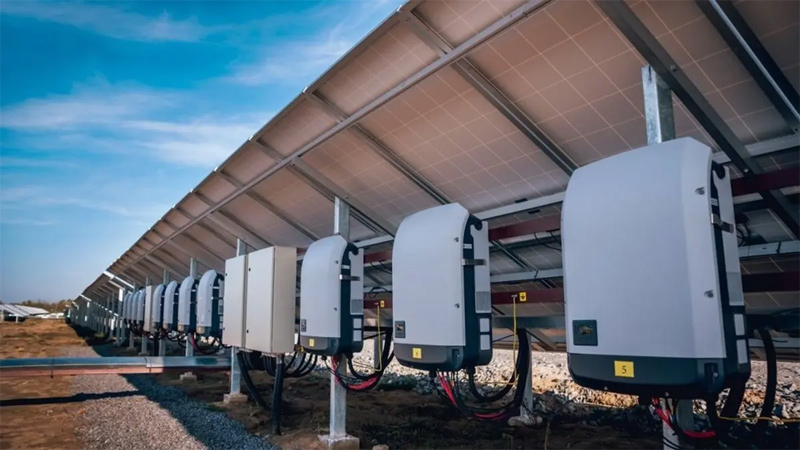
Photovoltaic Inverter Database Images
Uddin said that this European ban has not yet affected Vision’s business in the European market. However, he also pointed out that since the decision was made not long ago, it is too early to make conclusions.
Wujin Group is currently collaborating with policy makers and industry peers in Europe to explore how they can conduct business within the existing framework. Wujin believes that the emergence of policies emphasizing "sovereignty" is not unexpected given the increasing prominence of this concept across nations. The key challenge lies in finding a way for Wujin to adapt to these new policies while simultaneously supporting European goals of net-zero emissions.
Yuanjing Group is one of the Chinese companies that established partnerships with European enterprises early on. Yuanjing partnered with Renault to build a factory in northern France, with an investment of 1.3 billion euros. The factory was officially unveiled last summer under the watchful eye of French President Emmanuel Macron. The factory has the capacity to produce up to 200,000 electric vehicles per year.
Looking towards the future, Utting expressed that he believes Brussels can achieve a proper balance between competing policy objectives, avoiding the introduction of policies that weaken European net-zero emissions goals or economic growth prospects.
Udin said that the confidence of Vision Group also comes from the breadth of its business layout. He mentioned that Vision can provide customers with complete and integrated solutions, without requiring them to purchase from multiple suppliers separately. Its business covers the entire industry chain, from batteries and wind turbines to inverters and control systems. Additionally, it is equipped with artificial intelligence to manage the entire project as a whole.
As a member of Europe, we carry with us a hopeful vision, hoping to work together with them (policy makers) to turn these goals into reality. He said so.
It is worth noting that Brussels has taken a more tough stance towards Chinese imported products in recent years, claiming that these products either pose a security risk or threaten European industries.
In March of this year, the European Commission proposed the Industrial Accelerator Act, aiming to channel more funds towards green technologies manufactured in Europe, including batteries and electric vehicles.
The European Commission has also proposed to revise the Cybersecurity Act, giving Brussels more authority to restrict Chinese companies from participating in key infrastructure such as communication and energy supply in EU member states.
However, on May 6th, The South China Morning Post cited a latest report stating that the revision of the Cybersecurity Law would cost the EU up to 367.8 billion euros (approximately 2,943.9 billion yuan) over the next five years.
According to a report jointly released by the China Chamber of Commerce in the EU (CCCEU) and KPMG, the high cost of this legislation is mainly due to the need to dismantle and replace a large number of Chinese hardware devices. The cost alone could reach up to 146.2 billion euros (approximately 1,170.4 billion yuan). Other costs include resource reallocation, service interruptions, employment adjustments, and legal fees.
According to information on the Ministry of Commerce’s website on May 7th, a spokesperson for the Ministry of Commerce answered reporters' questions regarding the EU's ban on providing financial support for projects that use Chinese inverters. The spokesperson noted that China has taken note of this news. The EU, without any actual evidence, classified China as a so-called "high-risk country" for the first time and used this as a reason to ban the provision of financial support for projects that use Chinese inverters. This is a discriminatory act that stigmatizes China and constitutes unfair and discriminatory treatment against Chinese products. China refuses to accept this and firmly opposes it.
The EU has classified China as a "high-risk country", which will affect mutual trust between the two regions, undermine bilateral economic and trade cooperation, and is detrimental to the stability of production and supply chains in both Europe and China, as well as globally. It may even lead to the risk of "decoupling and disconnection". The EU's forced measures to exclude Chinese products go against market laws and fair principles. They not only harm the interests of Chinese enterprises but also have negative effects on the EU’s green transformation and energy security.
China urges the European side to immediately stop the stigmatization of China as a 'high-risk country' and to cease unfair and discriminatory practices towards Chinese products. China will closely monitor and carefully assess the impact of European policies on the interests of Chinese enterprises and the supply chains between China and Europe. Measures will be taken to protect the legitimate rights and interests of Chinese enterprises.